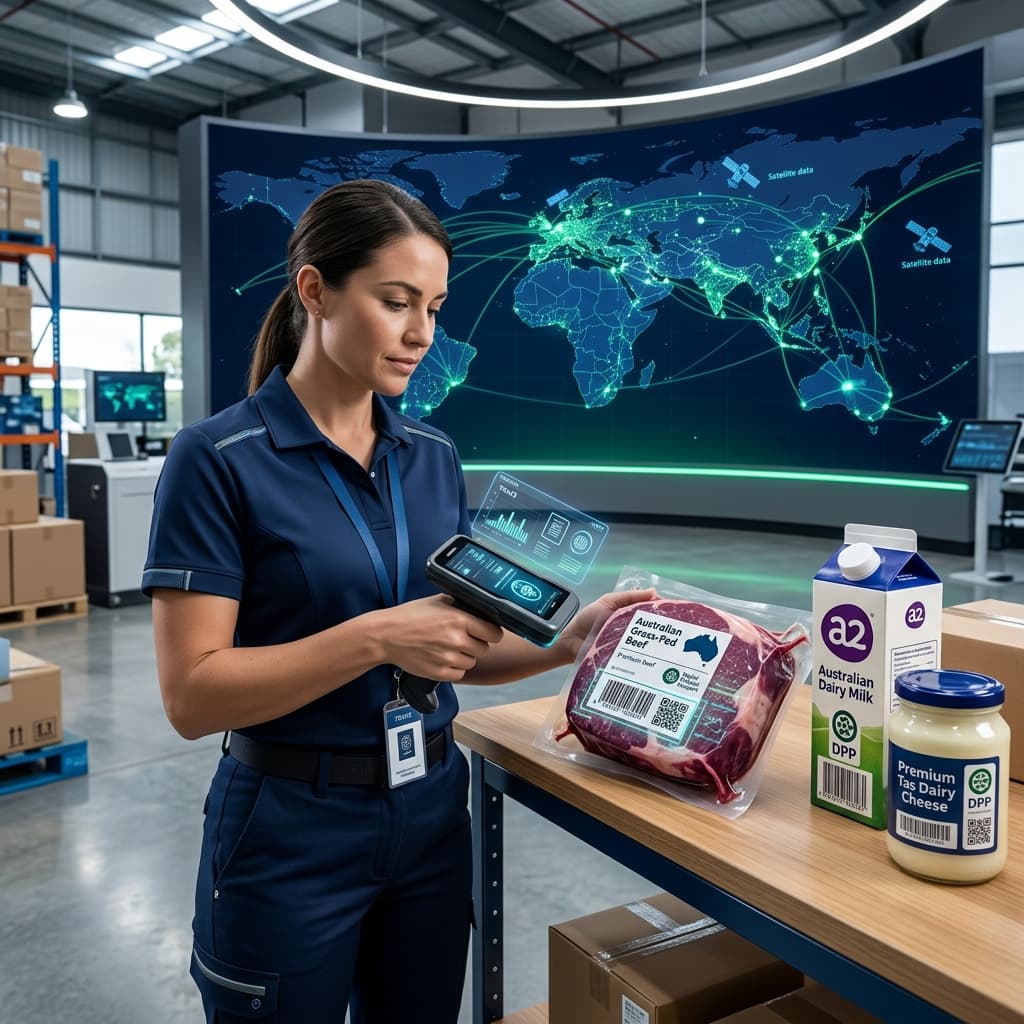
Australia's food and agricultural exports are a multi-billion dollar powerhouse. The foundation of this success isn't just the quality of the produce; it is the global perception of "Brand Australia." Our international buyers, particularly in premium Asian markets, pay top dollar because they trust that Australian food is clean, green, and ruthlessly safe.
However, that reputation is under constant threat from food fraud, counterfeiting, and supply chain opacity. To defend their margins and their markets, Australian food manufacturers are turning to advanced digital traceability.
The Threat of Food Fraud
Food fraud—the deliberate substitution, adulteration, or misrepresentation of food—costs the global industry billions annually. For Australian producers of premium goods (like Manuka honey, wagyu beef, premium dairy, and organic snacks), the threat is acute.
Counterfeiters in international markets frequently copy Australian packaging, filling it with inferior or unsafe products. When consumers have a bad experience with a counterfeit, the reputational damage flows directly back to the legitimate Australian brand.
Statistic: PricewaterhouseCoopers estimates that food fraud costs the global food industry between $30 billion and $40 billion every year.
Beyond "One Step Forward, One Step Back"
Historically, regulatory compliance only required a "one step forward, one step back" approach to traceability. You needed to know exactly who supplied you with an ingredient, and exactly who you sold the finished batch to.
Today, that is no longer enough for premium export markets. Consumers and regulators are demanding farm-to-fork visibility. They want to scan a QR code on a packet of infant formula in Shanghai and see the exact dairy farm in Victoria where the milk was sourced, the date it was processed, and the safety certifications of the facility.
The Elements of Advanced Traceability
Achieving this level of transparency requires shifting away from paper-based logs and disjointed spreadsheets. Advanced traceability relies on three pillars:
1. Granular Batch and Lot Tracking
Every ingredient that enters the facility must be digitally logged with its lot number, origin data, and certificate of analysis (CoA). As these ingredients are combined into WIP (Work in Progress) batches and finally into finished goods, the software must automatically link the parent and child lots.
2. Real-Time Data Capture
Traceability data cannot be entered at the end of the shift. It must be captured in real-time on the factory floor using barcode scanners, tablets, and integrated scales. This prevents human error and ensures that if a recall is required, the data is instantly accessible.
3. Supply Chain Interoperability (The Future)
The ultimate goal is for systems to talk to each other. The data from the farmer's management system feeds into the manufacturer's system, which then feeds into the logistics provider's system, culminating in a verifiable digital passport for the product. Technologies like blockchain are increasingly being explored to make these records immutable.
The Business Case for Digital Traceability
While the primary driver is often risk mitigation and recall readiness, advanced traceability offers massive commercial upside:
- Securing Premium Pricing: Export buyers require proof of provenance to justify premium pricing. Digital traceability provides unarguable proof.
- Market Access: Many international markets (such as the US under FSMA Rule 204) are tightening their traceability requirements. If you can't provide digital tracking, you simply can't export there.
- Internal Efficiency: The same data used for traceability is used for yield analysis and inventory control. A digitized floor reduces waste, prevents stockouts, and optimizes purchasing.
The Foundation is Digital
You cannot build a farm-to-fork traceability narrative on a foundation of clipboards and Excel files.
When an auditor walks in, or an international buyer demands proof of provenance, spending three days digging through filing cabinets is unacceptable. You need to be able to execute a mock recall and trace an ingredient across your entire supply chain in minutes.
This is the power of a unified system. By centralizing your recipe management, batch tracking, and compliance data, you protect your consumers, your brand, and your access to the world's most lucrative markets.
Ready to secure your export future? See how Batchbase provides the digital traceability infrastructure required for modern food manufacturing.