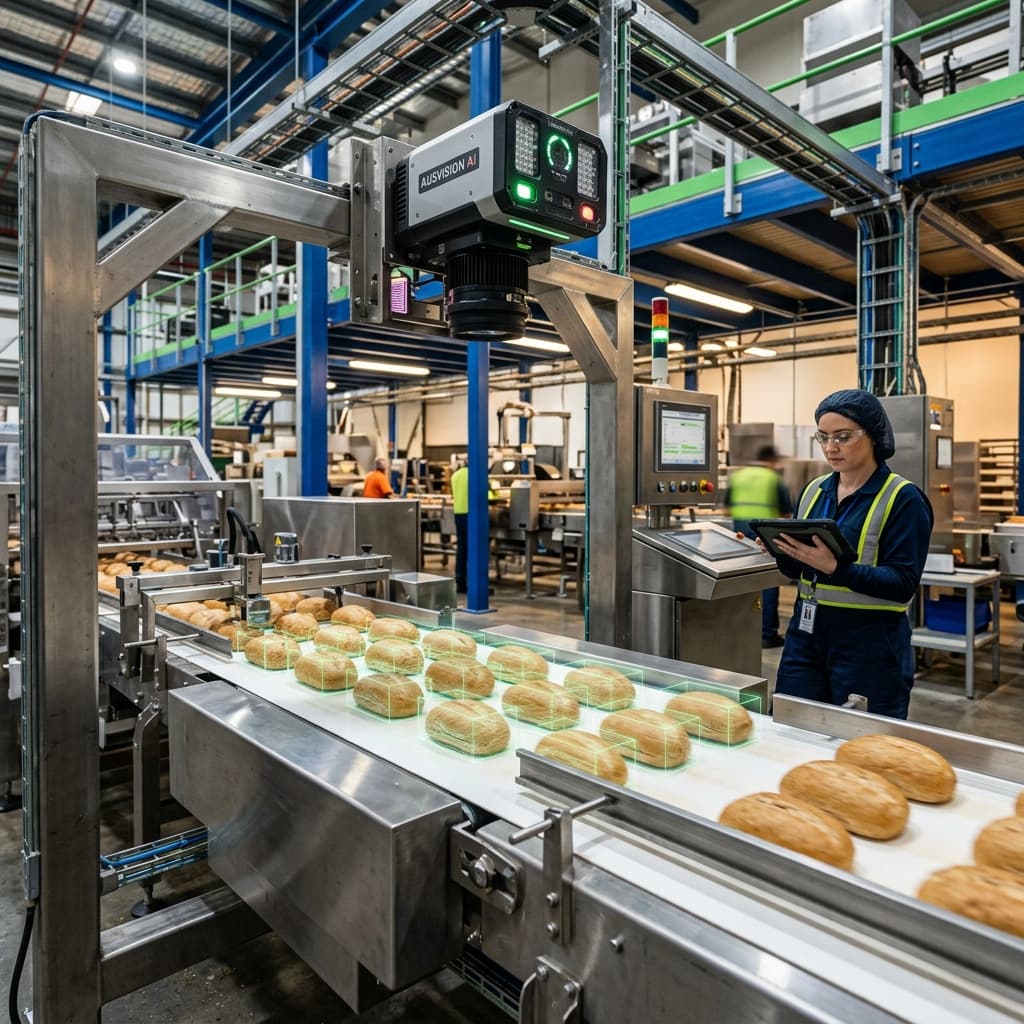
Artificial intelligence has moved from conference keynote to factory floor. Across Australian food and beverage manufacturing, machine vision cameras are grading products at line speed, sensors are predicting compressor failures before they happen, and generative AI tools are drafting SOPs and spec sheets in seconds.
Yet a striking 2026 survey of 500 sector workers by consultancy Argon & Co found that 58.4% of Australian food and beverage workers feel their organisation is becoming less productive, and 95.8% report work being duplicated across systems, teams or processes. Billions are being spent on "smart" technology while teams still re-key the same recipe into four different files.
This is the AI productivity paradox – and solving it has less to do with algorithms than with data foundations. This article looks at where AI is genuinely delivering value in Australian food plants, why so many projects stall, and how mid-tier manufacturers can get ready.
Where Australian Food Manufacturing Stands on AI
AI adoption figures vary widely depending on how the question is asked:
| Measure | Figure | Source |
|---|---|---|
| Australian businesses using AI (broad, all sectors) | ~12% | ABS Business Characteristics Survey |
| SMEs adopting AI in some form | ~40–44% | National AI Centre SME tracking |
| Manufacturing leaders planning increased AI investment | ~72% | Industry surveys |
| Advanced manufacturers using AI for quality/inspection | ~47–50% | Global manufacturing benchmarks |
| F&B workers who feel productivity is declining | 58.4% | Argon & Co, 2026 |
| F&B workers reporting duplicated work across systems | 95.8% | Argon & Co, 2026 |
The message is clear: intent is high, but execution is patchy. Food manufacturers are buying AI, but many lack the clean, connected data it needs to work.
The Use Cases Actually Delivering Value
1. Machine vision for quality control
Quality inspection is the most mature AI use case in food manufacturing. High-resolution cameras paired with trained models can inspect thousands of units per minute for:
- Seal integrity and pack defects
- Colour and bake consistency
- Foreign matter and contamination
- Size, shape and portion accuracy
- Label presence and correct date coding
Unlike a human inspector at the end of a long shift, the system doesn't tire – and it creates a timestamped audit trail by line, shift and batch.
2. Predictive maintenance
Unplanned downtime in a food plant is doubly expensive: you lose output and risk spoiling product mid-process. Vibration, temperature and current sensors on motors, compressors, ovens and fillers feed models that flag anomalies days or weeks before failure. Early adopters report reductions in unplanned downtime of up to 50% in some applications.
3. Demand forecasting and production planning
Machine learning models that combine historical sales, promotions, weather and seasonality can sharpen forecasts – reducing both waste from over-production and penalties from short-shipping.
4. Generative AI for documentation
Large language models are being used to draft SOPs, HACCP documentation, product descriptions and supplier correspondence. Used carefully, they save hours; used carelessly, they hallucinate allergen statements.
| Use case | Typical payback | Data required | Readiness for mid-tier plants |
|---|---|---|---|
| Machine vision QC | 12–24 months | Labelled images of good/bad product | High – self-contained |
| Predictive maintenance | 12–36 months | Sensor data + maintenance history | Medium – needs connected assets |
| Demand forecasting | 6–18 months | Clean sales, promo and production data | Medium – depends on data quality |
| GenAI documentation | Immediate | Accurate, structured source data | High – but requires governance |
| AI-assisted formulation | 12–24 months | Structured recipes, specs, nutrition & cost data | Low – most recipes still in spreadsheets |
Why AI Projects Stall in Food Plants
Industry research consistently points to the same barriers:
- Legacy equipment. Around 70% of manufacturers run a mix of modern and legacy machinery, making data capture difficult.
- Fragmented data. Close to 40% of F&B operations teams cite siloed SCADA, PLC, ERP and spreadsheet data as their primary barrier to scaling AI.
- Governance gaps. The National AI Centre has found that while many businesses believe they use AI responsibly, far fewer have formal frameworks covering data privacy, IP and – critically for food – safety and compliance.
- Skills shortages. Few mid-tier manufacturers employ data engineers, and the labour market for them is fiercely competitive.
The underlying issue is that AI amplifies whatever data you feed it. A forecasting model trained on inconsistent product codes, or a generative tool drafting spec sheets from an out-of-date recipe file, will produce confident, wrong answers – at scale.
The Data Foundation Checklist
Before investing in AI, food manufacturers should be able to tick off the basics:
| Foundation | Questions to ask | Why AI needs it |
|---|---|---|
| Single source of truth for recipes | Is there one master version of each recipe, with version history? | Formulation, costing and labelling AI all depend on it. |
| Structured ingredient & supplier data | Are specs, allergens, nutrition and certificates stored as data, not PDFs in inboxes? | Machines can't reason over scattered attachments. |
| Consistent product master data | Do SKUs, GTINs and product names match across ERP, QA and sales systems? | Forecasting and traceability break on mismatches. |
| Digital batch records | Are production and QA records captured digitally at the line? | Links quality outcomes to inputs and conditions. |
| Access control & audit trails | Who can change a recipe, and is every change logged? | Essential for AI governance and food safety. |
| Integration capability | Can systems exchange data via APIs rather than manual exports? | Enables automation without re-keying. |
A Practical AI Roadmap for Mid-Tier Manufacturers
Phase 1 – Fix the foundations (0–6 months). Consolidate recipes, specifications, allergen and nutrition data into a structured, cloud-based system. Eliminate duplicate spreadsheets. Standardise product master data.
Phase 2 – Quick wins (3–12 months). Deploy a self-contained use case with a clear ROI, such as machine vision on your highest-volume line, or generative AI for drafting documentation from verified source data.
Phase 3 – Connect and predict (6–24 months). Add sensors to critical assets for predictive maintenance; integrate production, QA and sales data for forecasting.
Phase 4 – Optimise (18 months+). Explore AI-assisted formulation and cost optimisation – testing ingredient substitutions against nutrition, allergen, HSR and cost constraints simultaneously.
Governance: Keeping AI Food-Safe
The National AI Centre's Guidance for AI Adoption (the six essential practices that replaced the 2024 Voluntary AI Safety Standard in October 2025) provides a useful framework. For food manufacturers, key principles include:
- Human sign-off on anything safety-critical. AI can draft an allergen statement; a qualified person must approve it.
- Traceable inputs. Know exactly which data version any AI output was based on.
- Supplier IP protection. Don't paste confidential supplier specs into public AI tools.
- Validation. Machine vision models must be validated like any other critical control.
Calculating the Cost of Duplicated Data
The Argon & Co finding that almost every food and beverage worker re-enters the same information in multiple places is not just an irritation – it's a measurable cost. Consider a mid-tier manufacturer with 150 active SKUs and a small technical team:
| Activity | Typical manual approach | Hours per year (est.) |
|---|---|---|
| Updating a recipe across costing, NIP and spec files | 3–4 separate spreadsheets per change | 200+ |
| Responding to retailer spec and allergen questionnaires | Copy-paste from multiple documents | 150+ |
| Recalculating costs after supplier price changes | Manual lookup and re-entry | 120+ |
| Reconciling product data between ERP and QA records | Exports and manual cross-checks | 100+ |
Illustrative estimates for a mid-tier manufacturer.
That's well over 500 hours a year – roughly a third of a full-time technical role – spent moving data rather than improving products. Worse, every manual re-entry is an opportunity for error, and errors in allergen or nutrition data can trigger recalls. Eliminating that duplication delivers an immediate productivity gain and creates the clean data that AI tools require.
Questions to Ask Any AI Vendor
Before signing up for an AI solution, food manufacturers should ask:
- What data does the system need, in what format, and who prepares it?
- How is the model validated, and how often is it retrained?
- Where is our data stored, and is it used to train models for other customers?
- Can outputs be traced back to the specific data version they were based on?
- How does the tool integrate with our existing ERP, QA and recipe systems?
- What happens to our data if we stop using the service?
Clear answers to these questions separate genuine operational tools from expensive pilots that never scale.
Frequently Asked Questions
Is AI only for large manufacturers? No. Cloud-based tools and off-the-shelf vision systems have brought costs within reach of mid-tier plants – but only if their data is organised.
What's the best first AI project? Usually one that is self-contained with measurable ROI, such as machine vision on a high-volume line. But the best first investment is often consolidating your product data.
Can generative AI write my labels? It can help draft them, but regulatory content such as NIPs, PEAL statements and claims must be calculated from verified data and reviewed by a qualified person.
The Bottom Line
AI will reshape Australian food manufacturing – but the winners won't be those who buy the most algorithms. They'll be the manufacturers who first build a clean, connected foundation of recipe, specification and production data.
Batchbase gives food manufacturers that foundation: a single, structured source of truth for recipes, ingredients, allergens, nutrition, costings and specifications, with full version history and audit trails. It's the AI-ready data layer that ends spreadsheet duplication today and powers smarter decisions tomorrow. Book a demo to get started.
References
- Australian Bureau of Statistics – Characteristics of Australian Business
- National AI Centre – Guidance for AI Adoption
- Argon & Co via PR Newswire – Australian F&B productivity survey (500 workers)