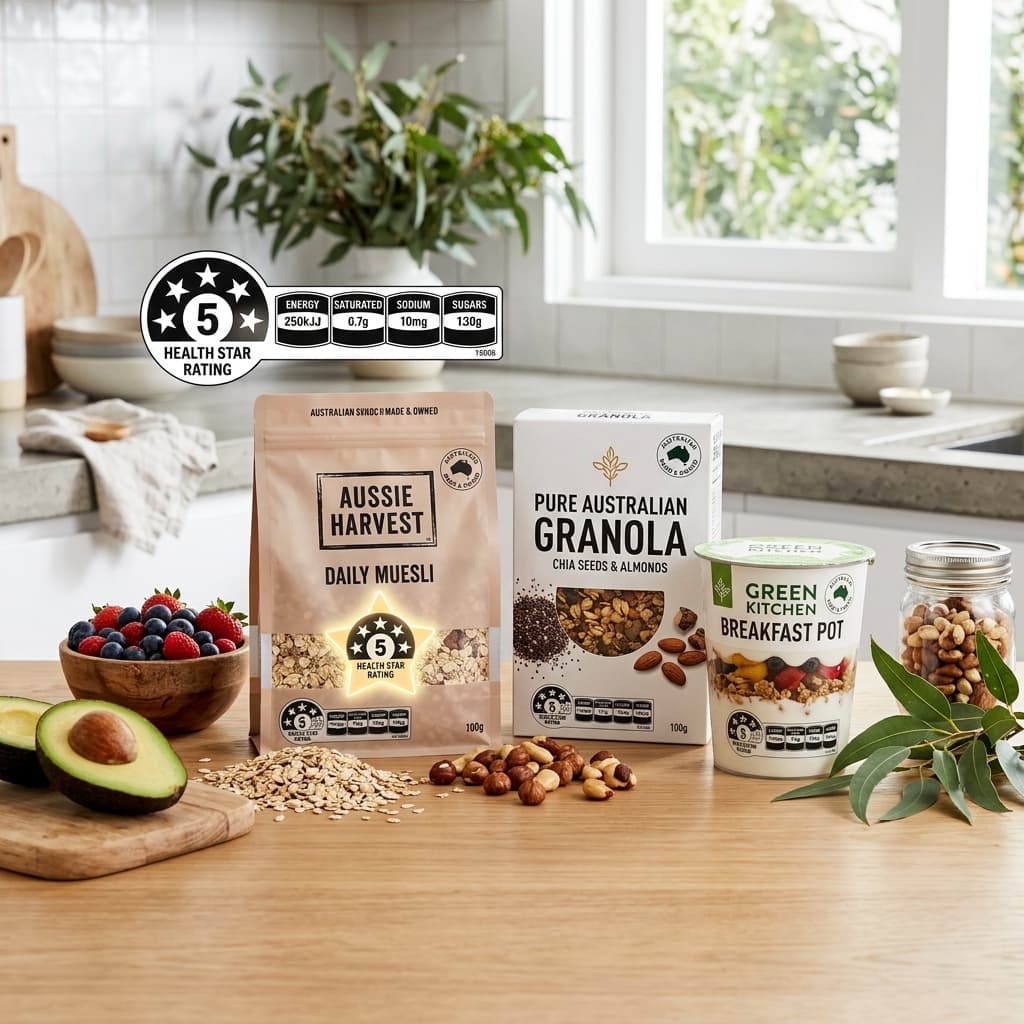
What is the Health Star Rating system?
The Health Star Rating (HSR) system is a front-of-pack labelling scheme introduced in Australia and New Zealand in 2014. It rates the overall nutritional profile of packaged food and beverages on a scale from 0.5 to 5 stars — the more stars, the healthier the product relative to similar foods in that category.
Participation is voluntary. There is no legal requirement to display an HSR on your packaging. However, uptake has grown significantly: the 2023 Five Year Review found more than 5,000 products across 180 companies now carry an HSR, covering roughly 30% of eligible packaged foods in Australian supermarkets.
The system is governed jointly by the Australian and New Zealand governments through the Health Star Rating Advisory Committee (HSRAC), with the Implementation Guide serving as the authoritative technical reference. The current version is Implementation Guide v9, published December 2025.
Why does it matter for your business?
The HSR is increasingly referenced by retailers, workplace wellness programs, hospital procurement policies, and school canteen guidelines. Several major retailers have begun using it as a secondary quality signal in ranging decisions — not a hard gate, but a factor.
More practically: if you're exporting to New Zealand or selling into channels that apply nutrition-based criteria, understanding your product's HSR before your retail partner calculates it for you is simply good practice.
There is also a defensive case. A low HSR on a product positioned as a health food is a reputational risk. Knowing the number lets you either reformulate proactively or calibrate your marketing claims accordingly.
How is the score calculated?
The HSR is calculated using a points-based algorithm that weighs positive and negative nutritional attributes against each other. The algorithm is applied per 100g for most foods, and per 100mL for beverages.
Step 1 — Baseline points (V)
Baseline points are assigned for nutrients of concern. Higher values in these nutrients mean more points, and more points in this category is bad.
| Nutrient | Points range |
|---|---|
| Energy (kJ) | 0–10 (beverages) or 0–11 (food) |
| Saturated fat (g) | 0–30 |
| Total sugars (g) | 0–10 (beverages) or 0–25 (food) |
| Sodium (mg) | 0–30 |
Beverages (Category 1) do not score saturated fat or sodium — only energy and sugars contribute to the baseline.
Step 2 — Modifying points (M)
Modifying points are assigned for beneficial nutrients. Higher values mean more points, which reduce the final score.
| Nutrient | Points range |
|---|---|
| FVNL content (%) | 0–10 (beverages) or 0–8 (food) |
| Dietary fibre (g) | 0–15 |
| Protein (g) | 0–15 |
Important: Protein points are blocked when the food category is not a dairy or protein product AND the baseline score (V) is ≥ 13 AND FVNL content is < 5%. This prevents manufacturers from using a protein boost to offset a fundamentally high-risk nutritional profile.
Step 3 — Final score and star conversion
The final score is: V − M
A lower final score maps to more stars. The exact conversion table varies by category. The thresholds are defined in the Implementation Guide — the star rating is not a linear function; it uses lookup tables with defined breakpoints.
The six HSR categories
One of the most commonly misunderstood aspects of the system is that it is not one algorithm — it is six. Each category uses different scoring tables and has different rules.
| Category | What it covers |
|---|---|
| Category 1 | Non-dairy beverages (water, juice, soft drinks, sports drinks) |
| Category 1D | Dairy beverages (milk, flavoured milk, drinking yoghurt) |
| Category 2 | Food (bread, cereal, snack foods, sauces, condiments, ready meals — the default for most packaged foods) |
| Category 2D | Dairy food (cheese, yoghurt, cream, ice cream) |
| Category 3 | Oils and spreads |
| Category 3D | Cheese (distinct from other dairy foods due to saturated fat scoring) |
The category is determined by the primary ingredients and nature of the product — not by how you choose to position it. A flavoured milk is Category 1D regardless of whether it is marketed as a snack. Misclassifying your product is a compliance risk and will produce an incorrect rating.
Beverages (Categories 1 and 1D) are scored per 100mL. All other categories are scored per 100g.
FVNL content — the variable most manufacturers overlook
FVNL stands for Fruit, Vegetable, Nut and Legume content. It is expressed as a percentage of the product by weight as sold, and it is the modifying factor that has the most room for manual input — and the most room for error.
The system distinguishes between two types of FVNL content:
Non-concentrated FVNL — fresh, frozen, or canned fruit or vegetables; nuts; legumes; seeds. The percentage is taken at face value.
Concentrated FVNL — dried or dehydrated fruit or vegetables, tomato paste, fruit juice concentrate. Because concentration effectively multiplies the nutritional density, the Implementation Guide applies a reconstitution factor when calculating effective FVNL percentage.
The effective FVNL percentage used in scoring is calculated from a formula defined in the Implementation Guide that combines both types. This matters because a product with 10% dried fruit may have a higher effective FVNL percentage than a product with 20% fresh fruit — which can meaningfully change the modifying points and therefore the final star rating.
If your product contains any fruit, vegetable, nut, legume, or seed component, you should be calculating and documenting your FVNL percentage explicitly. It is also a required input for any front-of-pack claim about fruit or vegetable content.
Automatic ratings for certain products
Some product types receive an automatic rating under the Implementation Guide, bypassing the standard calculation:
- Water (plain, still or sparkling, unflavoured): automatic 5 stars
- Alcohol (beer, wine, spirits): automatic 0.5 stars — regardless of nutritional profile
- Food for special medical purposes and infant formula: excluded from the HSR system entirely
If your product falls into one of these categories, the calculation algorithm does not apply. You either display the automatic rating or do not participate.
What goes on the label?
The HSR graphic on pack must comply with the visual specifications in the Implementation Guide. The core element is the stars element — a circle displaying the star rating numerically and graphically. Participation at this level (stars only, no nutrient icons) is the minimum display option.
Manufacturers may optionally display nutrient icons alongside the stars element, showing per-100g (or per-100mL) values for energy, saturated fat, total sugars, and sodium. This is the full Hierarchy Level 1 display and is the most commonly seen format in supermarkets.
All HSR graphics must display the reference measure used (e.g. PER 100g or PER 100mL). The colour scheme must follow the defined palette — the graphic cannot be recoloured to match brand guidelines.
Common calculation errors to avoid
1. Using the wrong category. The most consequential mistake. A dairy food scored as Category 2 will produce an incorrect result — usually more favourable than the correct one.
2. Confusing per-serve and per-100g values. The algorithm always uses per-100g (or per-100mL for beverages) values from your NIP, not per-serve values. If you are inputting nutritional data manually, verify you are using the right column.
3. Ignoring FVNL or entering zero when a FVNL ingredient exists. If your product contains tomato paste, dried fruit, nuts, or legumes and you enter 0% FVNL, you are leaving modifying points on the table — your stated rating will be lower than the true rating, and any front-of-pack FVNL claim may be unsupported.
4. Not accounting for the protein block. If your product has a baseline score of 13 or above and less than 5% FVNL, protein points cannot be claimed. Manufacturers sometimes calculate a higher star rating than they are entitled to by including protein points that should be blocked.
5. Rounding nutrients before scoring. FSANZ requires specific rounding rules for NIP values (e.g. energy rounded to the nearest 10 kJ, sodium rounded to the nearest 5 mg). Scoring should be applied to the rounded NIP values — the same values that appear on your label — not raw calculated values.
Should you display an HSR?
There is no single right answer. It depends on your product, your category, your retail channels, and your competitive positioning.
A 4.5-star product in the snack food category is a significant differentiator. A 2-star product in a category where competitors average 3.5 stars is a liability. Before committing to front-of-pack display, calculate the number, understand where it sits relative to category benchmarks, and make a deliberate decision.
The HSR Advisory Committee publishes category average data periodically. These benchmarks are a useful reference point — a 3-star rating that is above category average tells a different story than a 3-star rating that sits below it.
If your product would display a low rating, that is still useful information. It may point to a reformulation opportunity, or it may simply confirm that your product is positioned correctly in a category where high star ratings are not the primary purchase driver (think premium cheese, specialty oils, or craft confectionery).
The regulatory trajectory
The Five Year Review of the HSR system, completed in 2023, recommended maintaining the voluntary approach but strengthening the framework in several areas — including improved consistency in category assignment, expanded monitoring of industry uptake, and clearer guidance on the FVNL calculation for complex products.
Implementation Guide v9 (December 2025) incorporates these updates. If you have calculated your HSR against an earlier version of the guide, it is worth re-running the calculation to confirm your rating has not changed under the updated tables.
There is ongoing policy discussion about whether the HSR system should become mandatory for certain product categories — particularly those marketed to children. While no mandate is currently in force, the direction of policy travel is toward broader adoption. Getting familiar with the system now, while it is voluntary, is the lowest-risk approach.
Calculating your HSR
The calculation requires three inputs from your nutritional information panel:
- Per-100g (or per-100mL) values for: energy (kJ), saturated fat (g), total sugars (g), sodium (mg), dietary fibre (g), and protein (g)
- Your FVNL content percentage (non-concentrated and concentrated, separately)
- Your product category (1, 1D, 2, 2D, 3, or 3D)
If you use Batchbase to manage your product specifications, the HSR calculation is built directly into the finished good editor. Select your category, enter your FVNL percentages, and the system calculates your star rating from your current NIP — updating automatically as your recipe changes. You can see the full score breakdown (baseline V, modifying M, final score, and star conversion) without leaving your product record.
The Health Star Rating Implementation Guide v9 is the authoritative technical reference and is available on the Health Star Rating website. This article provides a general overview and should not be relied upon as a substitute for the official guide when making labelling decisions.
Wondering about the regulatory history and whether the HSR system might become mandatory? Read Is the Health Star Rating Becoming Mandatory? The Regulatory Timeline for Australian Food Manufacturers.