It's the question every food manufacturing business owner is asking right now: is this temporary, or are we looking at a sustained new normal?
The honest answer is that nobody knows for certain. But that doesn't mean you can't plan. It means you need to plan for multiple scenarios rather than waiting for one clear outcome.
Here's what the current evidence suggests.
The short-term picture: some relief, but not resolution.
The federal government's halving of the fuel excise — saving 26.3 cents per litre — is a meaningful short-term buffer. The reduction in the heavy vehicle road user charge adds further relief for road freight operators. These measures took effect in late March 2026 and are in place for three months.
They help. But they don't resolve the underlying supply problem. The Strait of Hormuz remains disrupted. Australia's structural fuel vulnerability — the lowest reserve levels of any IEA member nation — hasn't changed. The excise cut creates a window, not a solution.
The medium-term picture: geopolitics and alternative supply.
Resolution of the current crisis depends primarily on geopolitical developments that are genuinely unpredictable. The Grattan Institute has described the economic impact as potentially comparable to COVID-19. Energy research firm Wood Mackenzie has projected Brent crude could climb to US$150 per barrel if the conflict in the Middle East continues.
There are some partial relief valves. India, which has been redirecting diesel previously bound for Europe, could emerge as an alternative Australian supplier. South Korea, while restricting export growth, has not cut off Australian supply entirely. The US has been engaged as an emergency supplier for the first time in decades. Australia has also been relaxing fuel specifications to broaden the pool of usable supply.
These efforts are real, but logistics take time. Shipments take weeks to arrive. The full extent of the supply shortfall — masked initially by shipments already in transit before the disruption — is still working its way through the system.
The longer-term picture: structural vulnerability isn't going away.
Even if the current geopolitical crisis resolves, Australia's underlying fuel dependency hasn't changed. Domestic crude production fell from 277,000 barrels per day in 2011 to 61,000 barrels per day by 2025. The country imports roughly 80–90% of its refined fuel needs. Our two remaining refineries — at Lytton and Geelong — cover only around 20% of national demand.
The Grattan Institute and IEEFA both argue Australia needs a fundamental rethink of its fuel security strategy — renewable alternatives for freight, biodiesel investment, and minimum stockholding obligations that are actually enforced. These are multi-year policy shifts. They don't help your freight invoice this quarter.
What this means for planning.
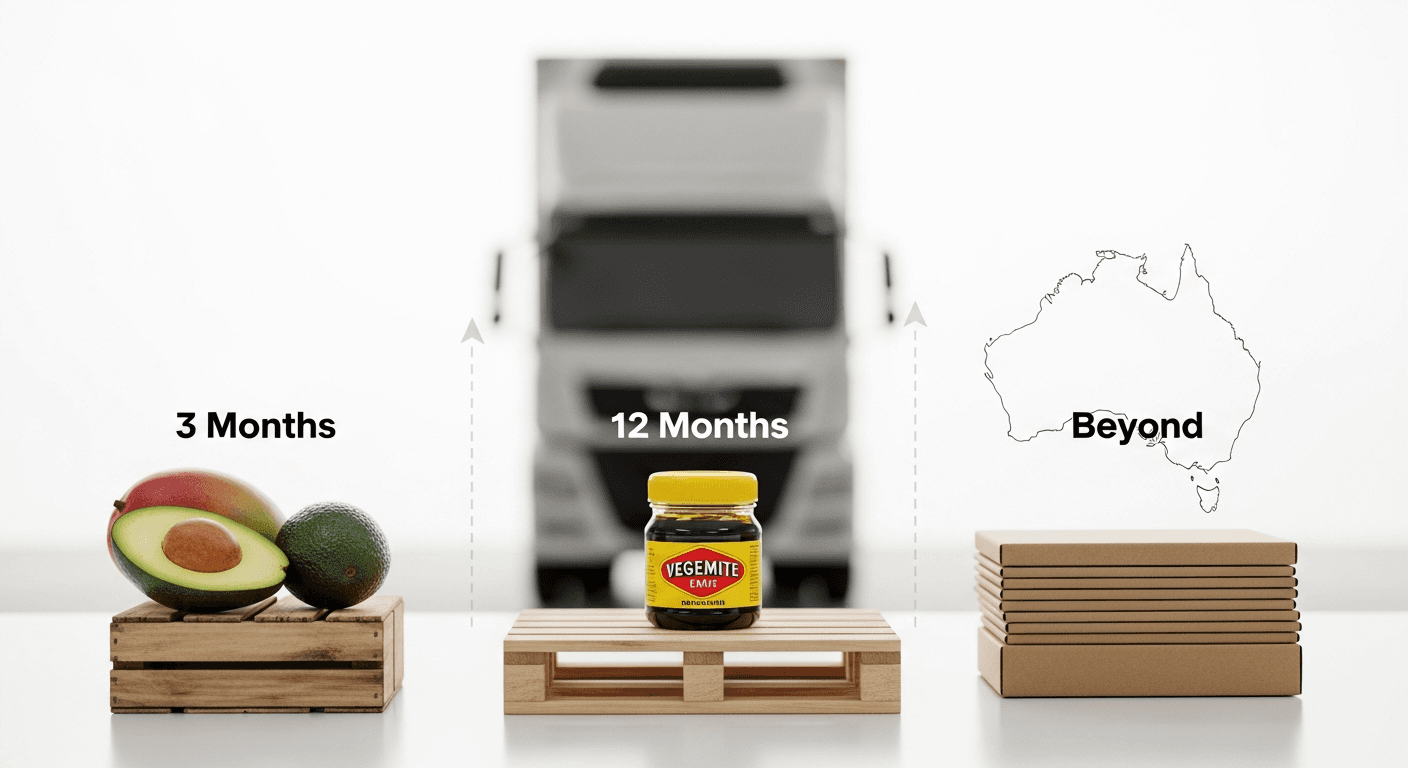
Think in three time horizons:
Next 3 months: The excise cut provides a buffer. Use this window to review freight contracts, consolidate routes, and build visibility into your cost-per-unit exposure. Don't assume conditions will improve further — plan as if they won't.
3–12 months: Geopolitical uncertainty remains the dominant variable. Surcharges are likely to persist in some form. Build a cost scenario into your pricing and production planning that assumes freight costs remain 15–25% above your pre-crisis baseline.
Beyond 12 months: If you are renegotiating any long-term supply or distribution agreements in the next year, build freight escalation clauses and cost-sharing mechanisms into those contracts from the start. Locking in last year's freight assumptions will expose you.
The businesses that come through this in the best shape will be the ones that treated the uncertainty as a planning input rather than a reason to delay decisions.
This is the third article in a four-part series on managing freight cost pressures in Australian food manufacturing.
References: Grattan Institute (grattan.edu.au) | IEEFA (ieefa.org) | OilPrice.com | Wood Mackenzie energy forecasts | SBS News | discoveryalert.com.au fuel supply chain analysis