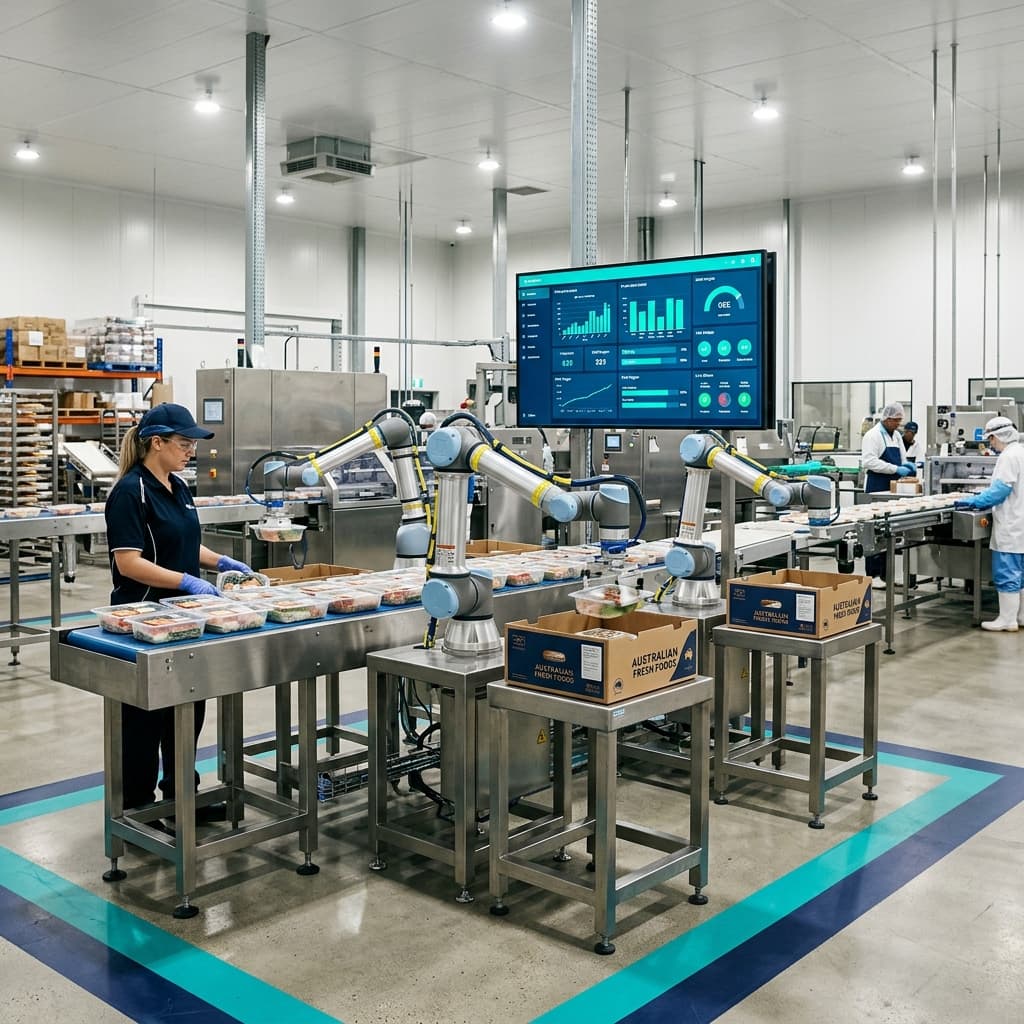
Australia's food and beverage manufacturing sector is facing a perfect storm. On one side, domestic and export demand for high-quality, safe, and traceable Australian food products has never been higher. On the other side, a chronic labour shortage and rising wage costs are making it increasingly difficult to meet that demand profitably.
The solution isn't just hiring more people—it's fundamentally changing how food is made. Welcome to the era of Industry 4.0 and practical automation for the mid-tier Australian food manufacturer.
The Reality of the Labour Crisis
According to recent industry surveys, over 70% of Australian food manufacturers report significant difficulties in attracting and retaining staff. This isn't just about skilled engineers; it's about production line workers, quality assurance technicians, and warehouse staff.
When you combine this shortage with recent wage increases and the sheer physical toll of traditional food processing jobs, the financial equation for manual production lines begins to break down.
- High Turnover: The repetitive nature of many food processing tasks leads to high turnover rates, costing businesses thousands in recruitment and training.
- Compliance Risks: Human error on the production line—especially regarding allergen segregation or precise recipe measurement—can lead to costly recalls.
- Margin Erosion: As input costs rise, the inability to scale production without linearly scaling labour costs severely compresses margins.
Enter Industry 4.0: Not Just for the Giants
Historically, advanced automation and robotics were the domain of multinational FMCG giants with endless capex budgets. That is no longer the case. The democratization of automation technology—Industry 4.0—means mid-tier manufacturers can now deploy smart systems that offer rapid ROI.
Industry 4.0 isn't just about robots; it's about connectivity. It's the Industrial Internet of Things (IIoT), where machines communicate with each other and with centralized software like Batchbase to optimize the entire production flow.
1. Automated Packaging and Palletizing
One of the most immediate ROI opportunities lies at the end of the line. Packaging and palletizing are labour-intensive, ergonomically challenging tasks. Collaborative robots (cobots) can now work alongside humans to handle these tasks safely and efficiently. Statistic: Automating end-of-line packaging can reduce related labour costs by up to 40% while significantly reducing workplace injury claims.
2. Smart Sensors and Real-Time QA
Quality assurance historically required technicians to manually pull samples and log data on clipboards. Today, smart sensors monitor temperature, moisture, and line speed in real-time. If a critical control point (CCP) deviates, the system flags it instantly, preventing entire batches from being ruined. This level of automated compliance is crucial for surviving unannounced audits and maintaining standards like HACCP and SQF.
3. Integrated Recipe and Batch Control
When recipes are managed on spreadsheets and executed manually on the floor, the variance between "planned" and "actual" costs can be devastating. By integrating smart scales and automated dispensing systems with your central recipe management software, you ensure that every batch is made exactly to spec. This not only protects the product's consistency but rigorously protects the margin.
The ROI Timeline for Mid-Tier Manufacturers
The hesitation for many Australian manufacturers is the upfront cost. However, the ROI calculation has shifted dramatically over the past five years.
When factoring in:
- Reduced direct labour costs
- Elimination of human-error batch wastage (which can easily cost $10k+ per incident)
- Increased throughput (machines don't take breaks or call in sick)
- Reduced workers' compensation premiums
Many mid-tier manufacturers are seeing ROI on specific automation cells within 18 to 24 months.
Overcoming the Implementation Hurdle
The biggest barrier to automation isn't the technology; it's the data foundation.
You cannot automate a process that isn't standardized. Before you buy a robotic arm, you need digital control over your recipes, specs, and workflows. If your specs are locked in PDFs and your inventory is managed on a white-board, the robot won't save you.
This is where systems like Batchbase come in. By digitizing the core data—from raw material specs to live costing and compliance tracking—you create the foundation that automated machinery plugs into.
The Future of the Australian Factory Floor
The Australian food manufacturing sector is at an inflection point. Those who rely on brute-force manual labour to scale will increasingly find themselves priced out of both domestic and export markets.
Automation and Industry 4.0 are not about replacing the human workforce; they are about elevating it. By automating the dull, dirty, and dangerous tasks, manufacturers can upskill their teams to focus on quality, continuous improvement, and product innovation.
The technology is ready. The question is: is your data foundation ready to support it?
Ready to digitize your production data and prepare for the automated future? Discover how Batchbase provides the single source of truth your factory needs.