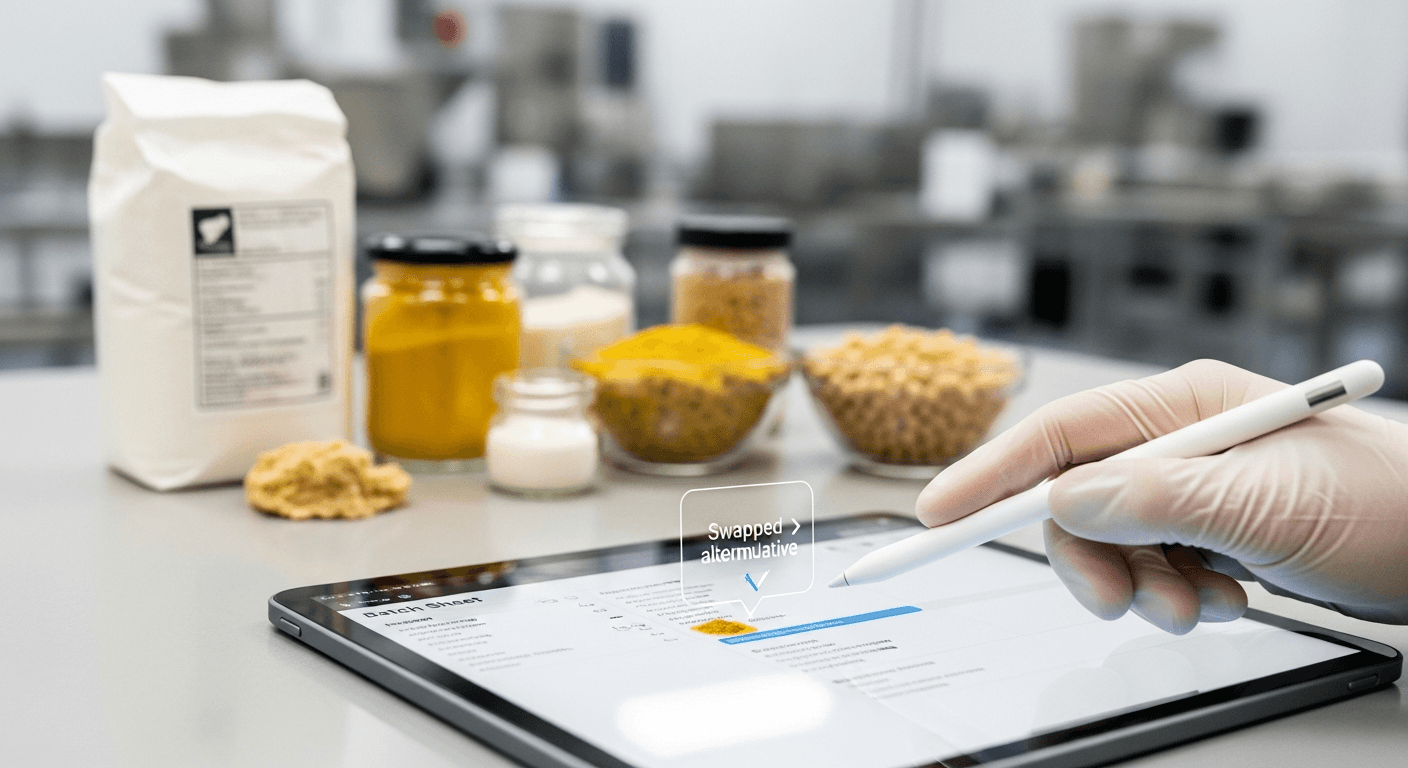
Australian food and beverage manufacturers operate under one of the strictest biosecurity border regimes in the world. While these controls are essential for protecting Australia's agricultural sector and unique ecosystems, they also mean that shipments of imported raw materials—such as thickeners, emulsifiers, starches, and specialised spices—can be held up at the port for weeks due to inspection backlogs or quarantine holds.
When an imported ingredient is delayed, production lines grind to a halt. To keep the factory floor running and avoid costly downtime, manufacturers must quickly find and swap in local alternatives. But in a highly regulated environment, "swapping an ingredient" is never a simple one-to-one exchange. It requires immediate, real-time recipe reformulation to protect your margins, allergen profiles, and label compliance.
Failing to manage this substitution with precision can lead to product recalls, margin erosion, or product inconsistency that damages customer trust.
The Risks of Blind Ingredient Substitution
Substituting an ingredient without a rigorous, systemised review process exposes your food business to severe operational and legal risks:
- Allergen Contamination: A local supplier's starch or seasoning blend might contain trace allergens (such as gluten, soy, or dairy) due to shared equipment at their facility that was not present in the imported version. Sourcing this without checking triggers a costly and dangerous product recall under Australia's strict PEAL (Plain English Allergen Labelling) laws.
- Cost Margin Erosion: Local ingredients can be significantly more expensive due to higher domestic processing and labor costs. If you substitute them without adjusting your recipe batch size or calculating the new yield cost, you could end up running the production line at a loss.
- Nutritional Deviation: Differences in sugar, fat, or protein content between the imported and local ingredients will alter the final product's nutritional panel, rendering your packaging labels incorrect and violating FSANZ standards.
- Functional Discrepancies: A local thickener or binder might have a different absorption rate, meaning a straight one-to-one swap will change the texture, viscosity, or shelf-life of the food.
The Power of Real-Time Digital Reformulation
To survive supply chain shocks, food manufacturers need a system that allows for agile reformulation. When a shipment is delayed at Melbourne, Brisbane, or Sydney ports, your food technologists should be able to model a substitution instantly before the raw materials ever hit the mixing bowl.
Here is how a digitised batch management system facilitates this transition:
- Immediate Allergen Auditing: The system automatically cross-checks the new ingredient's spec sheet against your product's declared allergen profile, flagging if the replacement introduces new risk factors.
- Dynamic Cost Recalculation: The system updates the batch cost based on the local supplier's pricing and immediately calculates the new margin, showing you the exact financial impact of the swap.
- Yield Adjustments: If the local alternative has a different concentration or moisture absorption rate, the system automatically scales the water or active ingredients on the batch sheet to maintain product consistency.
- Label Verification: The software recalculates the nutritional panel dynamically, letting you know if a temporary label overlay is required or if the deviation is within acceptable tolerances.
Building Supply Chain Resilience
Relying solely on single-source imported ingredients is a high-risk strategy in 2026. Forward-thinking Australian food manufacturers are building resilience by pre-approving local alternative ingredients in their product specifications.
By having pre-reformulated "Plan B" recipes saved in your digital system, you can switch production runs over in minutes during a supply chain shock, ensuring your retail partners always see full shelves and your factory floor never goes quiet.