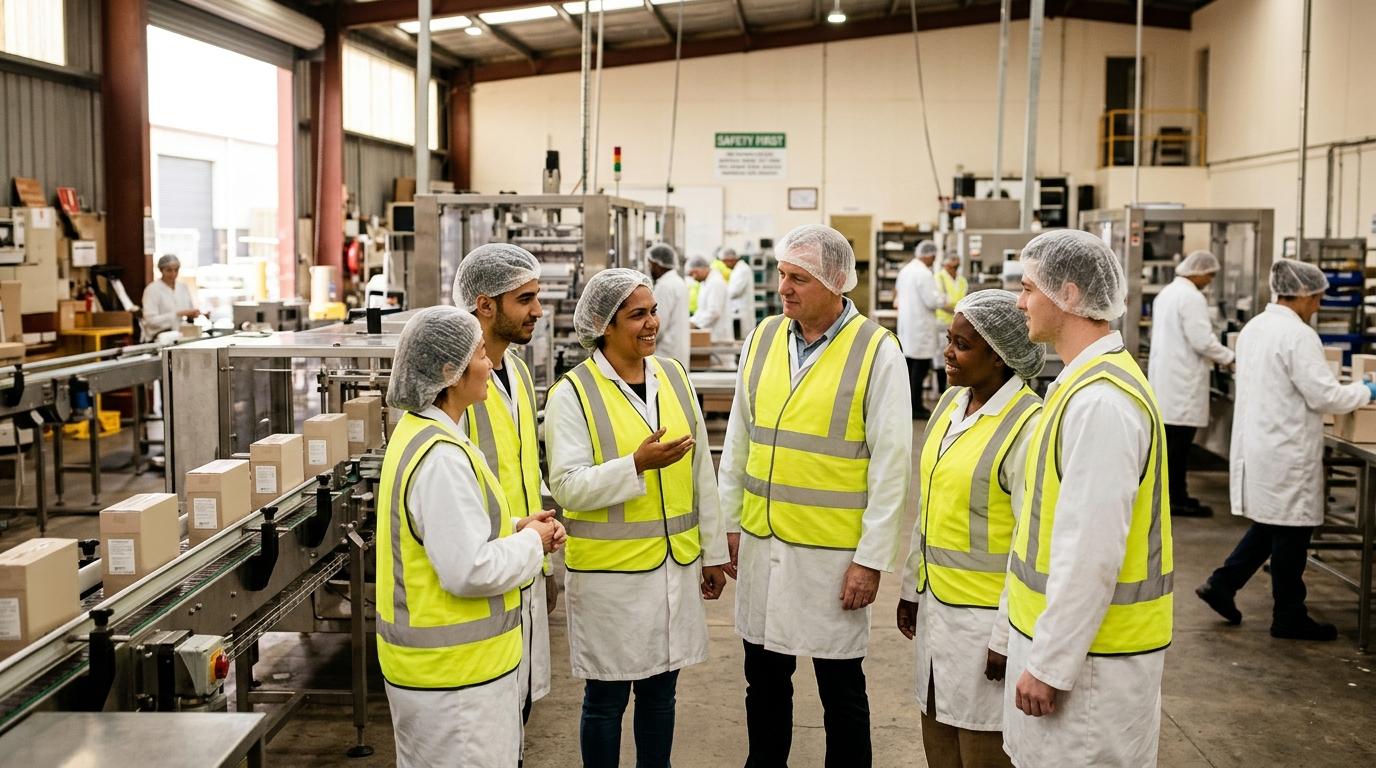
Food manufacturers have spent decades engineering physical risk out of their plants: guarding on slicers, lockout procedures on mixers, traffic management for forklifts and cold-store PPE. Those controls remain essential. But the legal definition of a safe workplace has expanded, and many food businesses have not caught up.
Every Australian jurisdiction now places an explicit duty on employers to manage psychosocial hazards with the same rigour as physical ones. At the same time, industrial manslaughter has become a criminal offence across all states, territories and the Commonwealth, with maximum penalties for companies of around $18 million and up to 25 years' imprisonment for individuals in several jurisdictions.
This guide explains what psychosocial hazards look like on a food manufacturing floor, what the law requires, and a practical framework to manage them.
What Are Psychosocial Hazards?
Safe Work Australia defines psychosocial hazards as anything in the design or management of work that increases the risk of work-related stress, which can lead to psychological or physical harm.
The model Code of Practice identifies common hazards, many of which are highly relevant to food manufacturing:
| Psychosocial hazard | How it shows up in food manufacturing |
|---|---|
| High job demands | Line speed targets, peak season volumes, short-staffed shifts |
| Low job control | Machine-paced work with no ability to pause or rotate |
| Poor support | Supervisors stretched across multiple lines, limited training |
| Lack of role clarity | Unclear responsibilities during changeovers or quality holds |
| Poor organisational change management | New equipment, rosters or systems introduced with no consultation |
| Remote or isolated work | Night-shift sanitation crews, cold-store pickers |
| Poor environmental conditions | Noise, cold rooms, heat from ovens and fryers |
| Traumatic events | Serious injuries on the line, aggressive incidents |
| Bullying, harassment and conflict | Interpersonal conflict under production pressure |
| Fatigue | Long shifts, rotating rosters, excessive overtime |
Why This Matters for Food Manufacturers
Food production combines many of the highest-risk psychosocial factors: repetitive machine-paced tasks, shift work, seasonal peaks, cold and noisy environments, and a workforce that often includes casual, migrant and non-English-speaking workers who may be less likely to raise concerns.
The cost of getting it wrong is significant. According to Safe Work Australia's Key Work Health and Safety Statistics, mental health conditions account for around one in ten serious workers' compensation claims, but they involve far longer time off work and much higher costs than the average claim. Median time lost for mental health claims is typically measured in months, compared with weeks for physical injuries.
Manufacturing as a whole consistently ranks among the industries with the highest numbers of serious claims.
What the Law Requires
Under the model WHS Regulations, adopted in most jurisdictions from 2023, a person conducting a business or undertaking (PCBU) must:
- Identify reasonably foreseeable psychosocial hazards
- Eliminate risks so far as is reasonably practicable
- Minimise remaining risks where elimination is not possible
- Maintain and review control measures
- Consult with workers and health and safety representatives throughout
When choosing controls, the PCBU must consider the duration, frequency and severity of exposure, how hazards interact, the design of work and systems, and the physical environment.
Victoria, which operates under the Occupational Health and Safety Act 2004 rather than the model WHS laws, introduced its own Occupational Health and Safety (Psychological Health) Regulations, commencing on 1 December 2025.
Industrial Manslaughter: The Stakes Have Changed
Industrial manslaughter applies where a PCBU or officer engages in conduct that breaches a health and safety duty, causes the death of a person, and does so negligently or recklessly, depending on the jurisdiction.
| Jurisdiction | Maximum penalty for a body corporate | Maximum for an individual |
|---|---|---|
| Commonwealth (from 1 July 2025) | ~$18 million | 25 years' imprisonment |
| Victoria | ~$19 million | 25 years' imprisonment |
| New South Wales | ~$20 million | 25 years' imprisonment |
| Queensland | ~$15 million | 20 years' imprisonment |
| South Australia | $18 million | 20 years' imprisonment |
Penalties are indicative, subject to indexation and vary by jurisdiction. Check the current legislation in your state.
Importantly, the death does not need to result from a physical incident alone. Work-related suicide linked to unmanaged psychosocial hazards, such as severe bullying or extreme fatigue, may fall within scope.
A Practical Framework for Food Plants
1. Identify Hazards With Workers
Use a combination of methods:
- Anonymous surveys using validated tools such as the People at Work survey, a free tool developed by Australian WHS regulators
- Floor walks and conversations with each shift, including nights and weekends
- Data review: absenteeism, turnover, overtime hours, incident reports and complaints by line or shift
- Exit interviews that ask specifically about workload, support and conflict
2. Assess and Prioritise
Map hazards by line, shift and role. A night sanitation crew working alone in cold, wet conditions faces a different risk profile from a day packing team. Focus first on hazards with the highest severity and frequency.
3. Apply the Hierarchy of Controls
| Control level | Example in a food plant |
|---|---|
| Eliminate | Remove unrealistic line-speed targets that were set without capacity analysis |
| Substitute / redesign | Introduce task rotation on repetitive lines; automate the most monotonous tasks |
| Engineering | Improve noise control, cold-store warming areas and ergonomic workstations |
| Administrative | Fatigue management rosters, overtime caps, clear escalation pathways |
| Training and support | Supervisor training in recognising distress; EAP access in multiple languages |
Higher-order controls that change the design of work are more effective than relying on training or wellbeing programs alone.
4. Plan Production Realistically
Many psychosocial hazards trace back to planning. When schedules are built on inaccurate capacity data, production teams absorb the shortfall through overtime, skipped breaks and pressure on the line. Accurate batch planning, realistic yields and visibility of labour requirements are therefore safety controls as well as efficiency tools.
5. Consult on Change
New equipment, systems, rosters or ownership changes are high-risk periods. Consult early, explain the reasons, and give workers a genuine opportunity to influence implementation.
6. Document, Monitor and Review
Keep records of hazard identification, risk assessments, controls and consultation. Review controls after incidents, complaints, significant change or at least annually. Officers, including directors, must exercise due diligence by understanding the risks and verifying that controls are working.
Peak Season Is a Pressure Point
For many food manufacturers, the period from October to December is the busiest of the year. Christmas ranges, retailer promotions and summer demand coincide with staff leave. This is precisely when fatigue, high demands and low control peak.
Practical peak-season controls include:
- Setting overtime limits and monitoring consecutive shifts
- Bringing in and training casual staff early
- Building realistic schedules that include changeovers, cleaning and breakdowns
- Ensuring supervisors have time to check in with teams
A Worked Example: Fatigue on the Night Sanitation Shift
A ready-meals manufacturer noticed rising absenteeism and two minor chemical splash incidents on its night sanitation shift. A People at Work survey and conversations with the crew revealed several interacting hazards:
| Hazard identified | Contributing factor | Control introduced |
|---|---|---|
| Fatigue | Crew regularly stayed back when day production overran | Production schedule rebuilt with realistic changeover times; hard stop for day shift |
| Isolation | Two-person crew spread across a large site | Buddy system and scheduled radio check-ins |
| Low support | No supervisor on site after 10pm | On-call supervisor roster and a clear escalation process |
| Poor role clarity | Cleaning tasks changed nightly with no written plan | Standard sanitation schedules issued per line |
| Environmental conditions | Cold, wet conditions in chiller areas | Thermal PPE and warm-up breaks |
Within three months, overtime on the shift fell, absenteeism improved and there were no further splash incidents. The most important control was not a wellbeing program but fixing the upstream production schedule that kept pushing work into the night.
Frequently Asked Questions
Are psychosocial hazards really enforced, or just guidance? They are a legal duty under WHS regulations in most jurisdictions and under specific regulations in Victoria. Regulators have issued improvement notices and pursued prosecutions relating to psychosocial risks, including bullying and excessive workloads.
Does a small food business have the same obligations? Yes. The duty applies to every PCBU regardless of size, although what is reasonably practicable will depend on the business's circumstances and resources.
Is an employee assistance program (EAP) enough? No. An EAP is a useful support, but regulators expect hazards to be controlled at the source through the design of work. Relying on an EAP alone is unlikely to satisfy the duty.
Who counts as an officer for industrial manslaughter? Officers generally include directors and senior managers who make or participate in decisions affecting the whole or a substantial part of the business. They must exercise due diligence to ensure the business complies with its WHS duties.
The Bottom Line
Psychosocial safety is no longer a soft HR issue. It is a legal duty, it is enforced, and serious failures can lead to criminal liability for companies and their officers. For food manufacturers, the most effective controls usually involve the design of work itself: realistic production planning, sensible rosters, task rotation, good supervision and genuine consultation.
Getting it right also pays off commercially, through lower turnover, fewer errors and a more stable workforce in a tight labour market.
References
- Safe Work Australia – Psychosocial hazards
- Safe Work Australia – Model Code of Practice: Managing psychosocial hazards at work
- Safe Work Australia – Key WHS Statistics Australia
- Safe Work Australia – Industrial manslaughter
- WorkSafe Victoria – Psychological health regulations
- Comcare – Psychosocial hazards
- People at Work – Psychosocial risk assessment survey