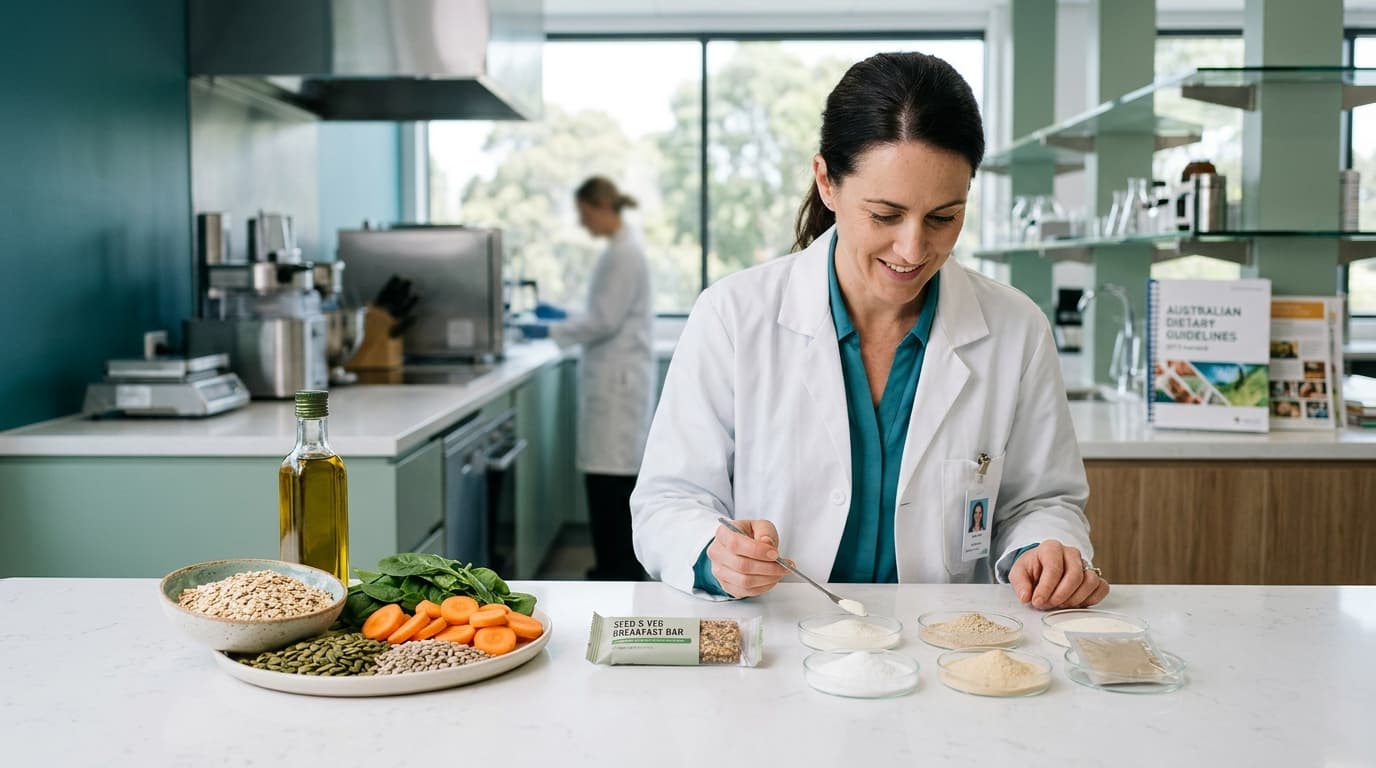
For decades, Australian food policy has judged products by their nutrients: how much sugar, salt, saturated fat and energy they contain. That framework underpins the Nutrition Information Panel, the Health Star Rating and most reformulation targets. In 2026, a second question is gaining ground: how processed is this food?
The National Health and Medical Research Council (NHMRC) is reviewing the Australian Dietary Guidelines for the first time since 2013, and its expert committee has flagged ultra-processed foods (UPFs) as a priority topic for evidence review. Public health groups are pushing hard for the new guidelines to address UPFs directly. Industry groups, including the Australian Food and Grocery Council, argue that processing is not inherently harmful and that nutrient-based measures remain the right approach.
Whatever the final wording, the debate is already shaping retailer expectations, media coverage and consumer behaviour. This article explains what UPFs are, what the evidence says, how the policy picture is shifting, and what food manufacturers can do now.
What Counts as "Ultra-Processed"?
The most widely used definition comes from the NOVA classification, developed by researchers at the University of São Paulo. It sorts foods into four groups by the extent and purpose of processing, not by nutrient content.
| NOVA group | Description | Examples |
|---|---|---|
| 1. Unprocessed or minimally processed | Whole foods, or foods altered by drying, freezing, pasteurising or similar | Fresh vegetables, plain milk, eggs, frozen peas, rolled oats |
| 2. Processed culinary ingredients | Substances extracted from foods and used in cooking | Olive oil, butter, sugar, salt, flour |
| 3. Processed foods | Group 1 foods with Group 2 ingredients added, using traditional methods | Cheese, tinned vegetables, cured meats, simple sourdough bread |
| 4. Ultra-processed foods | Industrial formulations, typically containing ingredients rarely used in home kitchens | Soft drinks, packaged snacks, many breakfast cereals, flavoured yoghurts, reconstituted meats, many plant-based alternatives |
Group 4 products typically contain ingredients such as hydrolysed proteins, modified starches, protein isolates, emulsifiers, flavour enhancers, non-sugar sweeteners and colours. NOVA is a contested tool. Critics point out that it groups a wholemeal sliced bread with a soft drink, and that it ignores nutrient profile entirely. Supporters argue it captures health effects that nutrient-based measures miss.
How Much Ultra-Processed Food Do Australians Eat?
A widely cited study in BMJ Open, based on the Australian Health Survey, found that ultra-processed foods made up around 42% of the total energy intake of Australians aged two and over. The same study found that diets higher in UPFs were higher in free sugars, total and saturated fat and sodium, and lower in fibre and protein.
That makes Australia one of the higher UPF-consuming countries, alongside the UK, US and Canada. It also means the policy debate affects a very large share of products on supermarket shelves.
What the Evidence Says
The most comprehensive review to date is an umbrella review published in The BMJ in 2024. It pooled 45 meta-analyses covering almost 10 million participants and assessed links between UPF exposure and 32 health outcomes.
| Health outcome | Association with higher UPF intake | Evidence grade |
|---|---|---|
| Cardiovascular disease-related death | ~50% higher risk | Convincing |
| Anxiety and common mental disorders | 48–53% higher risk | Convincing |
| Type 2 diabetes | ~12% higher risk | Convincing |
| All-cause mortality | ~21% higher risk | Highly suggestive |
| Depression | ~22% higher risk | Highly suggestive |
| Obesity and sleep problems | Higher risk | Highly suggestive |
These are observational associations, not proof of cause and effect, and researchers continue to debate whether the problem is processing itself or the nutrient profile and eating patterns that come with it. But the volume and consistency of the evidence is why public health bodies want UPFs addressed in national guidance.
The Australian Policy Picture in 2026
| Policy area | Current status | What to watch |
|---|---|---|
| Australian Dietary Guidelines review (NHMRC) | Evidence reviews under way, with UPFs a priority topic | Whether final guidance tells Australians to limit UPFs, and how "ultra-processed" is defined |
| Healthy Food Partnership reformulation program | Voluntary targets for sodium, sugar and saturated fat in key categories | Whether targets expand or become tied to processing level |
| Health Star Rating | Moving toward mandatory, still nutrient-based | Pressure to align HSR with any UPF guidance |
| Added sugars labelling (FSANZ P1058) | Abandoned in March 2026 | No separate added sugars line on the NIP; "no added sugar" claims still regulated |
FSANZ's decision to abandon P1058 is a useful signal. The regulator concluded that a separate added sugars line would add cost and potential consumer confusion without a clear health benefit. It shows that Australian food regulation still leans toward nutrient-based, evidence-tested measures, and that sweeping changes are unlikely to happen quickly. But dietary guidelines are not regulation: they shape school canteen policies, hospital procurement, public messaging and, increasingly, retailer range reviews.
Why This Matters Even Before Any Rules Change
- Retailers are listening. Major supermarkets publish health and sustainability commitments, and range decisions increasingly weigh how products will be perceived.
- Consumers are reading ingredient lists. "Ingredient literacy" is rising, with shoppers scanning for long lists, numbers and unfamiliar additives.
- Media coverage is intense. UPFs have become a mainstream topic, often without nuance about which products are genuinely problematic.
- Institutional buyers move first. Schools, hospitals and aged care providers often adopt dietary guideline principles directly in procurement.
Six Steps Food Manufacturers Can Take Now
1. Map your portfolio against NOVA
Classify each product as NOVA 1 to 4. You don't have to agree with the system to understand how your range would be judged by it. Many manufacturers find their exposure is narrower than feared, concentrated in a handful of products.
2. Audit ingredient lists for "cosmetic" additives
Some additives perform essential functions such as food safety, shelf life or texture. Others exist mainly to mimic or enhance colour, flavour or mouthfeel. Identify which can be removed or replaced with recognisable alternatives without compromising safety or quality.
3. Shorten and simplify where it adds value
A shorter, more recognisable ingredient list is a genuine selling point. Simplification can also reduce supplier complexity and allergen risk. Every change needs to flow through to your ingredient statement, allergen declarations and NIP. Our guide to NIP and labelling compliance covers what needs updating.
4. Keep improving nutrient profiles
Processing-based and nutrient-based approaches are not mutually exclusive. Reducing sodium, sugar and saturated fat and increasing fibre still improves your Health Star Rating, which remains the most visible on-pack nutrition signal in Australia.
5. Tell an honest processing story
If your product uses traditional methods, simple ingredients or minimal processing, say so clearly and accurately. Avoid vague terms like "natural" or "clean" without substantiation, as these can raise Australian Consumer Law concerns.
6. Document your rationale
Keep a record of why each ingredient is used. If a retailer or journalist asks why your product contains a particular emulsifier or stabiliser, a clear technical answer (food safety, shelf life, texture stability) is far more persuasive than silence.
Example: Simplifying a Muesli Bar
| Attribute | Original formulation | Simplified formulation |
|---|---|---|
| Number of ingredients | 19 | 11 |
| Binder | Glucose syrup, humectant (glycerol) | Honey, date paste |
| Flavour | Flavour, colour (caramel) | Cinnamon, vanilla |
| Protein source | Soy protein isolate | Almonds, seeds |
| Likely NOVA group | 4 | 3 |
| Trade-offs to test | – | Shelf life, texture consistency, cost per unit, allergen profile (tree nuts) |
This kind of change is rarely free. Natural binders can cost more, shorten shelf life or change texture, and replacing soy with almonds swaps one allergen for another. Run the numbers and the compliance checks before committing to a production trial.
A Special Case: Plant-Based and High-Protein Products
Some of the products most exposed to UPF criticism are ones marketed as healthy. Many plant-based meat and dairy alternatives, protein bars and protein-fortified snacks rely on protein isolates, binders, flavours and emulsifiers to deliver taste and texture, which places them firmly in NOVA group 4.
For manufacturers in these categories, the challenge is to keep the nutritional benefits (protein, fibre, lower saturated fat) while reducing reliance on highly refined ingredients where possible. Approaches include using whole legumes, pulses, grains and nuts as the protein base, fermentation to build flavour naturally, and being transparent about why remaining functional ingredients are needed.
Frequently Asked Questions
Will the new Dietary Guidelines ban ultra-processed foods?
No. Dietary guidelines are advice, not regulation. They may recommend limiting UPFs, but they don't change what can legally be sold.
Is there a legal definition of ultra-processed food in Australia?
Not currently. The Food Standards Code doesn't define UPFs. NOVA is a research classification, not a legal standard.
Does a high Health Star Rating protect my product from UPF criticism?
Not entirely. A product can have a good HSR and still be classified as NOVA 4. That gap is exactly what the current debate is about.
When will the updated guidelines be released?
The NHMRC has not locked in a final date. Follow the review page for updates and consultation opportunities.
The Bottom Line
The UPF debate won't be settled in a single guideline update, and nutrient-based labelling isn't going anywhere. But the direction is clear: consumers, retailers and policymakers are paying more attention to how food is made, not just what it contains. Manufacturers who understand their exposure, simplify where it makes sense and keep improving nutrient profiles will be ready whatever the final guidelines say.
Batchbase makes reformulation faster and safer. Change an ingredient and instantly see the impact on your NIP, allergen statement, Health Star Rating and cost per unit, all in one place. Book a demo to see how it works.
References
- NHMRC – Australian Dietary Guidelines review
- Lane MM et al. (2024) – Ultra-processed food exposure and adverse health outcomes: umbrella review, The BMJ
- Machado PP et al. (2019) – Ultra-processed foods and recommended intake levels of nutrients linked to non-communicable diseases in Australia, BMJ Open
- Department of Health, Disability and Ageing – Healthy Food Partnership
- Food Standards Australia New Zealand – Proposal P1058: Nutrition labelling about added sugars
- Australian Government – Health Star Rating system