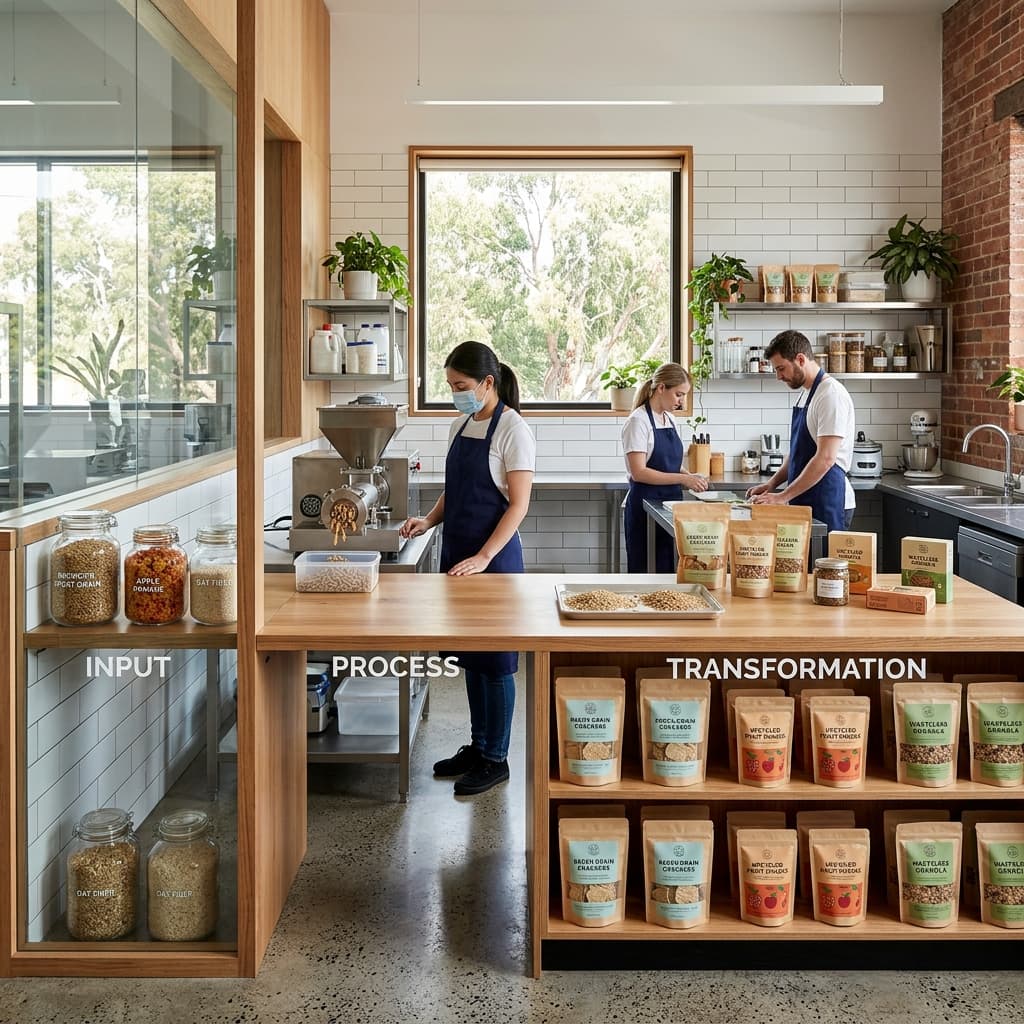
Food waste is no longer just an environmental issue—it is a direct assault on a manufacturer's bottom line. In an era where input costs for raw ingredients, freight, and energy are at record highs, paying to send usable biomaterial to a landfill is a luxury the Australian food industry can no longer afford.
Australia has committed to the National Food Waste Strategy, which aims to halve food waste by 2030. For food manufacturers, this isn't just about compliance or ESG reporting; it's about unlocking hidden revenue streams through the principles of the circular economy and upcycling.
The True Cost of Factory Floor Waste
When you throw away a byproduct, you aren't just losing the cost of the raw material. You are losing the embedded costs of the freight to get it to your factory, the labour used to process it, the energy used to chill or heat it, and finally, the waste disposal fees to take it away.
Statistic: According to the Food and Agribusiness Growth Centre (FIAL), food waste costs the Australian economy around $36.6 billion annually, with a significant portion occurring in the manufacturing and processing stages.
To combat this, manufacturers must shift their mindset: there is no such thing as waste, only resources without a current market.
What is Upcycling?
Upcycling goes beyond basic recycling or animal feed diversion. It involves taking ingredients that would otherwise slip through the cracks of the food system and transforming them into high-quality, value-added products for human consumption.
The upcycled food movement is gaining serious traction with consumers who are actively seeking out sustainable brands. The Upcycled Food Association reports that products bearing an upcycled certification see significant sales bumps, as consumers are willing to pay a premium for environmental stewardship.
Practical Upcycling Strategies in Action
Australian manufacturers are already proving that circular economy principles work at scale. Here are key pathways:
1. Brewer's Spent Grain (BSG)
Breweries produce massive amounts of spent grain. While traditionally sold cheaply as cattle feed, innovative companies are now drying and milling BSG into high-protein, high-fibre baking flours and snack bases. This transforms a low-value byproduct into a premium functional ingredient.
2. Fruit and Vegetable Pomace
Juice manufacturers are left with tonnes of pulp and skins (pomace). This material is rich in dietary fibre and antioxidants. Manufacturers are now extruding this pomace into healthy snacks, blending it into functional powders for smoothies, or extracting natural colourants and flavourings.
3. 'Ugly' Produce and Off-Cuts
Fresh produce processors dealing with strict retailer specifications for 'perfect' veg end up with significant off-cuts. These are increasingly being purposed into soups, sauces, and frozen ready-meals where the visual appearance of the raw ingredient doesn't matter, completely recovering the cost of the produce.
The Operational Challenge: Tracking and Segregation
The barrier to upcycling isn't usually a lack of ideas; it's operational control.
To sell a byproduct for human consumption, it must be treated with the exact same food safety, allergen control, and traceability standards as your primary product. You cannot upcycle sweepings off the floor.
This requires:
- Strict Segregation: Byproducts must be cleanly separated at the point of processing.
- Batch Traceability: The byproduct must carry the batch data of the original raw material so it can be traced forward.
- Yield Tracking: You need to know exactly what percentage of your input is becoming 'Product A' vs 'Product B' to accurately calculate your margins.
Digitising the Circular Economy
You can't optimize what you can't see. Relying on paper records and spreadsheets to track complex, multi-product yield splits is a recipe for chaos.
To successfully implement a circular manufacturing model, you need a digital backbone. Systems like Batchbase allow manufacturers to track raw materials as they split into multiple output streams. It ensures that the costs are allocated correctly across both the primary product and the upcycled product, giving you true visibility into the profitability of your waste-reduction efforts.
Stop throwing your margins in the bin. Learn how Batchbase helps you track yields, manage specs, and optimize your entire production process.