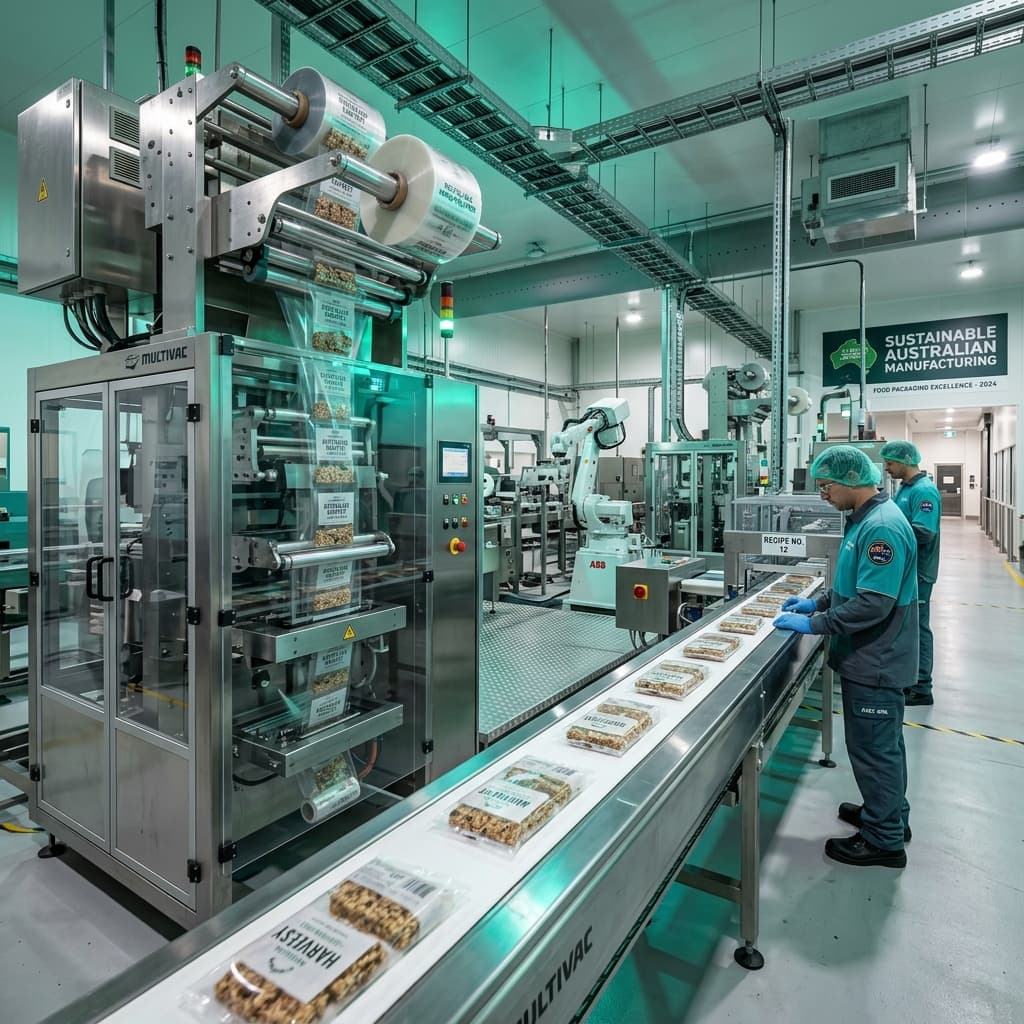
The Australian food packaging landscape is experiencing its most rapid transformation in decades. Following the high-profile suspension of the REDcycle soft plastics collection scheme and subsequent government inquiries, federal and state environment ministers alongside the Australian Packaging Covenant Organisation (APCO) have accelerated strict national sustainable packaging targets for 2025 and 2026.
For Australian food and beverage manufacturers, sustainable packaging is no longer a peripheral corporate social responsibility (CSR) goal. It is an urgent operational engineering mandate.
With over 3.5 million tonnes of packaging placed on the Australian market annually, food processing plants face stringent requirements: transitioning to 100% recyclable, reusable, or compostable packaging, eliminating unnecessary single-use plastics, and achieving a target average of 50% recycled content across all packaging formats.
However, for food manufacturers handling perishables—such as fresh meats, smallgoods, block cheeses, coffee, and ready-to-eat (RTE) meals—transitioning away from traditional high-barrier flexible packaging presents major technical hurdles.
The Technical Dilemma: Mono-Polymers vs. Traditional Multi-Layer Laminates
For decades, the standard choice for gas-flush and vacuum-sealed food packaging was multi-layer laminate films (such as PET/PE/EVOH or OPA/PE). These engineered multi-material structures provided exceptional performance:
- Oxygen Transmission Rate (OTR): Near-zero permeability, preventing lipid oxidation and spoilage.
- Moisture Vapor Transmission Rate (MVTR): Superior barrier against dehydration and weight loss.
- Thermal Sealing Window: Broad sealing temperature ranges allowing high-speed form-fill-seal (FFS) packaging line operations.
Unfortunately, because multi-layer laminates fuse chemically dissimilar polymers together, they cannot be processed through standard mechanical recycling infrastructure in Australia. They end up in landfill.
To meet APCO 2026 compliance mandates, food packaging engineers are transitioning to mono-polymer flexible films (typically Mono-Polyethylene [Mono-PE] or Mono-Polypropylene [Mono-PP]).
Operational Performance Comparison: Packaging Barrier Films
| Film Property / Parameter | Traditional Multi-Layer (PET/PE/EVOH) | APCO-Compliant Mono-PE Barrier Film | APCO-Compliant Mono-PP Barrier Film | Plant Operational Impact |
|---|---|---|---|---|
| Recyclability Status (Kerbside/Soft) | Non-Recyclable (Landfill Stream) | Fully Recyclable (APCO Stream) | Fully Recyclable (APCO Stream) | Achieves 100% APCO 2026 Mandate |
| Sealing Temperature Window | Wide Window (120°C – 180°C) | Narrow Window (115°C – 130°C) | Moderate Window (135°C – 155°C) | Requires precise line temperature control |
| Packaging Line Speed (PPM) | High Speed Baseline (100%) | Reduced Speed (80% – 90%) | Near Baseline (90% – 95%) | Risk of throughput reduction |
| Oxygen Barrier (OTR) | < 0.5 cm³/m²/24hr | 1.0 – 3.5 cm³/m²/24hr (with MDO-PE) | 1.5 – 5.0 cm³/m²/24hr (with SiOx) | Shelf-life validation required |
| Film Material Cost (Per KG) | Baseline ($) | +18% to +30% Premium | +12% to +22% Premium | Impacts finished SKU BOM cost |
4 Factory-Floor Operational Challenges in the Mono-Film Transition
While switching to recyclable flexible films solves regulatory compliance, quality control teams must navigate significant line-level disruptions:
1. Thermal Burn-Through and Narrow Sealing Windows
Traditional PET/PE laminates have an outer PET layer with a high melting point (260°C) and an inner PE sealant layer with a lower melting point (120°C). This allowed packaging operators to apply intense heat to seal bags rapidly without melting the exterior of the film.
Mono-PE structures, by contrast, consist of polyethylene throughout. Applying excessive heat melts the outer film structure, causing film burn-through, jaw sticking, and compromised seal integrity. Factory Solution: Food plants must retrofit packaging machinery with pulse-sealing jaws, digital temperature controllers, and precision dwell-time sensors.
2. Micro-Leakage and MAP (Modified Atmosphere Packaging) Loss
Gas-flushed food items (such as shredded cheese or fresh pasta) rely on modified atmosphere packaging (N₂ and CO₂ gas blends) to inhibit mold growth. Mono-polymer films tend to exhibit higher film stretch and memory during vacuum drawing, increasing the incidence of micro-pinholes along seal gussets.
A 1% increase in micro-leakers on the packaging line can lead to thousands of dollars in retailer return credits and premature product spoilage.
3. Verification of Recycled Content & APCO ARL Labelling
Under APCO guidelines, food brands utilizing the Australasian Recycling Label (ARL) must substantiate all recyclability claims using the PREP (Packaging Recyclability Evaluation Portal) tool.
If your packaging includes Post-Consumer Recycled (PCR) resin content, food safety teams must obtain verifiable Certificate of Analysis (CoA) documentation proving that PCR materials meet FSANZ Food Contact Guidelines and do not migrate harmful contaminants into food.
4. Updating Recipe & Packaging Bill of Materials (BOM) Costs
Mono-polymer barrier films currently command a 15% to 30% price premium over legacy multi-layer films. If cost accounting teams fail to update packaging BOM costs dynamically, food processors absorb hidden margin erosion on every unit shipped.
Using central costing platforms like Batchbase Recipe Costing Software, production teams instantly adjust packaging film rates across all SKUs, keeping live gross margins accurate.
Step-by-Step Implementation Roadmap for 2026 APCO Compliance
To achieve full packaging compliance without sacrificing factory efficiency or shelf-life, production directors should execute the following 4-phase roadmap:
Phase 1: Conduct a Facility Packaging Audit
Map every packaging SKU across primary, secondary, and tertiary formats. Identify non-recyclable multi-layer laminates, PVC stretch wraps, and carbon-black plastic trays that fail APCO recyclability thresholds.
Phase 2: Perform Accelerated Shelf-Life Testing (ASLT)
Trial Mono-PE and Mono-PP barrier films on critical SKUs. Conduct organoleptic, moisture, and microbial testing under accelerated temperature and humidity storage conditions to confirm shelf-life equivalence.
Phase 3: Calibrate Packaging Line Machinery
Work with equipment OEMs to recalibrate form-fill-seal (FFS) machines, flow-wrappers, and tray-sealers. Audit sealing jaw pressure, temperature accuracy, and cooling dwell times to prevent line slowdowns.
Phase 4: Digitise Specification Management & ARL Documentation
Store supplier technical spec sheets, PREP evaluation scores, and food-contact compliance certificates in a single digital repository. Explore how centralized spec management simplifies audit readiness in our guide to Central Spec Sheet Hub Features.
Conclusion: Turning Sustainable Packaging into a Competitive Asset
The transition to recyclable barrier films mandated by APCO is one of the most significant operational shifts facing Australian food manufacturers in 2026. While material cost increases and line calibration challenges are real, progressive food brands are leveraging packaging compliance to secure shelf space with major supermarket chains and appeal to environmentally conscious consumers.
By digitizing packaging spec sheets, monitoring live BOM costs, and systematically validating film performance, Australian food plants can meet national sustainability targets while defending profitability.
Ready to digitize your factory's spec sheet management and packaging cost tracking? Book a live Batchbase demo today.