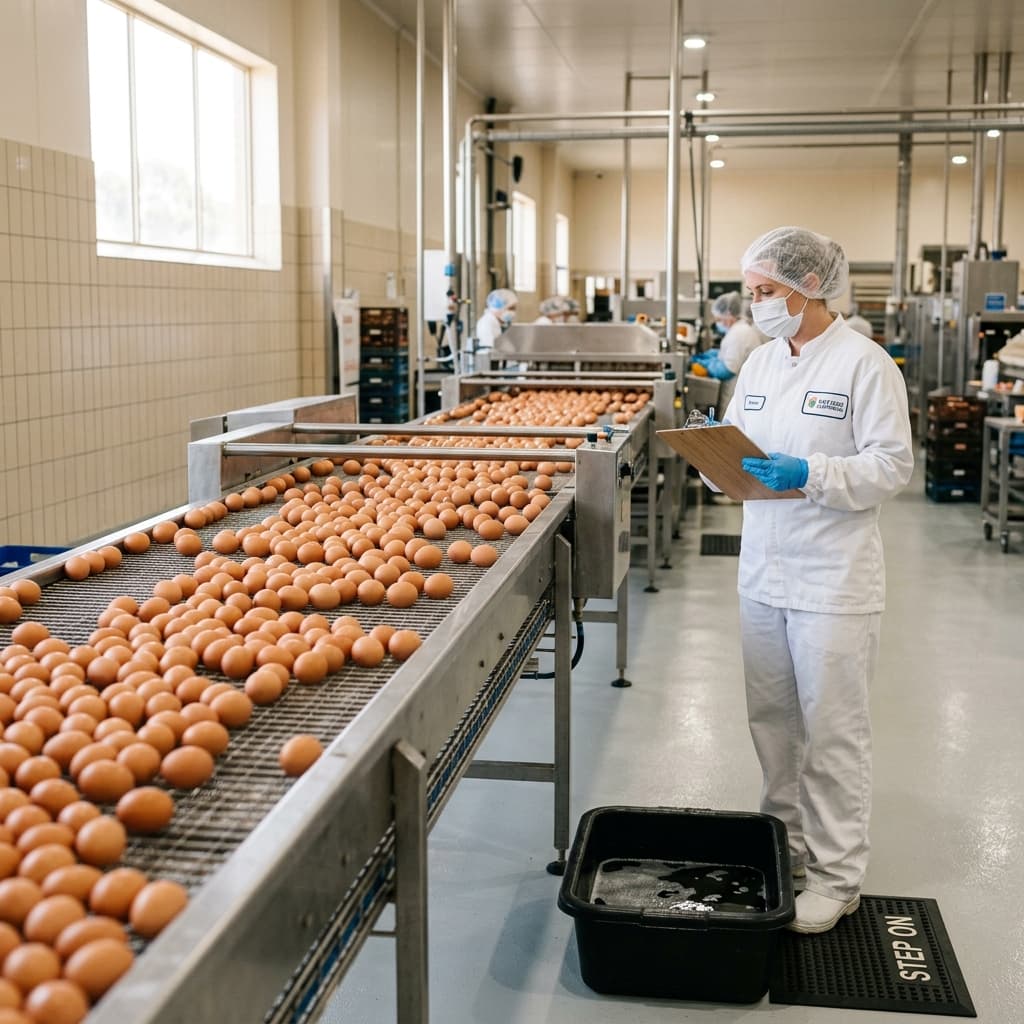
Eggs are one of the most quietly essential ingredients in Australian food manufacturing. They bind, aerate, emulsify, glaze and enrich everything from sponge cakes and pasta to mayonnaise, ready meals and confectionery. Most manufacturers don't think twice about them – until they can't get them.
In 2024, Australia got a sharp preview of that scenario. Outbreaks of H7 high-pathogenicity avian influenza (HPAI) across Victoria, New South Wales and the ACT led to the destruction of more than 1.5 million birds, triggered purchase limits on eggs at major supermarkets and sent wholesale prices sharply higher. Now, with the far more widespread H5N1 strain having circled the globe and continuing to threaten Australian wildlife and poultry, governments and industry are treating egg supply as a live biosecurity risk.
This article explains the current threat, what an H5N1 incursion would mean for ingredient supply, and how manufacturers can build resilience before the next shock.
Understanding the Threat: H7 vs H5N1
| H7 HPAI (2024 outbreaks) | H5N1 clade 2.3.4.4b | |
|---|---|---|
| Origin in Australia | Endemic low-path strains that mutated in local poultry | Spread globally via migratory wild birds |
| Geographic reach | Localised to specific farms and regions | Present on every continent except Oceania's mainland poultry (as of latest reporting) |
| Species affected | Primarily poultry | Poultry, wild birds, marine mammals, dairy cattle (US) |
| Containment | Eradicated through stamping out | Extremely difficult to contain once established in wildlife |
| Supply impact | Regional egg shortages, months-long recovery | Potential for repeated, multi-state disruption |
Australia's commercial flocks remain free of H5N1 at the time of writing, but the government considers an incursion a matter of when, not if. The Australian Government has committed over $100 million to H5 bird flu preparedness, including enhanced wildlife surveillance, diagnostic capacity at CSIRO's Australian Centre for Disease Preparedness, and industry response planning. Up-to-date situation reports are published at birdflu.agriculture.gov.au and outbreak.gov.au.
Lessons from Overseas
The United States offers a sobering case study. Since 2022, H5N1 has affected well over 150 million US birds, and in early 2025 the average retail price of a dozen Grade A eggs reached a record of more than US$6 – roughly triple pre-outbreak levels. Food manufacturers there faced:
- Allocation, not just price rises – suppliers prioritised long-term contract customers.
- Liquid and powdered egg shortages – breaker-stock plants were hit as hard as shell egg producers.
- Forced reformulation – bakeries and sauce makers rushed to trial egg replacers, often with labelling consequences.
- Long recovery tails – restocking a layer farm takes many months as replacement pullets must reach laying maturity.
How an Outbreak Disrupts Your Supply Chain
When HPAI is confirmed on an Australian commercial property, the response under AUSVETPLAN typically includes:
- Stamping out – humane destruction of all birds on infected premises.
- Restricted and control areas – movement controls on birds, eggs, equipment and vehicles within a radius of the infected farm.
- Decontamination – thorough cleaning before restocking is approved.
- Proof of freedom – surveillance before zones are lifted.
For manufacturers, this means supply can vanish overnight from a key region – and even unaffected farms within a control area may struggle to move product.
| Egg format | Typical use | Vulnerability in an outbreak |
|---|---|---|
| Shell eggs | Bakeries, food service, small-batch production | High – direct exposure to farm losses and movement controls |
| Liquid whole egg / yolk / albumen | Industrial bakery, sauces, ready meals | High – limited number of breaker plants; concentrated supply |
| Powdered egg | Dry mixes, confectionery, long-life products | Medium – some stock buffer, but imports may face restrictions |
| Egg replacers (plant-based) | Vegan lines, emergency substitution | Low – but performance and labelling trade-offs |
Building an Egg-Supply Resilience Plan
1. Map your exposure
Start by understanding exactly how dependent your range is on eggs:
- Which SKUs contain egg, and at what inclusion rate?
- What proportion of revenue do those SKUs represent?
- Which suppliers – and which farms and regions behind them – provide your egg?
- How many days of stock do you hold?
Many manufacturers are surprised to discover that egg appears as a minor ingredient in dozens of products via compound ingredients such as glazes, mayonnaise bases or pasta.
2. Diversify suppliers geographically
If all of your liquid egg comes from a single breaker plant fed by farms in one region, a single outbreak can halt supply. Qualify at least one alternative supplier from a different state, and audit tier-1 and tier-2 suppliers on their biosecurity practices.
3. Pre-qualify substitutions before a crisis
The worst time to develop a reformulation is in the middle of a shortage. Pre-trial alternative formats (e.g. powdered instead of liquid) and, where appropriate, partial egg replacers such as aquafaba, pulse proteins, modified starches or enzyme systems.
Document the impact of each substitution on:
| Consideration | Why it matters |
|---|---|
| Allergen declaration | Removing egg changes PEAL statements; adding pulse proteins may introduce new allergens (e.g. lupin, soy). |
| Nutrition Information Panel | Protein, fat and energy values will shift. |
| Health Star Rating | May move up or down depending on the replacement. |
| Ingredient list & claims | "Free range" or "made with real eggs" claims may need removal. |
| Cost per unit | Replacers can be cheaper or significantly more expensive. |
| Shelf life & quality | Texture, colour, rise and stability must be validated. |
4. Model the cost shock
Run scenarios: what happens to your margin if egg costs rise 25%, 50% or 100% for six months? Which SKUs become unprofitable? Where should you seek price relief from retailers – and what evidence will you need under the tougher negotiation environment of the mandatory Food and Grocery Code?
5. Agree contingencies with customers
Talk to key retail and food service customers now about how substitutions would be approved and communicated. Pre-agreed variation processes are far smoother than emergency phone calls.
Biosecurity Inside Your Own Plant
Although HPAI is primarily an on-farm risk, manufacturers that receive shell eggs or poultry products should review their own controls:
- Ensure suppliers comply with the national Egg Standards of Australia and state biosecurity requirements.
- Handle egg trays and outer packaging as potential contamination vectors; avoid returning used trays to farms.
- Maintain robust traceability so you can identify affected lots quickly if a supplier is placed in a control zone.
The Commercial Case for Acting Now
Resilience planning can feel like an insurance premium with no obvious return – until the moment it pays out. The 2024 H7 outbreaks offer a useful benchmark. Manufacturers with a single egg supplier in an affected region faced immediate allocation cuts, while those with qualified alternatives in other states were largely able to keep producing, albeit at higher cost.
There is also a negotiating dimension. Under the mandatory Food and Grocery Code, cost-price increase requests must be handled in good faith, but retailers will still expect clear evidence. A manufacturer that can show, SKU by SKU, exactly how much egg each product contains, how input prices have moved and what the resulting cost change is will secure relief faster than one relying on broad estimates.
Finally, the work you do to map egg exposure pays dividends well beyond bird flu. The same ingredient-dependency analysis can be applied to cocoa, dairy, wheat, canola oil or any other commodity exposed to climate, disease or geopolitical shocks.
Scenario Planning: A Simple Framework
| Scenario | Trigger | Duration | Recommended response |
|---|---|---|---|
| Watch | Detection in wild birds or overseas escalation | Ongoing | Review exposure, confirm supplier biosecurity, check stock levels. |
| Alert | Commercial outbreak in another state | Weeks | Activate alternative suppliers, increase safety stock of powdered egg, brief customers. |
| Disruption | Outbreak affecting your primary supply region | 3–9 months | Implement pre-validated substitutions, prioritise high-margin SKUs, seek cost relief. |
| Recovery | Zones lifted, restocking underway | 6–12 months | Gradually return to standard formulations, update labels, review lessons learned. |
Deciding in advance which SKUs to prioritise during a shortage – typically those with the highest margin, the strongest contractual commitments or no viable substitute – prevents rushed decisions when supply is tight.
Frequently Asked Questions
Can people catch bird flu from eating eggs? Properly cooked eggs and pasteurised egg products are considered safe. The primary risk is to birds and those working closely with infected animals.
Is H5N1 in Australia? Australia's commercial poultry remained free of H5N1 at the time of writing, but authorities are on high alert. Check birdflu.agriculture.gov.au for the latest status.
What should I do first? Map which of your products contain egg, and identify your single points of failure in supply.
The Bottom Line
The 2024 H7 outbreaks showed how quickly egg supply can tighten in Australia. An H5N1 incursion could be larger, longer and repeated. Manufacturers who know their exposure, have alternative suppliers lined up and have pre-validated substitutions will keep producing while competitors scramble.
Batchbase lets you instantly see every product that contains egg – including through compound ingredients – model the cost impact of supply shocks, and test reformulations with allergen statements, NIPs and spec sheets updating automatically. Book a demo to build your resilience plan.
References
- Department of Agriculture, Fisheries and Forestry – H5 bird flu preparedness
- Outbreak – Avian influenza in Australia
- Animal Health Australia – AUSVETPLAN
- Australian Eggs – Industry information
- USDA – Confirmations of HPAI in commercial and backyard flocks