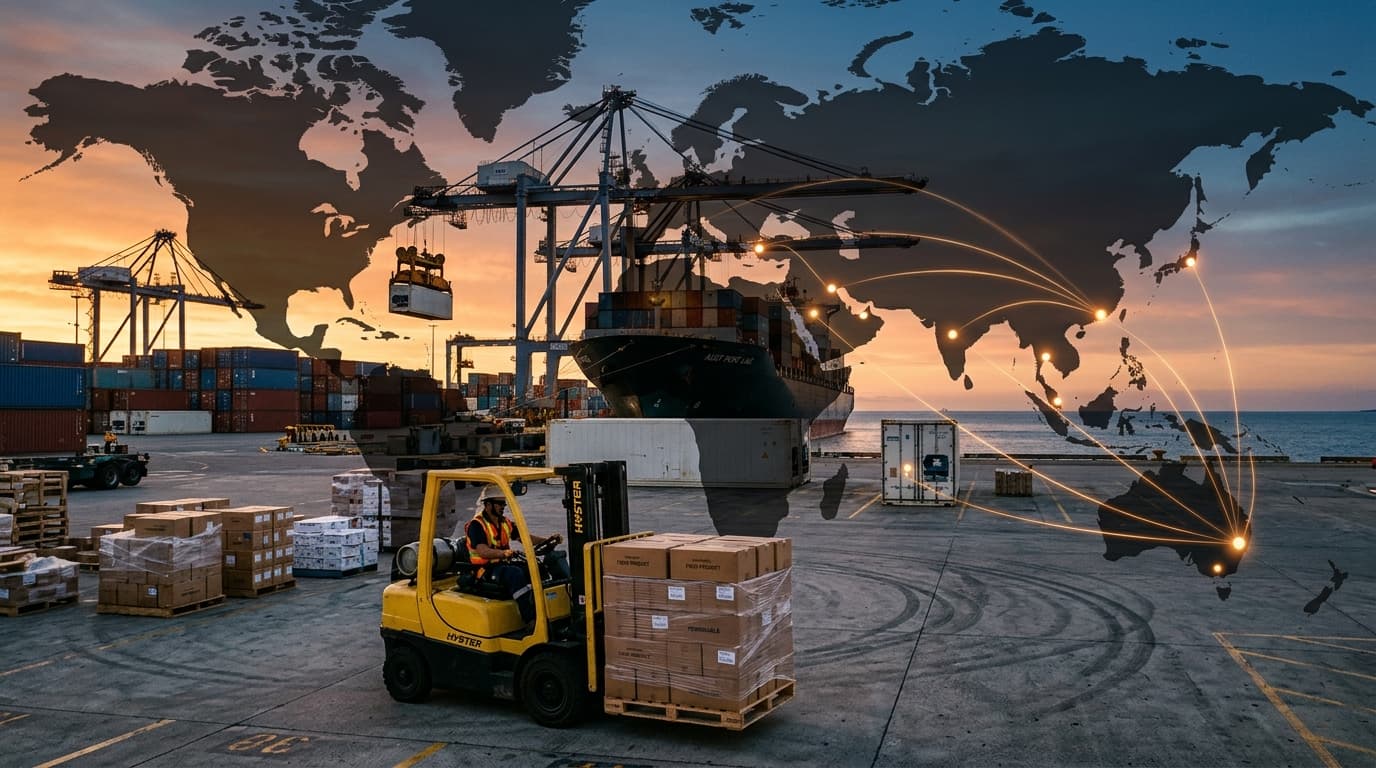
Australian agriculture and food exports are on track for another record year. ABARES has forecast agricultural, fisheries and forestry exports of around $84 billion for 2025–26. Yet behind the headline, many exporters are more nervous than the numbers suggest.
The reason is concentration. China still takes roughly a fifth to a quarter of Australia's agricultural exports, and the United States has become the second-largest market, driven by record demand for Australian beef. Both relationships have shown, in recent years, how quickly tariffs, trade disputes or policy shifts can redraw the map. The 2020–23 Chinese duties on barley and wine wiped out entire export channels almost overnight. US tariff policy since 2025 has created repeated bouts of uncertainty for exporters of beef, sheepmeat and processed foods.
At the same time, new trade agreements have opened doors that didn't exist five years ago. This article sets out where Australian food exports go today, which markets are opening up, and a practical playbook for manufacturers who want to spread their risk.
Where Australian Agricultural Exports Go Today
| Market | Approx. share of agricultural exports | Key food categories | Risk profile |
|---|---|---|---|
| China | ~22–24% | Beef, barley, wine, dairy, seafood | High value, but history of politically driven trade barriers |
| United States | ~12% | Lean beef, lamb, wine, specialty foods | Strong demand, but tariff and safeguard policy uncertainty |
| Japan | ~7% | Premium beef, dairy, horticulture | Stable, quality-driven, demanding specifications |
| South Korea, Indonesia, Vietnam | Combined ~15% | Grains, beef, live cattle, dairy | Growing, increasingly competitive |
| Middle East and India | Smaller but growing | Sheepmeat, beef, pulses, dairy, wine, nuts | New FTAs reduce tariffs; halal and certification requirements |
Shares are indicative and vary by year. See ABARES Agricultural Commodities and DFAT trade statistics for current figures.
For processed and packaged food manufacturers, concentration can be even sharper than these national figures suggest. A brand that built its export business around one distributor in one market has, in effect, a single point of failure.
The US Tariff Picture: Volatile but Not Closed
US tariff policy since 2025 has been the single biggest source of uncertainty for Australian exporters. Australian beef has remained competitive, helped by US cattle herds sitting at multi-decade lows and strong demand for lean manufacturing beef. Other categories, including some sheepmeat and processed products, have faced more friction.
For food manufacturers, the lesson isn't to abandon the US. It is a large, high-value market. The lesson is that no single market should be able to make or break your export business, and that pricing, contracts and product specifications need to be flexible enough to switch volume between markets when conditions change.
The New Doors: Trade Agreements Worth Knowing
| Agreement | Status | Headline benefit for food exporters |
|---|---|---|
| Australia–UAE Comprehensive Economic Partnership Agreement (CEPA) | In force from 1 October 2025 | Tariffs eliminated on over 99% of Australian goods exports, including red meat, with reduced tariffs on wine. The UAE is also a re-export hub for the wider Gulf region. |
| Australia–India Economic Cooperation and Trade Agreement (ECTA) | In force since December 2022, with a broader CECA under negotiation | Tariff cuts across many agricultural goods, including sheepmeat, wool, some horticulture and wine (phased) |
| Regional Comprehensive Economic Partnership (RCEP) | In force since 2022 | Harmonised rules of origin across 15 Asia-Pacific economies, simplifying multi-market supply chains |
| Australia–UK FTA | In force since 2023 | Phased elimination of tariffs on beef, sheepmeat, dairy and sugar |
| CPTPP | In force (expanded membership) | Improved access to Canada, Mexico, Peru and others, plus Japan and Vietnam |
Many exporters still don't claim the preferences they are entitled to. Using an FTA requires the right certificate or declaration of origin, and the product must meet the agreement's rules of origin. For processed foods with imported ingredients, this means knowing exactly where every input comes from and how much value is added in Australia.
The Diversification Playbook
1. Measure your concentration risk
Start with a simple question: what share of export revenue comes from your top market, your top customer and your top product? If any one of those exceeds 40% to 50%, a single tariff change, delisting or currency move could materially hurt the business.
2. Shortlist markets by fit, not just size
Assess candidate markets on tariff access under existing FTAs, demand for your category, cultural and dietary fit (including halal), cold chain and logistics, and how hard it is to meet local labelling and import rules. Austrade's market profiles are a good starting point.
3. Check import requirements early
The Department of Agriculture's Manual of Importing Country Requirements (MICoR) sets out the certificates, permits and conditions for each market and commodity. Some requirements, such as establishment registration, halal certification for Gulf markets or specific additive limits, can take months to satisfy.
4. Build export-ready specifications
Each market has its own labelling language, additive approvals, nutrition panel format and allergen rules. A product that is fully compliant in Australia may need reformulation or relabelling. Maintaining a single source of truth for recipes and specifications makes it far easier to create market-specific versions without errors.
5. Get rules of origin right
To claim FTA preferences, you need to show that your product qualifies, which usually depends on where ingredients come from and how they are transformed. Accurate ingredient sourcing data is essential. This links closely with the traceability requirements we covered in our article on US FSMA 204 and EU export traceability.
6. Protect your provenance premium
"Australian made" is a genuine price premium in many Asian and Middle Eastern markets, but it also attracts counterfeiting and substitution. Digital traceability and batch-level records support your provenance claims. See protecting Australian food provenance for export.
7. Use government support
The Export Market Development Grants (EMDG) program reimburses part of eligible export promotion costs. Austrade's in-market teams and state trade offices can also help with introductions, market research and trade missions.
Comparing Three Growth Markets
| Factor | UAE and Gulf | India | Southeast Asia (e.g. Vietnam, Indonesia) |
|---|---|---|---|
| Tariff access | Excellent under CEPA | Improving under ECTA, still high on some foods | Good under RCEP and ASEAN agreements |
| Consumer profile | High-income, large expat population, premium retail and food service | Fast-growing middle class, price-sensitive, strong vegetarian segment | Large, young, urbanising populations |
| Key requirements | Halal certification, Arabic labelling | FSSAI registration, specific labelling and additive rules | Halal (Indonesia, Malaysia), local registration |
| Best-fit categories | Red meat, dairy, premium packaged foods, wine (hospitality) | Pulses, nuts, horticulture, dairy ingredients, wine | Dairy, beef, bakery, snacks, health foods |
Pricing, Currency and Payment Risk
Diversifying markets also diversifies your financial risk, but only if you manage it deliberately. New markets bring new currencies, new payment customs and new counterparties.
- Currency exposure. Many Gulf currencies are pegged to the US dollar, so UAE sales behave much like USD sales from a currency perspective. Indian rupee and Southeast Asian currencies move independently. Consider whether to price in AUD, USD or local currency, and talk to your bank about hedging larger contracts.
- Payment terms. Letters of credit, documentary collections or export credit insurance can protect you when dealing with a new distributor. Export Finance Australia offers finance and guarantees for exporters who can't get support from commercial lenders.
- Landed cost. Tariffs are only one part of the price a buyer sees. Freight, cold chain, import duties, local taxes, distributor margins and retailer margins can multiply your ex-factory price several times. Build a full landed cost model for each market before quoting.
Common Export Diversification Mistakes
| Mistake | What happens | Better approach |
|---|---|---|
| Chasing too many markets at once | Resources spread thin, no market reaches scale | Enter one or two new markets properly, then expand |
| Assuming Australian labels will do | Shipments held at the border or rejected | Confirm labelling, additive and registration rules before production |
| Not claiming FTA preferences | Paying tariffs you don't need to pay, making you less competitive | Check rules of origin and obtain the correct certificate or declaration |
| Relying on a single distributor | Swapping market concentration for partner concentration | Build relationships with more than one channel over time |
| Underestimating cash flow | Long shipping times and payment terms strain working capital | Model cash conversion cycles and use trade finance where needed |
Frequently Asked Questions
Do I need a separate product for each export market?
Not always, but you often need market-specific labels, and sometimes reformulation to meet additive, nutrition or allergen rules. Plan for variants from the start.
How do I claim a tariff preference under an FTA?
You generally need a certificate of origin or an origin declaration showing your product meets the agreement's rules of origin. DFAT's FTA Portal explains the requirements for each agreement.
Is the US still worth pursuing?
Yes, for many categories. It remains a large, high-value market. The aim of diversification is to reduce dependency, not to exit good markets.
Where should a small manufacturer start?
Pick one new market with good tariff access and a clear fit for your product, then use Austrade and EMDG support to test it before scaling.
The Bottom Line
Record export numbers can hide fragile foundations. Trade policy will keep shifting, and the manufacturers who weather it best will be those with a spread of markets, export-ready specifications and the data to prove origin and compliance quickly. New agreements with the UAE and India, alongside RCEP and CPTPP, give Australian food manufacturers more options than ever.
Batchbase keeps your recipes, specifications, ingredient origins and compliance data in one place, so you can create market-specific product versions, support rules-of-origin claims and respond to new export opportunities faster. Book a demo to see how it works.
References
- ABARES – Agricultural Commodities and Outlook
- Department of Foreign Affairs and Trade – Australia's free trade agreements
- Department of Foreign Affairs and Trade – Australia–India ECTA
- Department of Agriculture, Fisheries and Forestry – Manual of Importing Country Requirements (MICoR)
- Austrade – Export Market Development Grants
- Austrade – Export market profiles and support
- Export Finance Australia – Finance and insurance for exporters