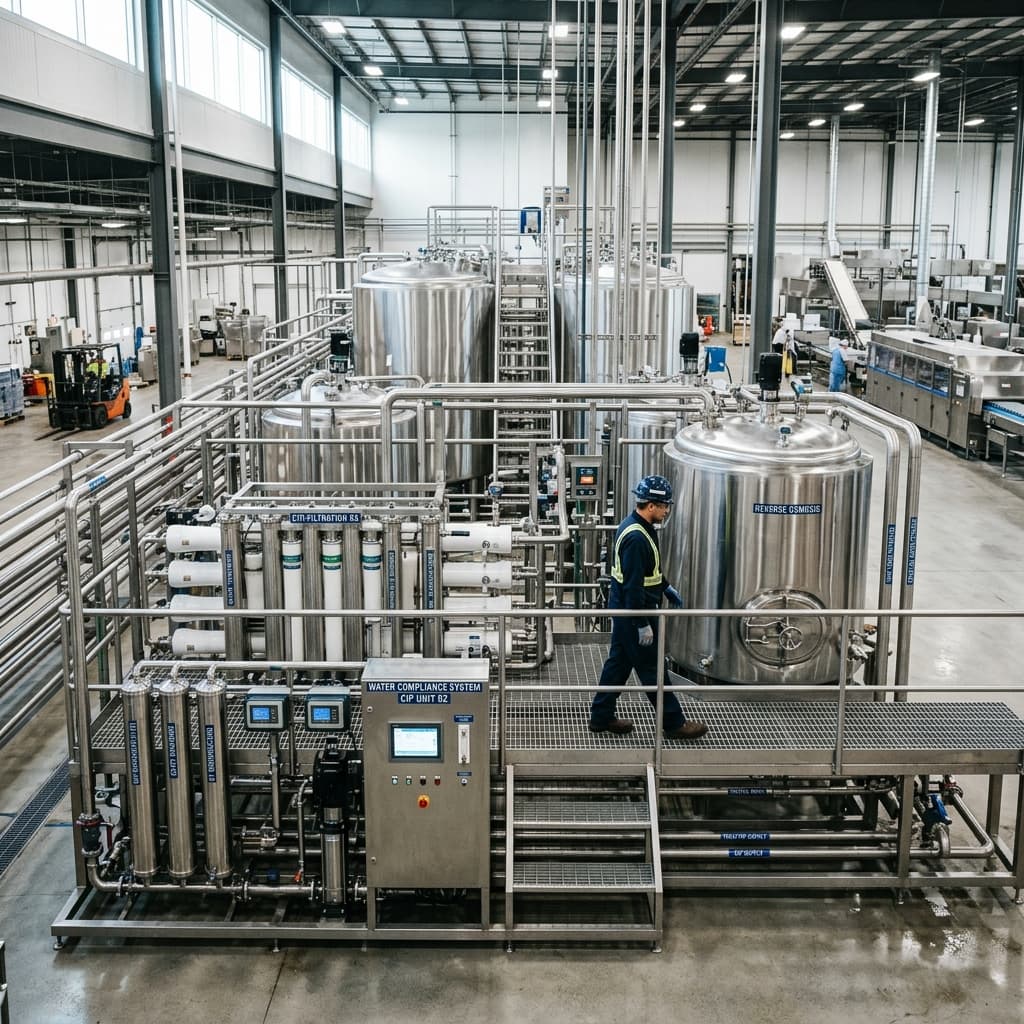
Water is a fundamental utility in food and beverage manufacturing. From raw ingredient washing and thermal jacket heating to rigorous multi-stage Clean-In-Place (CIP) equipment sanitation, Australian food processors consume over 25% of all commercial industrial water across metropolitan water catchments.
However, the major cost of water in food processing is rarely the incoming supply rate—it is the trade waste discharge surcharge.
Water utilities such as Sydney Water, Yarra Valley Water, SA Water, and Urban Utilities (Queensland) enforce strict volumetric and mass-pollutant pricing models. Food processing plants that discharge wastewater exceeding baseline thresholds for BOD (Biochemical Oxygen Demand), TSS (Total Suspended Solids), and FOG (Fats, Oils, and Grease) incur severe financial penalties that can add $150,000 to $600,000+ annually to operational overheads.
Understanding Trade Waste Discharge Parameters
Trade waste is defined as any liquid discharge generated by business or industrial activities, excluding domestic sewage. In food plants, trade waste originates from vessel washdowns, floor cleaning, product spills, sauce kettle rinsing, and blanching water.
Key Trade Waste Compliance Parameters:
- Biochemical Oxygen Demand (BOD5): BOD measures the amount of dissolved oxygen consumed by microorganisms to break down organic matter in wastewater over a 5-day period. High-sugar, high-starch, or high-protein washdowns (e.g., ice cream mix, fruit juices, dairy whey) have extreme BOD values (often 5,000 to 30,000 mg/L, compared to domestic sewage baseline of 300 mg/L).
- Total Suspended Solids (TSS): TSS represents insoluble organic and inorganic particles trapped in wastewater—such as vegetable peelings, meat trim scraps, flour dust, and batter residues. High TSS clogs municipal sewer trunks and incurs heavy mass-load charges.
- Fats, Oils, and Grease (FOG): FOG includes animal fats, vegetable oils, and butter fats. FOG solidifies inside sewer pipes, creating "fatbergs" and causing back-ups. Water authorities enforce strict upper limits (typically < 100 mg/L); exceeding this limit can lead to immediate trade waste agreement suspension.
Comparison Table: Trade Waste Tariff Impact & Pre-Treatment Payback
| Effluent Parameter | Standard City Baseline Limit | Typical Food Plant Untreated Effluent | Excess Surcharge Penalty Rate (Approx.) | Mitigation Technology Solution | Typical Payback Period |
|---|---|---|---|---|---|
| BOD (Biochemical Oxygen Demand) | < 600 mg/L | 3,500 – 15,000 mg/L | $1.80 – $3.40 / kg excess BOD | Dissolved Air Flotation (DAF) + Anaerobic Digestion | 14 – 24 Months |
| TSS (Total Suspended Solids) | < 500 mg/L | 1,200 – 4,500 mg/L | $1.20 – $2.10 / kg excess TSS | Rotary Drum Screen + Hydrosieve Filters | 6 – 12 Months |
| FOG (Fats, Oils & Grease) | < 100 mg/L | 400 – 2,500 mg/L | $2.50 – $4.80 / kg excess FOG | Grease Traps + Skimmer Tanks + DAF Coagulants | 10 – 18 Months |
| pH Range | 7.0 – 9.0 | 3.5 – 11.5 (CIP Acid/Caustic) | Hourly Violation Fines ($500/hr) | Automated pH Dosing Equalization Pit | 8 – 14 Months |
Operational Strategies to Reduce Trade Waste Surcharges
To eliminate unnecessary trade waste penalties and lower overall water bills, plant management should implement a three-tiered reduction strategy:
Tier 1: Source Separation & Dry Cleaning (Immediate ROI)
The most cost-effective way to manage trade waste is to prevent organic solids from entering floor drains in the first place:
- Dry Scrape Protocols: Enforce mandatory dry scraping of mixing vats, sauce kettles, and dough troughs before water washdown commences. Recovered product can often be diverted to organic animal feed or upcycled into secondary lines—see our guide to Upcycling and Circular Economy Revenue.
- Drain Basket Screens: Install high-mesh stainless steel drain baskets across all trench drains to catch physical particulates before they reach the main effluent pit.
Tier 2: Clean-In-Place (CIP) Optimization
Sanitation is vital for food safety, but unoptimized CIP cycles waste millions of liters of potable water and discharge thousands of kilograms of caustic soda (NaOH) and nitric acid into trade waste streams.
- Final Rinse Reuse: Capture the final, relatively clean rinse water from a CIP cycle and store it in a dedicated re-use tank to serve as the pre-rinse water for the next cleaning cycle.
- Conductivity-Based Chemical Dosing: Replace timer-based CIP chemical dosing with inline conductivity sensors. This ensures caustic and acid solutions are only added when necessary, preventing chemical over-dosing that skews trade waste pH levels.
Tier 3: Onsite Effluent Pre-Treatment Systems
For medium to large food factories, installing onsite pre-treatment equipment transforms high-tariff industrial effluent into low-impact wastewater:
- Dissolved Air Flotation (DAF): DAF systems introduce micro-air bubbles into wastewater, floating emulsified fats, oils, and suspended solids to the surface for automated skimming. DAF systems routinely remove 80% to 95% of FOG and TSS, reducing BOD load by up to 60%.
- pH Equalization Pits: Mixing acidic washdowns with alkaline CIP rinses in a continuous agitated equalization pit neutralizes pH automatically prior to discharge, eliminating pH violation fines.
Linking CIP Water Management to Production Planning
A common operational flaw in food plants is treating CIP water usage as a fixed overhead rather than a variable batch cost.
When production managers optimize batch scheduling—grouping similar product formulations together—they drastically reduce the total number of full CIP washdowns required per week.
Using central scheduling tools like Batchbase, plant teams align production runs to minimize changeovers, protecting both profit margins and environmental compliance.
Conclusion: Turning Trade Waste Compliance into Bottom-Line Savings
As Australian municipal water authorities raise trade waste tariffs to cover urban infrastructure upgrades, food manufacturers can no longer treat wastewater as an unmanageable expense.
By combining source separation, CIP rinse re-use, automated pH neutralization, and optimized production scheduling, mid-tier food plants can reduce trade waste fees by 30% to 65%, directly boosting plant operating margins.
Want to learn how Batchbase optimizes batch scheduling and spec compliance? Request a personalized demo today.