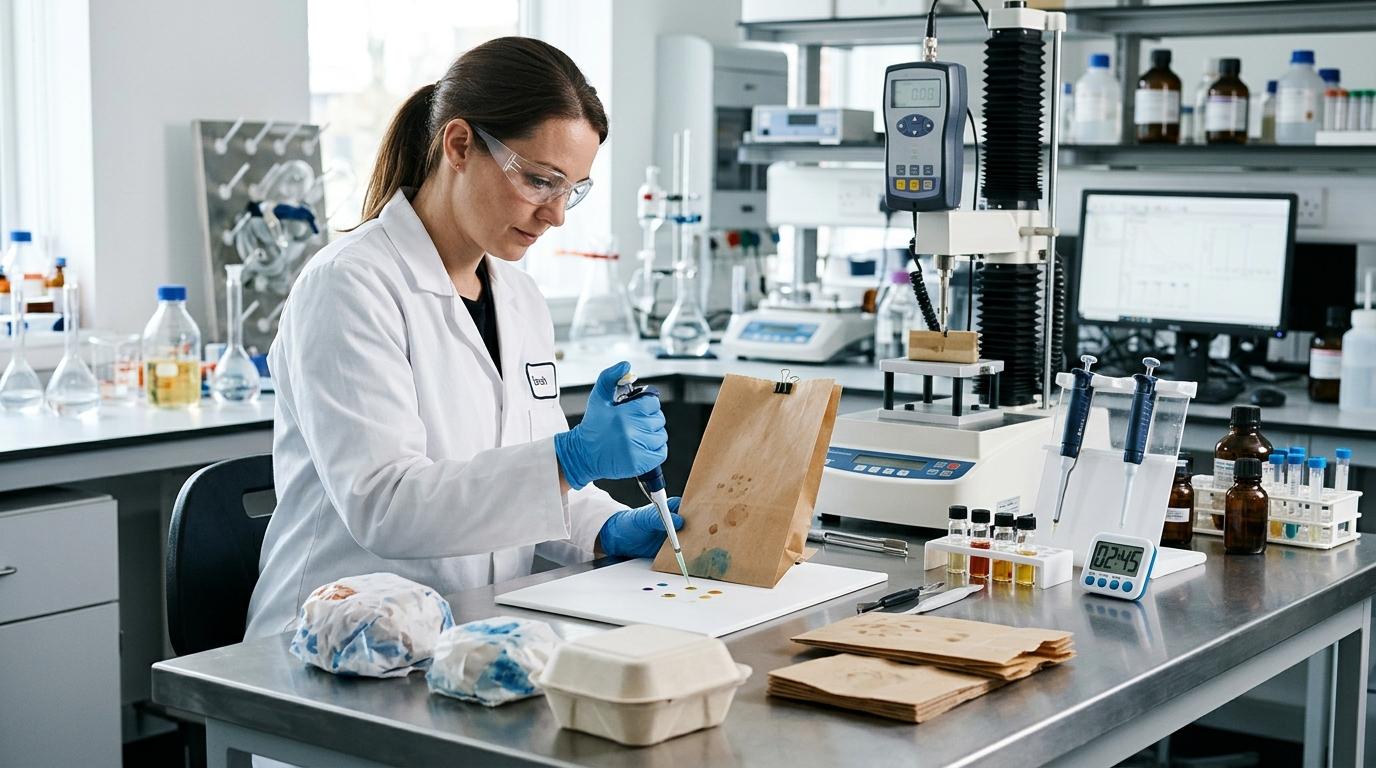
Per- and polyfluoroalkyl substances, better known as PFAS or "forever chemicals", have quietly protected food for decades. They make bakery bags grease-proof, stop burger wrappers going soggy and keep moulded fibre containers from leaking. In 2026, they have become one of the fastest-moving compliance issues in food packaging.
On 12 August 2026, the European Union's Packaging and Packaging Waste Regulation (PPWR) began restricting PFAS in food-contact packaging placed on the EU market. Australia has taken a different route, but domestic chemical controls are tightening, the Australian Packaging Covenant Organisation (APCO) is driving an industry phase-out, and export customers are already asking questions.
This guide explains what PFAS are, where they hide in food packaging, the current rules in Australia and key export markets, and a practical plan for food manufacturers.
What Are PFAS and Why Are They Used?
PFAS are a family of thousands of synthetic chemicals characterised by extremely strong carbon–fluorine bonds. That strength makes them resistant to heat, water, oil and degradation, which is exactly why they work so well in packaging and why they persist in the environment and the human body.
In food packaging, PFAS are most commonly found in:
- Grease-resistant paper and board, such as bakery bags, sandwich wraps and pastry boxes
- Moulded fibre containers, bowls and clamshells marketed as plastic-free
- Microwave popcorn bags
- Pizza box liners and baking papers
- Some coatings, inks and processing aids
The irony is significant. Many fibre-based packaging formats adopted to replace plastic rely on PFAS to perform, which means a sustainability upgrade can introduce a chemical compliance risk.
Why Regulators Are Acting
Health agencies worldwide have linked certain PFAS to adverse health outcomes. In 2023, the International Agency for Research on Cancer classified PFOA as carcinogenic to humans and PFOS as possibly carcinogenic. The European Food Safety Authority has set a tolerable weekly intake for the sum of four key PFAS of just 4.4 nanograms per kilogram of body weight.
Australia's Food Standards Australia New Zealand (FSANZ) has set tolerable daily intakes for PFOS and PFOA and monitors PFAS in the food supply. Its surveys have generally found PFAS levels in the Australian food supply to be low, but packaging is an area of growing scrutiny worldwide.
The EU Rule: What Changed on 12 August 2026
Under Article 5 of the PPWR, food-contact packaging cannot be placed on the EU market if it contains PFAS above the following limits:
| Measure | Limit |
|---|---|
| Any single targeted PFAS (measured by targeted analysis) | 25 µg/kg (ppb) |
| Sum of targeted PFAS | 250 µg/kg (ppb) |
| Total PFAS, including polymeric PFAS | 50 mg/kg (ppm) |
These thresholds effectively prohibit intentionally added PFAS in food packaging. Any Australian manufacturer exporting packaged food to the EU must ensure its packaging complies, regardless of where the packaging was made.
Other Export Markets Are Moving Too
| Market | Status |
|---|---|
| European Union | PPWR restriction applies from 12 August 2026 |
| Denmark | National ban on PFAS in paper and board food packaging since 2020 |
| United States | Major manufacturers voluntarily phased out PFAS grease-proofing agents by 2024 following FDA engagement; many states (including California, New York and Washington) have enacted bans |
| Canada | Moving towards restricting PFAS as a class |
For exporters, the direction of travel is clear. PFAS-free packaging is becoming a market access requirement.
The Australian Position
Australia does not yet have a single PPWR-style ban on PFAS in food packaging, but several mechanisms are converging.
- IChEMS scheduling. Under the Industrial Chemicals Environmental Management Standard, PFOS, PFOA and PFHxS were listed for the highest level of restriction, with prohibitions on their import, manufacture and use taking effect from 1 July 2025.
- AICIS evaluations. The Australian Industrial Chemicals Introduction Scheme has been evaluating large groups of PFAS, including those used in food-contact applications.
- APCO phase-out. APCO has worked with industry on phasing out PFAS in fibre-based food-contact packaging, aligned with the National Packaging Targets.
- Consumer law. Claims such as "chemical-free", "non-toxic" or "compostable" can breach the Australian Consumer Law if PFAS are present and the claim is misleading.
There is also a compostability issue. PFAS-treated fibre packaging is generally unsuitable for organics recycling because PFAS persist in compost, which undermines compostable claims and conflicts with Food Organics and Garden Organics (FOGO) programs.
Where Is Your Risk?
| Packaging type | PFAS risk | Questions to ask suppliers |
|---|---|---|
| Plain kraft or white paper bags | Low to medium | Is any grease-resistant treatment applied? |
| Greaseproof bakery papers | Medium to high | What delivers the grease resistance? |
| Moulded fibre bowls and clamshells | High | Is the oil barrier fluorine-based? |
| Plastic films and trays | Low | Were fluorinated processing aids used? |
| Glass and metal | Very low | Check coatings and closures |
The highest-risk products are typically fibre-based items that need to resist oil or moisture, especially those introduced to replace plastic.
A Practical PFAS Action Plan
1. Build a Packaging Inventory
List every food-contact packaging component by SKU, including wraps, liners, trays, labels in direct contact and closures. Record the supplier, material and function.
2. Request Supplier Declarations
Ask each supplier for a written declaration confirming whether PFAS are intentionally added, supported by test data where available. Declarations should cover both the base material and any coatings or treatments.
3. Test Where Risk Is High
Total fluorine screening is a cost-effective first test. Where results indicate potential PFAS, targeted analysis by an accredited laboratory can confirm specific compounds. Export customers may specify which method they require.
4. Qualify Alternatives
PFAS-free barrier technologies are now widely available:
- Water-based dispersion coatings
- Bio-based barriers, such as those derived from starch, chitosan or plant waxes
- Densified or glassine papers with natural grease resistance
- Mineral-based coatings
Each must be validated for grease resistance, shelf life, heat performance, recyclability and food-contact suitability for your product.
5. Update Specifications and Records
Packaging specifications should explicitly state PFAS-free requirements and test methods. Keep declarations and test reports attached to each packaging item so you can answer customer and auditor questions quickly.
6. Review Your Claims
Check that sustainability claims on pack remain accurate after any material change. If packaging is marketed as compostable, ensure it is certified to the relevant Australian standard (AS 4736 or AS 5810).
What It Costs
PFAS-free alternatives can cost more per unit, particularly for moulded fibre, though prices have fallen as volumes have grown. The larger cost is often the validation work: shelf-life trials, artwork changes and specification updates. Planning the transition alongside scheduled packaging reviews spreads that cost.
A Worked Example: A Bakery Supplier Exporting to Europe
Consider a mid-sized Australian bakery that supplies frozen pastries to a European importer. Its range uses three food-contact packaging components: a greaseproof interleaving sheet, a printed paperboard carton and a plastic inner bag.
| Component | Initial finding | Action taken |
|---|---|---|
| Greaseproof interleaving sheet | Supplier could not confirm PFAS status; total fluorine screen indicated presence | Switched to a glassine paper with natural grease resistance |
| Printed paperboard carton | Supplier declaration confirmed no intentionally added PFAS | Declaration filed against the specification |
| Plastic inner bag | Low risk; supplier confirmed no fluorinated processing aids | Declaration filed |
The switch required a six-week shelf-life trial to confirm the glassine sheet prevented sticking after freezing and thawing. Unit cost rose by a fraction of a cent, but the business retained its European listing and gained a PFAS-free claim it could share with other customers.
The lesson is that most of the effort sits in gathering evidence and validating one or two high-risk components, not in redesigning the entire pack.
Frequently Asked Questions
Do Australian food manufacturers have to stop using PFAS packaging today? There is currently no blanket Australian ban on all PFAS in food packaging, but the three most studied PFAS are prohibited under IChEMS, and export markets such as the EU now restrict PFAS in food-contact packaging. Retailer and customer requirements are also tightening.
Is compostable packaging automatically PFAS-free? No. Some moulded fibre products marketed as compostable have historically relied on fluorinated barriers. Ask for evidence and check certification to AS 4736 or AS 5810.
How much does PFAS testing cost? Total fluorine screening is relatively inexpensive per sample, while targeted analysis of individual PFAS compounds costs more. Focusing testing on high-risk components keeps costs manageable.
Who is responsible if packaging contains PFAS? The business placing the packaged food on the market carries the compliance risk in most export jurisdictions, even if the packaging was supplied by a third party. That is why supplier declarations and test evidence matter.
The Bottom Line
PFAS in packaging has moved from a niche chemical issue to a mainstream compliance and market access question. The EU rule is already in force, export customers are asking for declarations, and Australian controls are tightening. Food manufacturers who know what is in their packaging, hold supplier evidence and qualify alternatives now will be ready when domestic rules or retailer requirements catch up.
References
- European Union – Regulation (EU) 2025/40 on Packaging and Packaging Waste
- FSANZ – PFAS and food
- DCCEEW – Industrial Chemicals Environmental Management Standard (IChEMS)
- AICIS – Australian Industrial Chemicals Introduction Scheme
- APCO – Australian Packaging Covenant Organisation
- EFSA – PFAS in food: scientific opinion