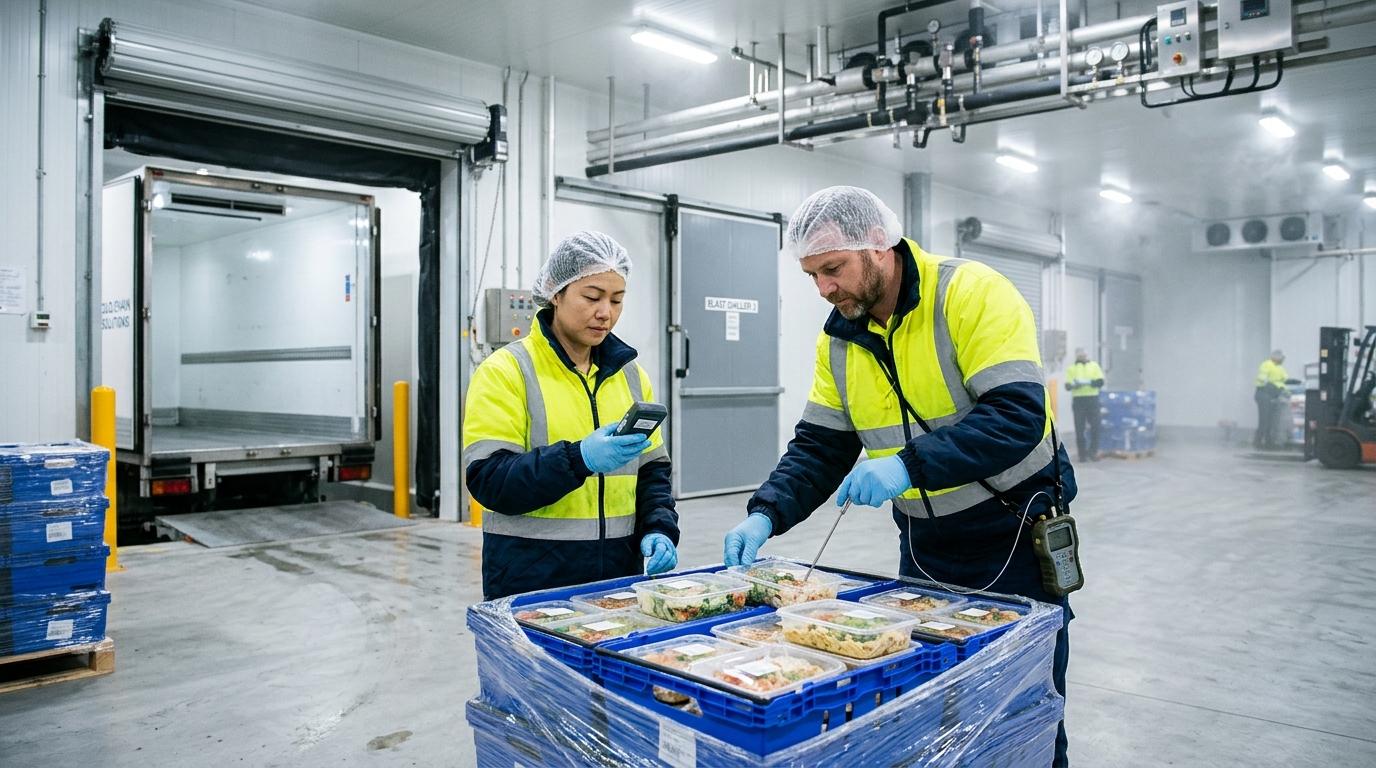
In Australian food manufacturing, summer is the ultimate stress test for two critical systems that rarely get discussed in the same meeting: your plant refrigeration hardware and your outbound cold-chain compliance.
When ambient temperatures across Western Sydney, northern Victoria, South Australia or Queensland climb past 38°C to 42°C, industrial condensers work at maximum head pressure, loading-dock doors open into blasts of hot air, and chilled transport trailers fight to hold temperature across long interstate highways. At the receiving end, supermarket distribution centres (DCs) stand ready with calibrated core-temperature probes: if a pallet of chilled dairy, meat, ready meals or fresh produce arrives above the 5.0°C statutory limit (or tighter 4.0°C retailer specs), the entire load can be rejected on the dock.
In 2026 and 2027, that annual summer pressure is colliding with a structural regulatory shift: Australia's mandatory Hydrofluorocarbon (HFC) Refrigerant Phase-Down administered by the Department of Climate Change, Energy, the Environment and Water (DCCEEW). As Australia's HFC import quota steps down sharply toward an 85% reduction by 2036, legacy synthetic refrigerants like R404A and R134a are becoming scarce and expensive to top up—forcing food processors to plan capital transitions toward natural refrigerants while keeping FSANZ Standard 3.2.2 cold-chain compliance bulletproof.
This guide covers what the HFC phase-down means for food-plant chillers and freezers, the exact FSANZ and supermarket temperature rules for blast chilling, storage and dispatch, and a practical playbook to eliminate summer temperature excursions and rejected loads.
Part 1: Australia's HFC Refrigerant Phase-Down and Your Plant's Cooling Assets
Under the Ozone Protection and Synthetic Greenhouse Gas Management Act 1989, Australia committed under the Kigali Amendment to the Montreal Protocol to phase down the import of bulk Hydrofluorocarbons (HFCs)—synthetic refrigerants with high Global Warming Potentials (GWPs) measured in carbon dioxide equivalents ($CO_2$-e).
Unlike older ozone-depleting CFCs and HCFCs (such as R22, which is already phased out), HFCs do not deplete the ozone layer, but a single kilogram of leaked R404A has the same greenhouse warming impact as 3,922 kilograms of carbon dioxide.
How Australia's HFC Import Quota Step-Down Squeezes Legacy Systems
DCCEEW reduces the total national HFC import quota (measured in metric tonnes of $CO_2$-e) in legislated two-year steps from a baseline of 8.0 Megatonnes (Mt) $CO_2$-e in 2018–2019 down to 1.2 Mt $CO_2$-e (an 85% reduction) from 1 January 2036.
Because the quota is denominated in GWP-weighted tonnes ($CO_2$-e) rather than physical kilograms of gas, importers use up almost three times as much quota importing 1 kg of high-GWP R404A (GWP 3,922) as they do importing 1 kg of mid-GWP R448A/R449A (GWP ~1,387)—and virtually zero quota for natural refrigerants like Ammonia ($NH_3$, GWP 0) or Carbon Dioxide ($CO_2$, GWP 1).
| Refrigerant Type | Common Code | Global Warming Potential (GWP 100-yr) | Current Status in Australian Food Manufacturing Plants | Strategic Recommendation for 2026–2030 |
|---|---|---|---|---|
| High-GWP Legacy HFC | R404A / R507A | 3,922 – 3,985 | Still found in many older coolrooms, blast freezers and transport units installed pre-2018 | High Financial & Supply Risk: Leak top-ups are increasingly costly; prioritise retrofit to lower-GWP HFO blends or replacement with natural refrigerants |
| Medium-High GWP HFC | R134a / R410A | 1,430 – 2,088 | Medium-temperature chillers, glycol systems, commercial heat pumps and air conditioning | Monitor leak rates strictly; transition new capex to natural or ultra-low-GWP alternatives |
| Interim HFO / HFC Drop-In Blends | R448A / R449A / R452A | 1,387 – 2,140 | Used as transitional retrofits in existing R404A direct-expansion (DX) compressors and valves | Useful 5–7 year bridge to extend life of sound piping/compressors while cutting GWP by ~65% |
| Natural: Transcritical / Subcritical $CO_2$ | R744 ($CO_2$) | 1 | Rapidly becoming the Australian standard for mid-sized food plants, supermarkets and blast chillers | Future-Proof Capex: Exempt from HFC quota cuts; pairs exceptionally well with process hot-water heat recovery |
| Natural: Industrial Ammonia | R717 ($NH_3$) | 0 | Long-standing gold standard for large meat, dairy, beverage and cold-storage plants (including low-charge $NH_3$/glycol or $NH_3/CO_2$ cascade systems) | Highest Thermodynamic Efficiency: Zero GWP; low-charge packaged ammonia-glycol systems now make it viable for mid-tier sites |
| Natural: Hydrocarbons | R290 (Propane) | 3 | Self-contained plug-in cabinets and smaller packaged chillers (charge-limited due to A3 flammability) | Excellent for small modular or secondary glycol chillers with outdoor machine placement |
The Double Hit of a Refrigerant Leak: Replacement Gas Cost + Scope 1 Emissions
Many food manufacturers don't realise that fugitive refrigerant leaks are Scope 1 greenhouse gas emissions—on the exact same accounting footing as burning natural gas in your boiler or diesel in your trucks.
Consider a mid-sized chilled and frozen food facility whose ageing R404A system holds a 250 kg refrigerant charge and suffers a 15% annual leak rate (37.5 kg/year) through vibrating flare joints and shaft seals:
- Direct Gas & Callout Cost: Replacing 37.5 kg of high-GWP R404A plus emergency technician callouts during a January heatwave can easily cost $7,500 to $12,000+—before counting production downtime.
- Hidden Scope 1 Carbon Impact: $37.5\text{ kg} \times 3,922\text{ GWP} = 147,075\text{ kg } CO_2\text{-e}$ (147.1 tonnes of Scope 1 $CO_2$-e). That single 37.5 kg gas leak creates roughly the same carbon footprint as burning 2,850 GJ of natural gas!
- Under mandatory AASB S2 climate reporting and supermarket emissions disclosures, eliminating high-GWP refrigerant leaks is one of the fastest ways a food plant can slash its Scope 1 footprint.
Part 2: FSANZ Standard 3.2.2 Temperature Rules Every Plant Must Enforce
Whether your coolrooms run on legacy HFCs or brand-new transcritical $CO_2$, your legal food-safety obligations are governed by FSANZ Standard 3.2.2 (Food Safety Practices and General Requirements) and your state food authority licence.
1. The 5°C Rule and the Temperature Danger Zone (5°C to 60°C)
Under Standard 3.2.2, potentially hazardous food (any food that must be kept at certain temperatures to minimise the growth of pathogenic microorganisms or toxin formation—including meat, poultry, dairy, seafood, cooked rice/pasta, cut fruit/salads and prepared ready meals) must be stored, displayed and transported at:
- 5°C or colder (for chilled foods), or
- 60°C or hotter (for hot-held foods), or
- Frozen hard (typically -18°C or colder under industry and retail standards).
2. The "2-Hour / 4-Hour" Cooling Rule for Cooked Batches
One of the most frequently audited Critical Control Points (CCPs) in Australian food plants that cook sauces, soups, sous-vide meats, fillings or ready meals is the post-cook blast-chilling curve. Under Clause 7(3) of FSANZ Standard 3.2.2, when cooling cooked potentially hazardous food, the internal core temperature must be cooled:
- From 60°C down to 21°C within 2 hours, AND
- From 21°C down to 5°C (or colder) within a further 4 hours (a total maximum cooling window of 6 hours from 60°C to 5°C).
Why is the first stage (60°C to 21°C in 2 hours) so strict? Because spore-forming bacteria such as Clostridium perfringens and Bacillus cereus—whose heat-resistant spores survive cooking—germinate and multiply rapidly between 52°C and 20°C. If a deep 200-litre tub of hot sauce or cooked mince is wheeled directly into a standard static holding coolroom instead of a high-velocity blast chiller, the centre of the tub can stay above 25°C for 10 to 14 hours—turning the batch into a microbial hazard and warming up every other pallet in the coolroom.
3. The 2-Hour / 4-Hour Ambient Exposure Rule During Processing & Packing
When chilled ingredients are brought out of the coolroom onto the processing or assembly floor:
- Total time between 5°C and 60°C under 2 hours: Food may be returned to refrigeration at $le 5^\circ\text{C}$ for later use.
- Total time between 2 and 4 hours: Food must be used or cooked immediately and cannot be returned to chill storage.
- Total time exceeding 4 hours: Food must be disposed of (scrapped).
Note: For ready-to-eat foods distributed to supermarkets, your HACCP plan and retailer WQA/CSR addendums typically require processing rooms to be refrigerated (e.g., $le 10^\circ\text{C}$ to $12^\circ\text{C}$) and product core temperatures to remain $le 5^\circ\text{C}$ throughout packing.
Why Summer Loads Get Rejected at Supermarket Distribution Centres
Every summer, Australian food manufacturers lose tens of thousands of dollars to DC temperature rejections. Even when the product left the factory coolroom at 3.2°C, three common failure modes push the load over 5.0°C by the time it reaches the supermarket receiving dock:
| Summer Failure Mode | What Actually Happened | How to Prevent It |
|---|---|---|
| 1. "Hot-Loading" Un-Equilibrated Pallets | Product was packed at 6.5°C, palletised and wrapped in 6 layers of stretch film, and loaded straight onto a refrigerated truck. Refrigerated transport trailers are designed to hold temperature, not pull down warm core temperatures through tight stretch-wrap. | Enforce a mandatory Pre-Dispatch Core Temperature CCP ($le 3.5^\circ\text{C}$ to $4.0^\circ\text{C}$) in your dispatch checklist before a pallet can be released to the loading dock. |
| 2. Un-Pre-Cooled Trailer & Dock Staging | Pallets sat on an unrefrigerated 32°C loading apron for 25 minutes while waiting for a 3PL truck whose box body was still at 18°C when the doors opened. | Require 3PL trailers to pre-cool to $le 2^\circ\text{C}$ (chilled) or $le -18^\circ\text{C}$ (frozen) before backing onto the dock seal, and log trailer air temp prior to loading. |
| 3. Blocked Evaporator Airflow & Short-Cycling | Pallets were stacked above the trailer's red load-line or pushed tight against the rear doors with no return-air floor pallet gap, starving the back pallets of cold air while the front pallets froze. | Train forklift drivers on air-chute clearances, use calibrated real-time BLE/cellular data loggers in the rear-top pallet, and verify door curtain seals. |
A 6-Step Cold-Chain & Refrigeration Resilience Plan for Food Plants
1. Build a Refrigerant Asset Register and Calculate Leak Rates
List every chiller, freezer, blast cell and glycol plant on site, recording the refrigerant type (e.g., R404A, R134a, $CO_2$, $NH_3$), total charge weight in kg, equipment age, and every top-up recorded on your ARCtick technician service invoices over the past 24 months. Any system leaking more than 5% of its charge annually should be scheduled for leak repair or retrofit.
2. Perform Pre-Summer Condenser & Door-Seal Maintenance (Every September/October)
Dirty condenser coils, failing condenser fan motors, and perished coolroom door gaskets can cut cooling capacity by 15% to 25%—a deficit that goes unnoticed in winter and causes compressor high-pressure trips on the first 38°C day in November. Include Variable Speed Drives (VSDs), demand-based defrost cycles and refrigeration heat-recovery exchangers in your upgrade scope.
3. Digitise Your 2-Hour / 4-Hour Blast-Chilling CCP Logs
Replace paper clipboards hanging outside the blast chiller with digital batch CCP logs in Batchbase:
- When a cooked batch finishes thermal processing, the operator logs the Start Cooling Time and Core Temp ($ge 60^\circ\text{C}$).
- The system enforces the 2-hour checkpoint ($le 21^\circ\text{C}$) and the 6-hour final checkpoint ($le 5^\circ\text{C}$) directly against that batch number.
- If a batch breaches the cooling curve, the system automatically triggers a corrective-action hold before the batch can be moved to packing.
4. Enforce a Pre-Dispatch Core Temperature Gate
Never release a chilled or frozen shipment without recording:
- Product Core Temperature (using a calibrated probe inserted between packs or into a dummy thermal pack, not an infrared surface gun which only reads cardboard skin temperature)
- Pre-cooled Trailer Air Temperature
- Data Logger Serial Number placed in the tail pallet
5. Use Continuous IoT Temperature Loggers to Defend Unfair Rejections
Sometimes a supermarket DC probe reads 5.8°C on the outer carton of a pallet that sat on the retailer's receiving dock for 40 minutes before being checked. Having a calibrated continuous USB or cellular data logger inside the pallet—showing an unbroken 2.8°C to 3.6°C trace from your factory dispatch right up to the moment the truck doors opened at the DC—gives you objective evidence to contest an unfair rejection and save a $25,000 load.
6. Plan Future Refrigeration Capex Around Natural Refrigerants & Grants
When replacing end-of-life R404A or R134a systems, specify transcritical $CO_2$ or low-charge ammonia-glycol systems and check eligibility for federal and state energy efficiency grants and Victorian/NSW Energy Upgrades certificates.
Frequently Asked Questions
Is it illegal to keep running an existing R404A refrigeration system in Australia? No. Australia's HFC phase-down restricts the bulk import quota of new high-GWP HFCs rather than banning existing operating equipment overnight. However, as the import quota steps down toward an 85% reduction by 2036, virgin R404A becomes increasingly scarce and expensive, making leaks and major compressor failures costly to service without retrofitting.
Why do infrared (IR) laser thermometers cause false cold-chain alarms? An infrared surface thermometer measures the radiant temperature of the outer cardboard carton or plastic film, which warms up within seconds of exposure to humid ambient dock air even while the food inside is at 2.8°C. FSANZ and supermarket QA standards require calibrated contact or insertion probes (measured between two packs or inside a designated simulant pack) for official acceptance decisions.
Can we freeze a chilled product to extend its life if a customer order is delayed? Only if your validated shelf-life and labelling protocol explicitly permits freezing and thawing (or sale as frozen) and the date mark, storage instructions and thawing traceability comply with FSANZ Standard 1.2.5 and your customer's specification.
The Bottom Line
Cold-chain integrity is where engineering reliability meets food-safety compliance. Australian food manufacturers who proactively transition off high-GWP HFC refrigerants, digitise their 2-hour/4-hour blast-chilling CCPs, and enforce strict pre-dispatch core temperature checks will lower both their power bills and their Scope 1 emissions—while ensuring every pallet arrives at the supermarket dock cold, compliant and accepted first time.
References
- DCCEEW – HFC Phase-Down in Australia & Import Quota Schedule
- Australian Refrigeration Council (ARCtick) – Refrigerant Handling Licences & Compliance
- FSANZ – Standard 3.2.2 Temperature Control & the 2-Hour / 4-Hour Rule
- Australian Food Cold Chain Council (AFCCC) – Cold Chain Best Practice Guidelines
- AIRAH (Australian Institute of Refrigeration, Air Conditioning and Heating) – Natural Refrigerants & Flammable Refrigerant Safety Guides