Ask any emerging or mid-tier Australian chilled food manufacturer what nearly derailed their first national supermarket listing, and the answer is rarely taste or branding. It is the 75% to 80% Minimum Life on Receipt (MLOR) rule at the retailer's distribution centre.
Under the commercial supply terms enforced by Woolworths, Coles, ALDI and major Australian foodservice distributors, a chilled or ambient product delivered into a regional Distribution Centre (DC) must typically arrive with at least 75% to 80% of its total stated shelf life remaining.
Do the maths on a chilled dip, fresh pasta, ready meal, deli meat or bakery item that currently carries a 14-day total Use-By shelf life:
- 80% remaining shelf life required at the DC gate means the pallet must be received into the supermarket DC within 2.8 days (67 hours) of manufacture.
- If your production batch requires 48 hours for pathogen or micro release testing, plus 24 to 36 hours for consolidator freight from Melbourne to Brisbane or Sydney to Perth, your product is already out of specification before the truck reaches the DC gate—forcing you either to produce micro-batches five days a week or to walk away from interstate ranging.
Conversely, if you scientifically validate and extend that product's shelf life from 14 days to 28 or 35 days, your delivery window opens up from 2.8 days to 5.6 to 7 days. Suddenly, you can run longer, more profitable production batches, hold buffer stock, and ship interstate on consolidated linehaul freight.
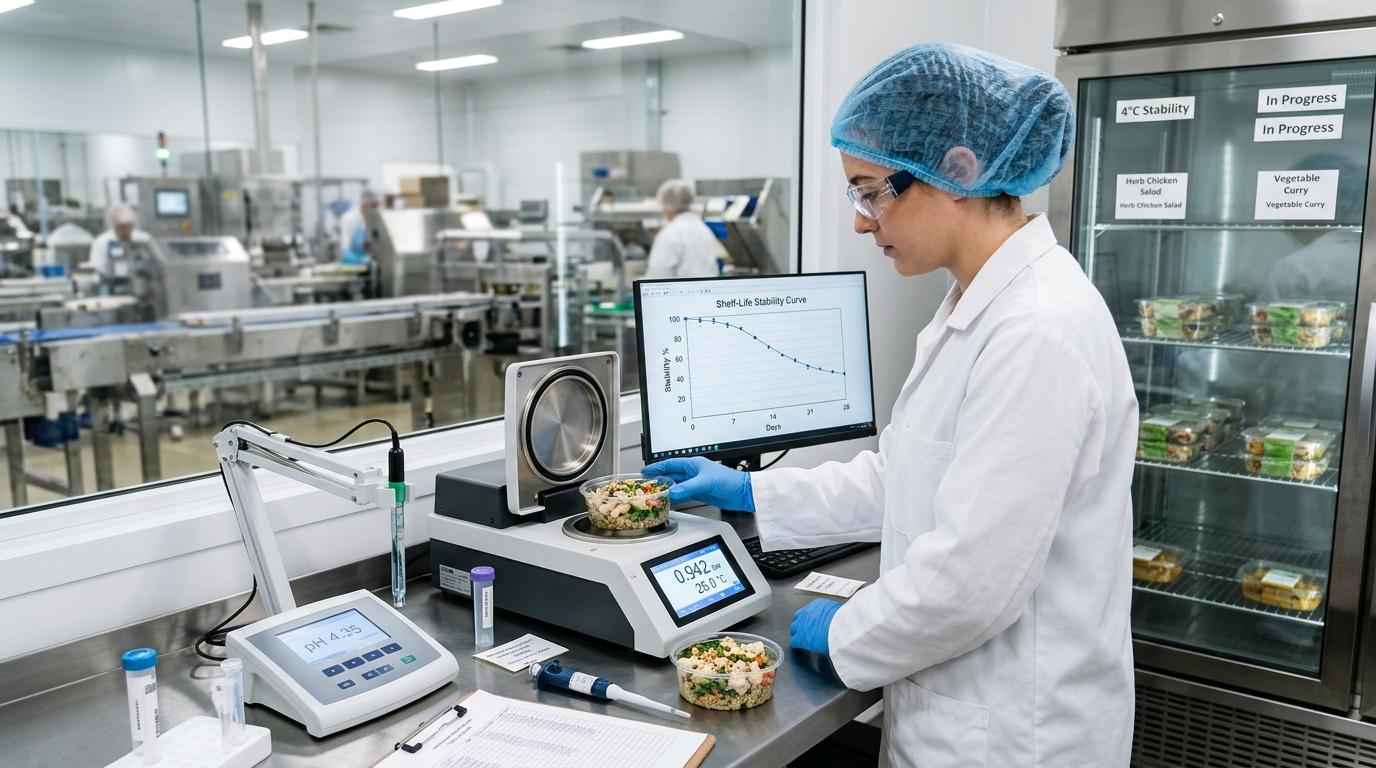
However, under FSANZ Standard 1.2.5 (Date Marking), Standard 1.6.1 (Microbiological Limits in Food) and supermarket WQA/CSR audit standards, you cannot simply print a longer date on the label and hope for the best. This guide explains the science of Water Activity ($a_w$) and pH hurdle technology, how FSANZ classifies ready-to-eat foods for Listeria monocytogenes growth, when a NATA-accredited Challenge Test is mandatory, and how to document an audit-proof shelf-life validation protocol.
How the Supermarket 75%–80% MLOR Rule Drives Factory Batch Economics
Supermarkets enforce Minimum Life on Receipt (MLOR) rules so that after a pallet moves from the state DC to a local store, sits in the back-of-house chiller, goes onto the shelf, and is purchased by a shopper, the consumer still gets several days of usable life in their home fridge.
Look at how total validated shelf life transforms factory economics for an Australian chilled processor:
| Total Validated Shelf Life | Max Age at Supermarket DC Gate (at 75% MLOR) | Max Age at Supermarket DC Gate (at 80% MLOR) | Operational Impact on Your Factory & Freight |
|---|---|---|---|
| 10 Days | 2.5 days (60 hrs) | 2.0 days (48 hrs) | Local state only: Requires make-to-order daily production runs; zero finished-goods buffer stock; high changeover and washdown waste |
| 14 Days | 3.5 days (84 hrs) | 2.8 days (67 hrs) | Tight east-coast corridor: Difficult to hold stock for 48-hr micro clearance and ship interstate without express freight |
| 21 Days | 5.25 days | 4.2 days | Viable East-Coast Distribution: Allows 2 production runs per week per SKU + 48-hr positive QA release + standard linehaul to SYD/MEL/BNE |
| 28 – 35 Days | 7.0 – 8.75 days | 5.6 – 7.0 days | National Ranging (including WA/SA/TAS): Allows full shift batch runs, consolidated freight, and 30–40% lower unit production & write-off costs |
| 45 – 90+ Days | 11.25 – 22.5 days | 9.0 – 18.0 days | Export & National Retail Ideal: Full container/pallet consolidation and minimal retail markdown shrink |
"Use By" vs "Best Before": What FSANZ Standard 1.2.5 Legally Requires
Before extending a product's date mark, you must ensure you are using the legally required date-marking prefix under FSANZ Standard 1.2.5:
- "Use By" Date (Health & Safety Cutoff): Mandatory where, for health or safety reasons, the food should not be consumed after a certain date because pathogenic bacteria (such as Listeria monocytogenes or Clostridium botulinum) could grow to dangerous levels even before the food smells or looks spoiled. It is illegal in Australia to sell any food past its Use-By date.
- "Best Before" Date (Quality Cutoff): Used where the food remains legally safe to consume after the date (provided packaging is intact), but may lose sensory quality, crunch, colour or vitamin potency. Products with a shelf life of 2 years or more (such as canned goods) are exempt from mandatory date marking, though they still require lot identification under Standard 1.2.2 and GS1 barcoding.
The Science of Hurdle Technology: Water Activity ($a_w$) vs Moisture Content
One of the most expensive misunderstandings in food manufacturing is confusing total moisture content (%) with Water Activity ($a_w$).
- Moisture Content (%) measures the total physical weight of water in a food (both bound and unbound), typically determined by drying a sample in an oven.
- Water Activity ($a_w$) measures the thermodynamic availability of free, unbound water able to support microbial growth and enzymatic reactions—measured on a scale from 0.00 (bone dry) to 1.00 (pure distilled water) as the ratio of the vapour pressure of water in the food ($p$) to the vapour pressure of pure water ($p_0$) at the same temperature:
$$a_w = \frac{p}{p_0} = \frac{\text{Equilibrium Relative Humidity (%)}}{100}$$
Why does the difference matter? Because two foods can have the exact same 35% moisture content while having completely different water activities. When dissolved solutes (salt, sugars, glycerol, amino acids) or hydrocolloids bind water molecules via hydrogen bonding or osmotic pressure, that water is no longer available for bacteria, yeasts or moulds to use for cell division.
Minimum Water Activity ($a_w$) Growth Thresholds for Major Food Pathogens & Spoilage Organisms
| Microorganism | Minimum Water Activity ($a_w$) for Growth | Minimum pH for Growth | Typical Food Categories at Risk |
|---|---|---|---|
| Campylobacter jejuni & Pseudomonas (spoilage) | 0.98 – 0.97 | ~4.9 – 5.0 | Fresh raw poultry, meat, fish and high-moisture chilled foods |
| Clostridium botulinum (Non-proteolytic Type E) | 0.97 (or 0.94 for proteolytic Types A & B) | 5.0 (Type E) / 4.6 (Types A & B) | Critical Vacuum / MAP / Sous-Vide Hazard: Anaerobic chilled meals, smoked fish, garlic-in-oil, low-acid canned foods |
| Escherichia coli (STEC) & Salmonella spp. | 0.95 – 0.94 | ~3.8 – 4.4 | Fresh produce, raw/undercooked meats, dressings, dairy, sprouts (note: Salmonella survives in low-$a_w$ dry foods like chocolate & tahini even when it cannot multiply) |
| Listeria monocytogenes | 0.92 | 4.4 | #1 Chilled Ready-to-Eat (RTE) Pathogen: Deli meats, pâté, soft cheeses, dips, prepared salads, chilled desserts |
| Staphylococcus aureus (Aerobic growth / toxin) | 0.86 (aerobic) / 0.90 (anaerobic) | 4.0 – 4.5 | Ham,cured meats, cream-filled bakery goods, hand-assembled foods |
| Most Spoilage Yeasts & Moulds | 0.88 (Yeasts) / 0.80 (Moulds) | < 2.0 – 3.0 | Bakery goods, jams, sauces, cheese surfaces, dried fruit |
| ** Absolute Microbial Growth Floor (Xerophilic Moulds / Osmophilic Yeasts)** | 0.60 | — | Below $a_w = 0.60$, no microorganism can proliferate |
FSANZ Standard 1.6.1: Does Your Ready-to-Eat Food Support Listeria Growth?
If you manufacture any Ready-to-Eat (RTE) chilled food (a food intended by the producer to be eaten without further cooking by the consumer), your shelf-life validation revolves around FSANZ Standard 1.6.1 (Schedule 27 — Microbiological Limits in Food) and the accompanying Compendium of Microbiological Criteria for Food.
Standard 1.6.1 divides RTE foods into two strict legal categories for Listeria monocytogenes:
Category A: RTE Foods in Which Growth of L. monocytogenes WILL NOT Occur
- Regulatory Limit: Up to a maximum of $100\text{ cfu/g}$ ($n=5, c=0, m=100\text{ cfu/g}$) throughout the product's stated shelf life.
- Under Schedule 27, a Ready-to-Eat food is automatically deemed NOT to support the growth of Listeria monocytogenes if it meets any one of these statutory criteria:
- $pH < 4.4$ (regardless of water activity);
- Water activity ($a_w$) $< 0.92$ (regardless of pH);
- Combination Hurdle: $pH < 5.0$ AND $a_w < 0.94$;
- Refrigerated shelf life is 5 days or less;
- The food is frozen (including foods thawed immediately before consumption); OR
- Validated scientific evidence (such as a NATA-accredited Challenge Test) proves that L. monocytogenes will not increase by more than $0.5\text{ log}_{10}\text{ cfu/g}$ over the food's stated shelf life.
Category B: RTE Foods in Which Growth of L. monocytogenes CAN Occur
- Regulatory Limit: Not detected in 25 g ($n=5, c=0, m=\text{not detected in } 25\text{ g}$).
- If your chilled RTE product has a pH of 5.8, a water activity of 0.97, and a proposed shelf life of 21 days—and you do not have validated anti-listerial hurdles or a passed challenge test showing $< 0.5\text{ log}$ growth—a single detected cell of Listeria monocytogenes in a 25 g retail sample triggers a mandatory consumer food recall.
How to Use "Hurdle Technology" to Extend Shelf Life Safely
Rarely can a food manufacturer drop pH to 4.1 or drop water activity to 0.88 using a single ingredient without making a dip taste like pure vinegar or a sauce taste intolerably salty.
Instead, food scientists use Leistner's Hurdle Technology: combining multiple mild intrinsic and extrinsic barriers that act synergistically to exhaust a pathogen's cellular homeostasis mechanisms without ruining sensory quality:
- Mild pH Adjustment ($pH\text{ 4.6 – 5.2}$): Using buffered vinegar, lactic acid, citric acid or glucono-delta-lactone (GDL) to lower intracellular pH.
- Water Activity ($a_w$) Depression ($a_w\text{ 0.91 – 0.95}$): Adjusting salt, soluble solids, humectants, or bake/cook-out moisture loss so every batch sits reliably within a tight target $a_w$ window.
- Clean-Label Natural Antimicrobials & Fermentates: Incorporating cultured dextrose/sugar fermentates (rich in natural propionates, acetates and organic acid salts), rosemary extract, nisin or protective lactic acid bacteria cultures that inhibit Listeria outgrowth.
- In-Pack Thermal Pasteurisation / Hot-Fill / HPP: Applying a validated post-packaging kill step—such as High Pressure Processing (HPP) at 600 MPa, in-pack hot-water bath pasteurisation, or hot-filling above 85°C—to eliminate post-cook handling contamination.
- Modified Atmosphere Packaging (MAP) & Oxygen Barrier Films: Flushing headspace with $CO_2 / N_2$ gas mixtures (typically $20%\text{–}30%\ CO_2$ dissolved into the aqueous phase as carbonic acid to inhibit aerobic Gram-negative spoilage bacteria like Pseudomonas). Warning: Whenever you remove oxygen via vacuum packing or MAP on a chilled food with shelf life $>10$ days, you MUST validate controls against non-proteolytic Clostridium botulinum (e.g., $a_w < 0.97$, $pH < 5.0$, $ge 3.5%$ aqueous salt, or a $90^\circ\text{C for 10 min}$ equivalent thermal process).
Standard Shelf-Life Storage Trial vs Microbial Challenge Testing: What Do Supermarkets Require?
When you apply to range a chilled product—or apply to extend an existing SKU's shelf life from 14 days to 28 days—in Coles, Woolworths or ALDI, their technical managers distinguish between two different types of laboratory studies:
| Validation Study Type | How the Test Is Conducted | What It Proves | When Australian Supermarkets Require It |
|---|---|---|---|
| 1. Real-Time Shelf-Life Verification (End-of-Life Storage Trial) | Uninoculated production batches from 3 separate commercial runs are stored in a NATA lab (typically at 4°C–5°C plus an 8°C temperature-abuse phase to mimic domestic fridges) and tested at Day 0, Mid-Life, End-of-Life (e.g., Day 28) and End-of-Life + 20% margin (Day 34) for Standard Plate Count, Yeasts/Moulds, E. coli, Salmonella, Listeria, pH, $a_w$ and organoleptic sensory scores | Proves the uninoculated product does not spoil, sour or fail microbiological limits past its proposed date mark | Mandatory for almost every new SKU or shelf-life extension |
| 2. Inoculated Microbial Challenge Test (Listeria or C. botulinum) | A specialist NATA lab artificially inoculates the food with a multi-strain cocktail of Listeria monocytogenes (typically $10^2\text{–}10^3\text{ cfu/g}$) and incubates it across the full shelf life under realistic temperature-abuse profiles (e.g., 5°C transport + 7°C–8°C retail/home storage) | Proves scientifically whether the food's intrinsic matrix ($a_w$, pH, organic acids/fermentates) keeps Listeria growth $le 0.5\text{ log}_{10}\text{ cfu/g}$ if post-process contamination ever occurs | Required for chilled RTE foods with shelf life $>5$ days that do not automatically meet the $pH < 4.4$ or $a_w < 0.92$ exemption criteria |
Why "End-of-Life + 20% Buffer" Is the Golden Rule
Never validate a 28-day Use-By date by stopping your laboratory storage trial on Day 28. Major supermarket QA standards and state food authorities expect your validation data to cover at least 115% to 125% of the claimed shelf life (for example, testing out to Day 34 or Day 35 to justify a 28-day printed Use-By date), including a simulated temperature-abuse window at 7°C to 8°C to reflect real-world consumer refrigerators.
Locking Shelf-Life Hurdles Into Every Production Batch
A NATA challenge test report is only valid if every commercial batch your factory produces matches the physico-chemical parameters of the batch you sent to the lab.
If your shelf-life validation passed because your lab trial batch had a pH of 4.85 and a water activity ($a_w$) of 0.930, and six months later a busy afternoon shift dispatches a batch with a pH of 5.35 and an $a_w$ of 0.955, your shelf-life validation is void—and your product is now in the Listeria growth zone.
To make your shelf-life extension permanent and audit-proof:
- Make pH and $a_w$ Mandatory Release CCPs on Every Batch: Measure and log pH and benchtop water activity ($a_w$) on every production batch in Batchbase before the batch can move to finished-goods release.
- Link Formulation Changes Automatically to Shelf-Life Re-Validation: When R&D reduces salt, sugar, acid or preservative levels in a recipe inside Batchbase, the system flags that the intrinsic hurdle profile has changed and prompts QA to review whether shelf-life re-validation is required.
- Automate Date-Code Calculation by SKU: Store each SKU's validated shelf-life days in its master specification so inline 2D and date coders calculate the exact Use-By or Best-Before date automatically without manual operator maths.
Frequently Asked Questions
Can we use Accelerated Shelf-Life Testing (ASLT) at high temperatures for chilled foods? Accelerated shelf-life testing (storing samples at elevated temperatures like 30°C–40°C and applying the Arrhenius equation) works well for predicting chemical and lipid oxidation in low-moisture, ambient shelf-stable foods (biscuits, snack bars, powders, oils). However, ASLT is not accepted by FSANZ or supermarkets for chilled microbiologically sensitive foods, because different spoilage and pathogenic bacteria dominate at 25°C versus 4°C. Chilled RTE foods must be validated at realistic chilled and mild-abuse temperatures (4°C–8°C).
How much does a benchtop water activity ($a_w$) meter cost for a food factory? A commercial-grade chilled-mirror dewpoint or capacitance benchtop water activity meter typically costs between $4,500 and $9,500 and measures a sample in 3 to 5 minutes. For any manufacturer producing bakery goods, snacks, sauces, jerky, confectionery or chilled RTE foods, it pays for itself in months by preventing out-of-spec batches and cutting external lab turnaround times.
Does extending our shelf life qualify for the 43.5% R&D Tax Incentive? If your shelf-life extension required systematic hypothesis-driven experimentation to resolve a genuine technical unknown (such as testing novel hurdle combinations, natural fermentates or packaging gas ratios where the microbial and sensory outcomes could not be known in advance), the experimental trials and NATA testing fees can often be claimed under the 43.5% R&D Tax Incentive.
The Bottom Line
Extending a product's validated shelf life is one of the highest-ROI technical projects an Australian food manufacturer can run. Lifting a chilled SKU from 14 days to 28+ days unlocks national supermarket DC ranging under the 75%–80% MLOR rule, cuts production changeovers and markdown waste, and lowers freight costs. By combining smart $a_w$ and pH hurdle formulation with NATA validation and batch-level QC logging in Batchbase, you can grow nationally with complete food-safety confidence.
References
- FSANZ – Standard 1.6.1 Microbiological Limits in Food & Schedule 27 (Listeria monocytogenes Criteria)
- FSANZ – Compendium of Microbiological Criteria for Food
- NSW Food Authority – Shelf Life Testing & Validation Guidance for Food Businesses
- Dairy Food Safety Victoria (DFSV) / PrimeSafe – Listeria Control and Shelf-Life Validation Guidelines
- FSANZ – Standard 1.2.5 Information Requirements – Date Marking of Food for Sale