For more than half a century, the familiar 1D linear barcode—the row of vertical black bars known in Australia as an EAN-13—has done one simple job at the supermarket checkout: look up a 13-digit Global Trade Item Number (GTIN) and return a price. It cannot tell the register whether the tub of yoghurt in a shopper's hand expires tomorrow, whether it already expired two days ago, which factory batch it came from, or whether that specific lot is subject to a food safety recall.
By the end of 2027, that limitation is scheduled to end. Under the global GS1 Sunrise 2027 initiative—championed locally by GS1 Australia and already rolled out across Australian supermarkets led by Woolworths—point-of-sale (POS) optical scanners are transitioning to read data-rich 2D barcodes (GS1 DataMatrix and QR codes powered by GS1 Digital Link) alongside traditional linear barcodes.
For Australian food and beverage manufacturers, this is not merely a packaging artwork change. Because a 2D barcode at checkout frequently carries dynamic batch/lot numbers and use-by or best-before dates, static pre-printed film is no longer enough. Your production line coding hardware, recipe and batch software, and inline print-verification systems must work together in real time.
This guide explains how GS1 2D barcodes work, why Australian supermarkets are pushing adoption ahead of the 2027 deadline, the hardware and data changes required on the factory floor, and a practical readiness roadmap.
Why Australian Supermarkets Are Moving to 2D Barcodes Now
Australia has quietly become one of the world's fastest adopters of retail 2D barcoding. Beginning with variable-weight fresh meat, poultry, bakery and deli items and expanding across packaged grocery categories, Woolworths Group partnered with GS1 Australia to deploy 2D-enabled optical scanners across its national store network.
The commercial and food-safety drivers are compelling:
- Automated Expiry Blocking at the Register: When a 2D barcode embeds the product's use-by date, the POS terminal automatically blocks the sale if a customer attempts to purchase an out-of-date item, protecting consumers and eliminating manual date-check failures.
- Up to 40% Reduction in Fresh Food Waste: Trials and store rollouts documented by GS1 Australia and retail partners found that encoding expiry dates into 2D barcodes reduced food waste in targeted fresh categories by up to 40%, because store teams can scan shelves rapidly and trigger automated, dynamic markdowns before products expire.
- Surgical Batch-Level Recall Execution: With a standard 1D EAN-13 barcode, every unit of a SKU looks identical at the checkout. If a single shift's production is recalled, supermarkets often pull all stock from shelves as a precaution. A 2D barcode carrying the exact batch/lot number allows the POS system to block only the affected batch while allowing safe batches to keep selling.
- Accurate Variable-Weight & Price Per Kg Calculation: For random-weight cheese, smallgoods, meat and produce, a single 2D code carries the GTIN, net weight in grams, price and batch number without needing separate price-embedded barcodes.
- Direct Consumer Transparency (GS1 Digital Link): When a 2D code uses the GS1 Digital Link QR standard, the exact same square scanned by the supermarket laser at checkout can be scanned by a shopper's smartphone camera to open allergen declarations, Health Star Rating details, Country of Origin Labelling (CoOL) provenance, and Australasian Recycling Label (ARL) disposal instructions.
1D Linear vs GS1 DataMatrix vs GS1 Digital Link QR: What Is the Difference?
Not all 2D barcodes on food packaging serve the same operational purpose. GS1 Australia supports two primary 2D symbologies for retail POS scanning, depending on whether your goal is purely supply-chain and checkout efficiency or combined checkout + consumer smartphone interaction.
| Barcode Format | Primary Use Case in Food Manufacturing | Typical Data Encoded | Can Smartphones Scan It Natively? | Minimum Print Footprint |
|---|---|---|---|---|
| 1D Linear (EAN-13 / EAN-8) | Legacy POS price lookup only | 13-digit GTIN only (static across all batches) | No (requires dedicated app) | Large (~37mm × 26mm at 100% magnification) |
| GS1 DataMatrix | High-speed inline coding of GTIN + batch + expiry on fresh, chilled, dairy, meat & bakery packs | GTIN (01) + Expiry/Best Before (17) or (15) + Batch/Lot (10) + Net Weight (310n) |
No (designed for optical POS and warehouse scanners) | Very compact (~10mm × 10mm to 14mm × 14mm) |
| QR Code with GS1 Digital Link | Dual-purpose: POS checkout scanning AND consumer smartphone web experiences | Web URI containing GTIN, batch, expiry and link to product specification/provenance page | Yes — standard iOS & Android cameras open the URL | Medium (~16mm × 16mm to 22mm × 22mm including quiet zone) |
| GS1-128 (Carton/Pallet Linear) | Outer shippers, cases and SSCC logistics pallet labels | GTIN (01), Expiry (17), Batch (10), Quantity (37), SSCC (00) |
No | Very wide (requires thermal label on outer carton) |
How GS1 Application Identifiers (AIs) Structure Your Batch Data
Inside a GS1 2D barcode, data fields are separated using standard numerical prefixes called Application Identifiers (AIs). For Australian food processors, the five most important AIs are:
- AI
(01)— Global Trade Item Number (GTIN): Your 14-digit product identifier (your 13-digit EAN with a leading zero). - AI
(17)— Expiration / Use-By Date: Formatted strictly asYYMMDD(for example,261215for 15 December 2026). - AI
(15)— Best-Before Date: Formatted asYYMMDDfor shelf-stable or ambient goods that use a "Best Before" rather than a mandatory "Use By" date under FSANZ Standard 1.2.5. - AI
(10)— Batch or Lot Number: Up to 20 alphanumeric characters linking the pack directly to your factory production batch record. - AI
(3103)— Net Weight in Kilograms (to 3 decimal places): Commonly used on variable-weight meat, poultry, cheese and deli packs.
For example, a single 12mm × 12mm GS1 DataMatrix printed on a chilled ready-meal sleeve might encode:
(01)09312345678904(17)261218(10)B261125-L2
In one sub-second scan at the supermarket checkout, the register reads the SKU (09312345678904), verifies that today is on or before 18 December 2026 (261218), and records that the unit came from batch B261125-L2.
The Operational Shift: From Pre-Printed Packaging to Dynamic Line Coding
Here is the catch that surprises many mid-tier food manufacturers.
With a traditional 1D EAN-13 barcode, your packaging designer drops the barcode vector onto the artwork file, and your film or carton converter prints 100,000 identical pouches or sleeves. On the packing line, your date coder simply prints two lines of human-readable text (USE BY 18 DEC 26 / BATCH B261125) inside a small white window.
When you move to a batch- and expiry-encoded 2D barcode, the barcode itself changes with every single production batch—and on variable-weight lines, with every single pack. You cannot pre-print a dynamic 2D barcode at your packaging supplier. It must be printed inline on your factory floor during packaging.
Comparing Inline 2D Coding Technologies for Food Plants
| Coding Technology | Best Packaging Substrates | 2D Print Resolution & Speed | Consumables & Maintenance | Typical Food-Plant Application |
|---|---|---|---|---|
| Thermal Inkjet (TIJ) | Folding cartons, coated lidding films, sleeves, labels | 300–600 dpi; excellent contrast for high-density DataMatrix and QR at medium-to-high line speeds | Snap-in ink cartridges; virtually zero mechanical maintenance | Bakery cartons, ready-meal sleeves, dry grocery boxes |
| Thermal Transfer Overprinting (TTO) | Flexible film form-fill-seal (VFFS / HFFS) pouches, flow-wrap | 300 dpi; crisp edge definition directly onto flexible plastic film prior to forming | Thermal ribbon rolls; printhead wear requires periodic replacement | Snack bags, grated cheese pouches, fresh salad bags, confectionery |
| Continuous Inkjet (CIJ) | Curved cans, glass jars, HDPE bottles, wet/chilled surfaces | Lower dot density (~70–90 dpi matrix); suitable for basic DataMatrix at high speed, less ideal for dense QR codes | Liquid ink + make-up solvent; scheduled filter/nozzle servicing | Beverage cans, dairy bottles, sauces, jars |
| UV / CO2 / Fibre Laser | Paperboard cartons, anodised foil, PET bottles, coated labels | Permanent ablation/colour-change; high precision when substrate includes a laser-reactive ink patch | Zero ink consumables; high upfront capex + fume extraction | High-volume dairy, beverage and shelf-stable lines |
| Print-and-Apply Labelling | Variable-weight meat/deli trays, thermoformed packs, outer cartons | 300 dpi direct thermal or thermal transfer labels applied via tamp/blow | Pre-cut pressure-sensitive labels + thermal heads | Chilled meat, poultry, seafood, specialty cheese |
Why Print Verification (ISO/IEC 15415) Is Non-Negotiable
A 1D barcode has vertical redundancy: if a horizontal scratch or a dead printer pixel cuts across the middle of the bars, the checkout laser can still read the top or bottom half.
A 2D DataMatrix or QR code stores data across both the X and Y axes. While Reed-Solomon error correction allows a 2D code to survive minor localized damage, a blocked inkjet nozzle, a dead thermal printhead element, ribbon wrinkling, or film vibration can corrupt an entire row or column of modules—rendering the barcode unreadable or lowering its scan grade below retail thresholds.
Under GS1 Australia guidelines and major supermarket supplier specifications:
- 2D barcodes intended for general retail POS scanning must achieve a minimum ISO/IEC 15415 print quality grade of 1.5 (Grade C) or higher across contrast, modulation, axial non-uniformity, fixed-pattern damage and quiet-zone clearance.
- Relying on a smartphone camera to "test" a barcode on the line is a classic trap. Smartphone cameras apply aggressive computational image sharpening that can read a poorly printed QR code that a high-speed supermarket bi-optic checkout scanner will reject at 2 metres per second.
- If a batch of 20,000 units reaches a supermarket distribution centre with unscannable 2D codes, the manufacturer faces DIFOT rejections, manual re-labelling chargebacks, or full shipment returns.
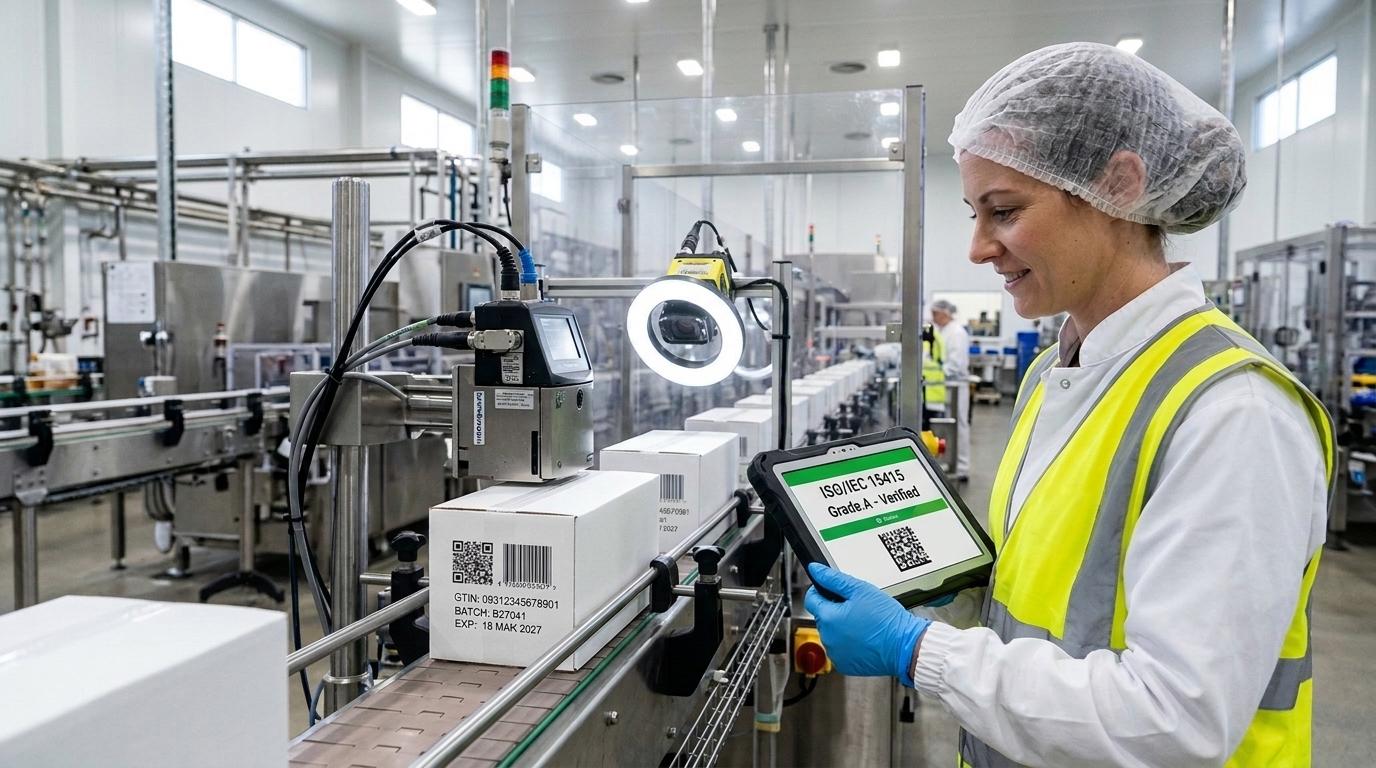
Leading food plants pair their inline TIJ, TTO or print-and-apply coders with an inline machine-vision camera verifier mounted immediately downstream of the printhead. If three consecutive packs drop below Grade C (or if a thermal pixel fails), the vision system triggers an automatic line stop or reject arm before hundreds of non-compliant packs are cased and palletised.
The Hidden Bottleneck: Who Sends the Batch and Expiry Data to the Printer?
Even the best thermal printer and vision camera cannot prevent a recall if an operator manually types the wrong GTIN, batch number or shelf-life date into a touchscreen HMI at 5:30 AM.
As we examine in our analysis of FSANZ food recall statistics, packaging and labelling errors—putting the wrong product into a pack, selecting the wrong label template, or miscalculating a use-by date—remain a leading trigger of Australian food recalls.
When your 2D barcode embeds GTIN + Batch + Expiry, manual keypad entry at the printer creates three severe risks:
- Wrong Shelf-Life Calculation: An operator adds 21 days instead of 14 days to a chilled product's manufacture date, encoding an unsafe use-by date directly into the checkout barcode.
- Batch Mismatch: The production floor starts batch
B261203-02, but the line coder is still printing batchB261203-01from the previous run, breaking lot-level traceability. - GTIN / Artwork Mismatch during Changeovers: The physical packaging film is switched from Original to Cheese & Bacon flavour, but the printer template still encodes the Original GTIN.
The solution is single-source-of-truth integration:
- Your central recipe, specification and batch production system (such as Batchbase) holds the master SKU record: its verified 14-digit GTIN, its validated shelf-life rule (e.g.,
Manufacture Date + 18 days), and whether it requires a Use-By(17)or Best-Before(15)identifier. - When a production batch is scheduled and started in Batchbase, the system automatically generates the unique batch/lot code and calculates the exact expiry date.
- Your line coding software pulls those verified parameters directly from the active batch record—eliminating manual typing on the factory floor.
During the Transition: Dual Marking (1D + 2D Coexistence)
GS1 Sunrise 2027 is a readiness milestone: by the end of 2027, retail POS systems worldwide are expected to scan 2D barcodes seamlessly. During the transition period, GS1 Australia recommends dual marking (coexistence) unless your retail customer has explicitly approved 2D-only packaging for a specific category:
- Keep the existing 1D EAN-13 barcode on pack for independent grocers, convenience stores and export markets still upgrading legacy laser scanners.
- Place the 2D barcode (DataMatrix or GS1 Digital Link QR) adjacent to the 1D barcode within the designated placement zone so a single pass over the checkout glass captures the code.
- Never encode conflicting GTINs between the 1D and 2D symbols on the same pack.
- Eliminate redundant marketing QR codes: If your pack currently has a generic marketing QR code on the front or back AND you add a GS1 2D code near the barcode, checkout scanners can accidentally read the wrong QR code if they sit too close together. Migrating your consumer QR code to GS1 Digital Link lets one single 2D code handle both checkout scanning and consumer smartphone engagement.
Worked Cost & ROI Example: A Mid-Sized Chilled Ready-Meals Processor
Consider an Australian chilled ready-meals manufacturer running three thermoforming/sleaving lines producing 4.5 million packs per year across 18 SKUs for major supermarkets and independent grocers.
| Cost / Benefit Item | Year 1 Impact (A$) | Ongoing Annual Impact (A$) | Notes |
|---|---|---|---|
| 3× High-resolution TIJ / TTO coders + inline vision verifiers | -$48,000 | -$3,500 | Hardware upgrade across 3 lines + annual calibration |
| Artwork window & template standardisation (18 SKUs) | -$9,000 | $0 | Phased in during routine artwork reprints |
| Elimination of 2 date-coding operator errors / rework incidents per year | +$18,000 | +$18,000 | Avoided labour, stripped sleeves and dumped WIP |
| Batch-specific recall containment preparedness | +$35,000 (risk-weighted) | +$35,000 (risk-weighted) | Narrowing a potential quality withdrawal to 1 sub-batch instead of a full week's production |
| Retailer vendor scorecard & tender compliance | Commercial retention | Commercial retention | Meets supermarket 2D barcode specifications for fresh/chilled tenders |
Beyond the direct ROI from eliminating coding errors and protecting retail listings, the manufacturer gains full end-to-end digital alignment between every batch mixed in the kitchen and every individual pack scanned at the register.
A 6-Step GS1 Sunrise 2027 Readiness Checklist for Food Manufacturers
| Step | Action Item | Owner | Target Window |
|---|---|---|---|
| 1. Audit Master GTINs | Verify every active SKU has a valid registered GTIN in the GS1 Australia registry and matches your specification database. | QA / Regulatory | Month 1 |
| 2. Choose 2D Symbology by Range | Decide whether each range needs GS1 DataMatrix (pure POS + batch/expiry) or GS1 Digital Link QR (POS + consumer smartphone scan). | Commercial & QA | Month 1–2 |
| 3. Assess Line Coding Hardware | Test whether existing inkjet/TTO/laser coders on each packing line can print 300 dpi+ 2D symbols at full line speed without distortion. | Engineering / Ops | Month 2 |
| 4. Reserve Artwork Quiet Zones | During scheduled label and film reprints, create a clean high-contrast print window adjacent to the 1D EAN-13 barcode and remove competing non-GS1 QR codes. | Marketing / Packaging | Month 2–4 |
| 5. Connect Batch & Shelf-Life Data | Link production batch records and automated shelf-life calculations to line coding templates so operators never key in GTINs or dates manually. | Operations / IT | Month 3–5 |
| 6. Validate to ISO/IEC 15415 | Submit first-off production samples to GS1 Australia Barcode Check or verify inline to confirm Grade C (1.5) or better. | Quality Assurance | Prior to first dispatch |
Frequently Asked Questions
Is GS1 Sunrise 2027 a government law or an industry standard? It is a global industry standard coordinated by GS1 and adopted commercially by major retailers including Woolworths and Coles. While FSANZ does not mandate 2D barcodes under the Food Standards Code, FSANZ does mandate lot identification and date marking under Standard 1.2.2 and Standard 1.2.5—and major supermarkets increasingly require GS1 2D barcodes in their commercial supplier specifications.
Will traditional 1D barcodes stop working in 2028? No. Existing 1D EAN-13 barcodes will continue to scan during the transition, and dual marking (1D + 2D on the same pack) is standard practice while smaller independent retailers finish upgrading legacy laser scanners.
What happens if a consumer scans our GS1 Digital Link QR code? When a checkout scanner reads a GS1 Digital Link QR code, it extracts the GTIN, batch and expiry offline in milliseconds. When a consumer scans that exact same QR code with a smartphone camera, it opens a web URL (via a GS1 resolver) where you can display live nutrition facts, allergen warnings, recipes, sustainability credentials or a recall alert for that specific batch.
The Bottom Line
The transition to 2D barcodes under GS1 Sunrise 2027 turns the humble barcode from a static price tag into a live data link between your factory floor and the supermarket checkout. Australian food manufacturers who standardize their SKU specifications, automate batch and shelf-life data, and verify inline print quality now will avoid last-minute capex scrambles—and turn batch-level traceability into a commercial advantage with retail buyers.
References
- GS1 Australia – 2D Barcodes at Retail Point of Sale & Sunrise 2027
- GS1 Australia – Barcode Check & ISO/IEC 15415 Verification Service
- GS1 Global – GS1 Digital Link Standard Overview
- Woolworths Group – 2D Barcodes and Food Waste Reduction Initiatives
- FSANZ – Standard 1.2.2 Food Identification Requirements & Standard 1.2.5 Date Marking