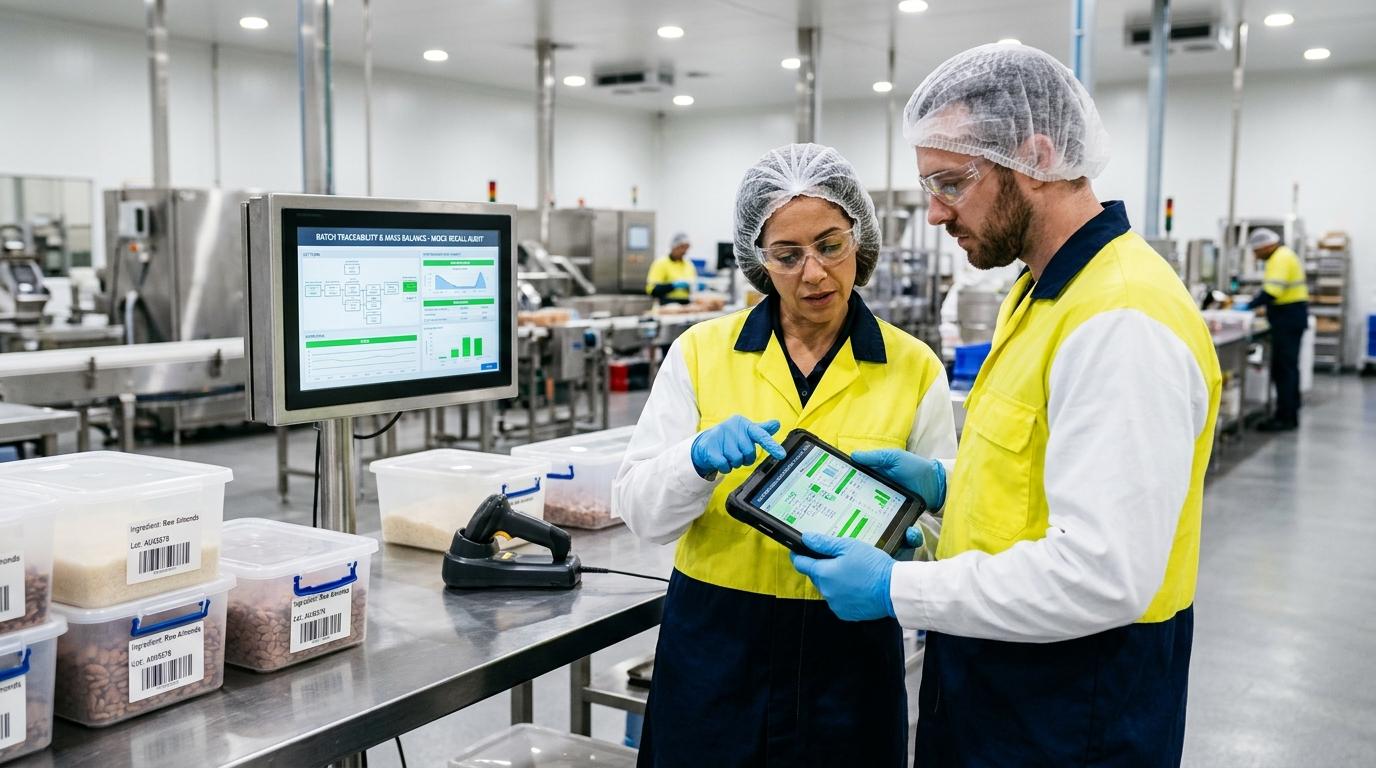
No phone call stops a food manufacturing plant faster than a notification that a batch already sitting in supermarket distribution centres—or worse, in consumers' pantries—may contain an undeclared allergen, a pathogen or fragments of foreign material.
Across the decade from 2016 to 2025, Food Standards Australia New Zealand (FSANZ) coordinated 866 food recalls nationwide, averaging roughly 87 recalls per year and reaching 92 recalls in 2025. While those numbers represent a tiny fraction of the billions of food units sold in Australia annually, the financial, legal and reputational cost of a single recall for a mid-sized processor regularly exceeds $250,000 to $1 million+ once stock retrieval, destruction, laboratory testing, line shutdowns, retailer penalties and lost listings are tallied.
What makes FSANZ's official recall data so valuable for operations and quality leaders is that the root causes are remarkably consistent—and overwhelmingly preventable.
This guide breaks down the latest FSANZ food recall statistics, examines why packaging and specification disconnects trigger more allergen recalls than factory-floor cross-contact, and provides a step-by-step operational blueprint to pass a 2-hour GFSI and supermarket mock recall with 100% mass-balance reconciliation.
What 10 Years of FSANZ Food Recall Statistics Reveal
FSANZ coordinates and publishes detailed annual statistics on every trade-level and consumer-level food recall in Australia. Three primary hazards consistently account for more than 85% of all Australian food recalls:
| Primary Recall Cause | 2025 Recalls (Out of 92) | Share of 2025 Recalls | 10-Year Historical Share Range | Most Frequent Triggers in Australian Food Plants |
|---|---|---|---|---|
| Undeclared Allergens | 35 recalls | 38% | 38% – 57% (nearly 200 recalls across 2021–2025) | Wrong packaging/label applied, supplier ingredient change not updated on artwork, missing PEAL summary word |
| Microbial Contamination | 23 recalls | 25% | 22% – 30% | Listeria monocytogenes, Salmonella spp., E. coli, histamine or hygiene validation failure |
| Foreign Matter | 22 recalls | 24% | 13% – 24% | Hard plastic fragments, metal wire/shavings, glass chips, rubber seals or stones |
| Biotoxins / Chemical / Other | 12 recalls | 13% | 10% – 18% | Excess caffeine, prohibited substances, packaging fault/swelling, sanitiser residue, unapproved novel ingredients |
Source: FSANZ Food Recall Statistics (2016–2025 dataset).
Look closely at the top three rows. Together, undeclared allergens (35), microbial contamination (23) and foreign matter (22) drove 80 of the 92 recalls (87%) recorded in 2025.
Deep Dive 1: Why Undeclared Allergens Remain Australia's #1 Recall Trigger
With Australia having some of the highest rates of diagnosed food allergies in the world—and following the transition to mandatory Plain English Allergen Labelling (PEAL) under FSANZ Standard 1.2.3—many manufacturers assume allergen recalls happen mainly because trace dust drifts from one production line to another during processing.
FSANZ's root-cause analysis tells a very different story.
While physical cross-contact on shared equipment is a genuine hazard, the majority of undeclared allergen recalls in Australia are caused by labelling, packaging and specification management failures:
- Right Product in the Wrong Packaging (Packaging Mix-Ups): A line changeover finishes running a dairy-containing sauce or biscuit, switches the filler to a dairy-free SKU, or vice versa, while a roll of film, cartons or back labels from the adjacent SKU remains loaded in the labeller.
- Uncommunicated Supplier Sub-Ingredient Changes: A raw material supplier reformulates a compound spice blend, glaze, chocolate chip or flavour base to include milk powder, wheat starch or soy lecithin, sends an updated PDF specification via email, and the change never flows through to the manufacturer's master recipe and finished-goods label.
- Recipe Reformulation Without Artwork Synchronisation: R&D tweaks a recipe to manage input cost volatility or ingredient shortages, production starts running the new formulation, and the warehouse continues consuming three months of pre-printed packaging carrying the old ingredient list.
- PEAL Formatting Errors: Omitting a required bolded allergen within the ingredient list, failing to match the separate "Contains" summary statement exactly to the bolded ingredients, or using non-prescribed tree-nut terminology (e.g., declaring "tree nuts" generically instead of naming cashew, almond, walnut or hazelnut individually as PEAL requires).
The Allergens Most Frequently Involved in Australian Recalls
Across FSANZ's multi-year allergen recall data, the top culprits are:
- Milk / Dairy (consistently #1 across bakery, confectionery, plant-based and convenience foods)
- Wheat and Gluten (cereals containing gluten)
- Tree Nuts (almonds, cashews, walnuts, hazelnuts, macadamias)
- Peanuts
- Egg
- Sesame and Soy
Even more concerning: FSANZ data shows that a substantial share of undeclared allergen recalls are still first identified via consumer complaints or allergic reactions, rather than internal QA checks—meaning the error passed line clearance, finished-goods release, warehouse dispatch and retail shelf stocking undetected.
Deep Dive 2: Microbial Recalls (Listeria, Salmonella and E. coli)
Microbial contamination accounted for 23 recalls in 2025 and remains the highest-consequence category for severe illness and hospitalisation.
- Listeria monocytogenes is the primary pathogen of concern for ready-to-eat (RTE) chilled foods that support bacterial growth: sliced meats and smallgoods, soft and surface-ripened cheeses, smoked seafood, pre-cut salads and chilled sandwiches. Because Listeria thrives in cold, damp factory environments (floor drains, chiller evaporator trays, hollow conveyor rollers, slicer blades), environmental swabbing under Standard 3.2.2A and HACCP is the frontline defence.
- Salmonella spp. frequently affects low-moisture foods where thermal kill-steps are absent or post-process contamination occurs—such as tahini, sesame halva, chocolate, nuts, sprouts, poultry and egg-containing products.
- Shiga toxin-producing E. coli (STEC) and Bacillus cereus appear in raw agricultural commodities, dairy, sprouted seeds and temperature-abused cooked rice or pasta meals.
The operational lesson from microbial recalls is the importance of positive-release hold protocols: if your QA program involves pathogen testing on finished goods or Zone 1 food-contact surfaces, the batch must remain quarantined in your warehouse (digitally blocked from dispatch) until laboratory clearance is logged against that batch record.
Deep Dive 3: Foreign Matter Recalls (22 Recalls in 2025)
Foreign matter recalls rose to 22 incidents in 2025—nearly matching microbial recalls. While industrial metal detectors are standard on almost every Australian packing line, metal is only part of the problem:
- Hard and brittle plastics (chipped ingredient scoops, conveyor flight fragments, broken tote corners, scraper blades) are invisible to standard metal detectors and often have a density too close to food for basic X-ray systems to catch unless colour-contrasted or metal-detectable polymers are used.
- Fine stainless-steel mesh wire from worn sieves or sifters can pass through poorly calibrated metal detectors if oriented parallel to the magnetic field.
- Glass and ceramic fragments from sight glasses, jars or lighting fixtures require strict glass-and-brittle-plastic registers checked per shift.
Trade Recall vs Consumer Recall: What FSANZ Requires When an Incident Happens
Under the FSANZ Food Industry Recall Protocol, every Australian food manufacturer, importer and wholesaler must maintain a written, tested Food Recall Plan.
When a food safety hazard is identified in distributed stock, recalls fall into two classifications:
- Trade-Level Recall: Conducted when the food has been distributed to wholesalers, distribution centres, foodservice operators or catering kitchens, but has not been sold directly to retail consumers.
- Consumer-Level Recall: Conducted when the food has been sold through retail outlets (supermarkets, convenience stores, bakeries, online D2C) directly to the public. Consumer recalls require public recall notices published on the FSANZ website, state food authority alerts, point-of-sale notices in retail stores, and social/media notifications.
When initiating a recall, you must immediately provide the Home State Action Officer and the FSANZ Recall Coordinator with:
- Exact product description, brand name, pack size and packaging type
- Specific Batch/Lot numbers and Use-By / Best-Before dates affected
- The nature of the defect and the clinical risk to consumers
- Complete distribution list: total quantity manufactured, quantity still on hand in your warehouse, and exact quantities dispatched to every customer, state and export market
Here is the commercial reality: if your traceability records cannot prove which specific batches are affected within a couple of hours, regulators and retailers will require you to recall every batch on the market.
The 2-Hour Mock Recall Standard: Why Spreadsheets Fail Under Pressure
Under GFSI-recognised certification standards (SQF Edition 9/10, BRCGS Food Safety Issue 9, FSSC 22000) as well as the Coles Supplier Requirements and Woolworths Quality Assurance (WQA) standards, manufacturers must conduct regular mock recalls—and during announced or unannounced audits, auditors routinely trigger a live traceability challenge.
The benchmark expectation across major Australian retail standards is clear:
- Time Limit: Trace a nominated raw material lot forward to every finished batch and customer invoice (and trace a finished product lot backward to every raw material lot, packaging roll and CCP record) within 2 to 4 hours (with leading retailers expecting under 2 hours).
- Mass-Balance Reconciliation: Account for 99.5% to 100% of the total material weight (Quantity Received = Quantity Used in Production + Quantity Wasted/Reworked + Quantity Remaining in Warehouse Inventory).
Paper & Spreadsheets vs Connected Digital Batch Traceability
| Mock Recall Step | Paper Clipboards & Excel Spreadsheets | Connected Digital System (Batchbase) |
|---|---|---|
| 1. Identify all WIP & sub-batches using Raw Material Lot #X | 35–60 mins digging through lever-arch folders and production logs | < 10 seconds via one-click forward lot search |
| 2. Identify all finished goods batches containing those sub-batches | 30–45 mins cross-referencing mixing sheets with packing logs | Instant — parent-child batch genealogy is linked automatically |
| 3. Reconcile mass balance (received vs used vs waste vs stock on hand) | 45–90 mins manually summing weights and hunting for unrecorded rework or floor waste | Instant — live inventory, yield loss and rework are logged per batch |
| 4. Retrieve packaging lot numbers & CCP / metal detector sign-offs | 20–40 mins searching QA clipboards from the packing line | < 30 seconds — attached directly to the digital batch record |
| 5. Generate customer distribution & contact report by batch | 20–30 mins matching dispatch dockets to invoices | < 1 minute — exportable recall report ready for FSANZ & retailers |
| Total Mock Recall Time | 2.5 to 4.5+ hours (high risk of audit non-conformance) | Under 10 minutes |
Six Practical Controls to Prevent a Recall Before It Starts
1. Lock Artwork & Ingredient Lists to Live Recipe Specifications
Never manage recipes in one spreadsheet and label copy in an external Word document. When R&D approves a recipe change or updates an incoming raw material specification in your recipe and spec system, the system should automatically flag whether the ingredient declaration, characterising ingredient percentage, NIP or PEAL allergen summary has changed—and block production of the new recipe until packaging sign-off is recorded.
2. Enforce Barcode-Verified Line Clearance at Every Changeover
Before a packing run begins, require a documented Line Clearance Checklist:
- All previous product, wip, rework, film rolls, cartons and labels physically removed from the line
- New packaging barcode (1D EAN-13 or GS1 2D barcode) scanned against the active work order in your production system to prove the right packaging is loaded for the right batch.
3. Mandate Certificate of Analysis (CoA) & Supplier Spec Verification at Goods Receipt
Do not allow warehouse staff to book in high-risk raw materials (spice premixes, dairy powders, nut pastes, gluten-free flours) without checking the lot number, CoA and allergen status against the approved supplier specification.
4. Track Rework and WIP with the Same Lot Rigour as Raw Ingredients
One of the most common points where mass-balance fails during a mock recall—and where undeclared allergens sneak into a batch—is rework (e.g., trimmings, over-weight dough, or start-up purges added back into a later batch). Every container of rework must carry a batch number and allergen profile, and adding rework to a batch must be logged as a traced input.
5. Colour-Code and Register All Brittle Plastics, Sieves and Utensils
Eliminate white, clear or food-coloured plastic scoops, scrapers and cable ties from processing zones. Switch to blue, metal-detectable, X-ray-visible polymers, inspect sieves and scraper blades at the start and end of every shift, and log checks digitally against the shift's batches.
6. Run Unannounced 2-Hour Mock Recalls Twice a Year (Including a Rework Scenario)
Do not test your recall plan on an easy, single-ingredient batch from yesterday. Pick a batch from four months ago that included a reworked sub-batch, a packaging film roll change, and multiple customer shipments. Time every step with a stopwatch and fix any data gap that takes longer than 15 minutes to retrieve.
Frequently Asked Questions
How quickly must a food business notify FSANZ and state authorities of a recall? Immediately upon determining that a distributed food product poses a health or safety risk (such as an undeclared allergen, pathogen or dangerous foreign object). Under the FSANZ Food Industry Recall Protocol, you must contact your Home State or Territory Action Officer and the FSANZ Recall Coordinator without delay.
Why did undeclared allergen recalls stay high even after the PEAL transition ended? Because PEAL standardised how allergens are displayed on labels, but it cannot prevent human and operational errors on the factory floor—such as loading the wrong pre-printed packaging roll during a line changeover or failing to update a label after a supplier reformulates a compound ingredient.
What is the difference between a food withdrawal and a food recall? A recall removes food from the supply chain or consumers because of a health and safety risk (e.g., undeclared milk allergen, Listeria, glass fragments) and must be reported to FSANZ. A withdrawal removes product for a purely commercial or quality defect with no safety risk (e.g., split outer shipper cartoon or minor colour variation).
The Bottom Line
FSANZ's 866 food recalls over the past decade prove that most recalls are not freak scientific accidents—they are data and process disconnects between supplier specifications, recipe changes, packaging artwork and factory-floor batch records. Manufacturers who connect their recipes, allergen declarations and lot tracking in a single digital platform protect consumers, pass 2-hour audit challenges in minutes, and keep their brands off the FSANZ recall register.
References
- FSANZ – Food Recall Statistics (Annual & 10-Year Trends)
- FSANZ – Food Industry Recall Protocol: A Guide to Writing a Food Recall Plan and Conducting a Food Recall
- FSANZ – Allergen Labelling for Food Businesses (PEAL Standard 1.2.3)
- Safe Food Production Queensland / NSW Food Authority – Food Recalls and Traceability Guidance
- Australasian Society of Clinical Immunology and Allergy (ASCIA) – Food Allergy Fast Facts Australia