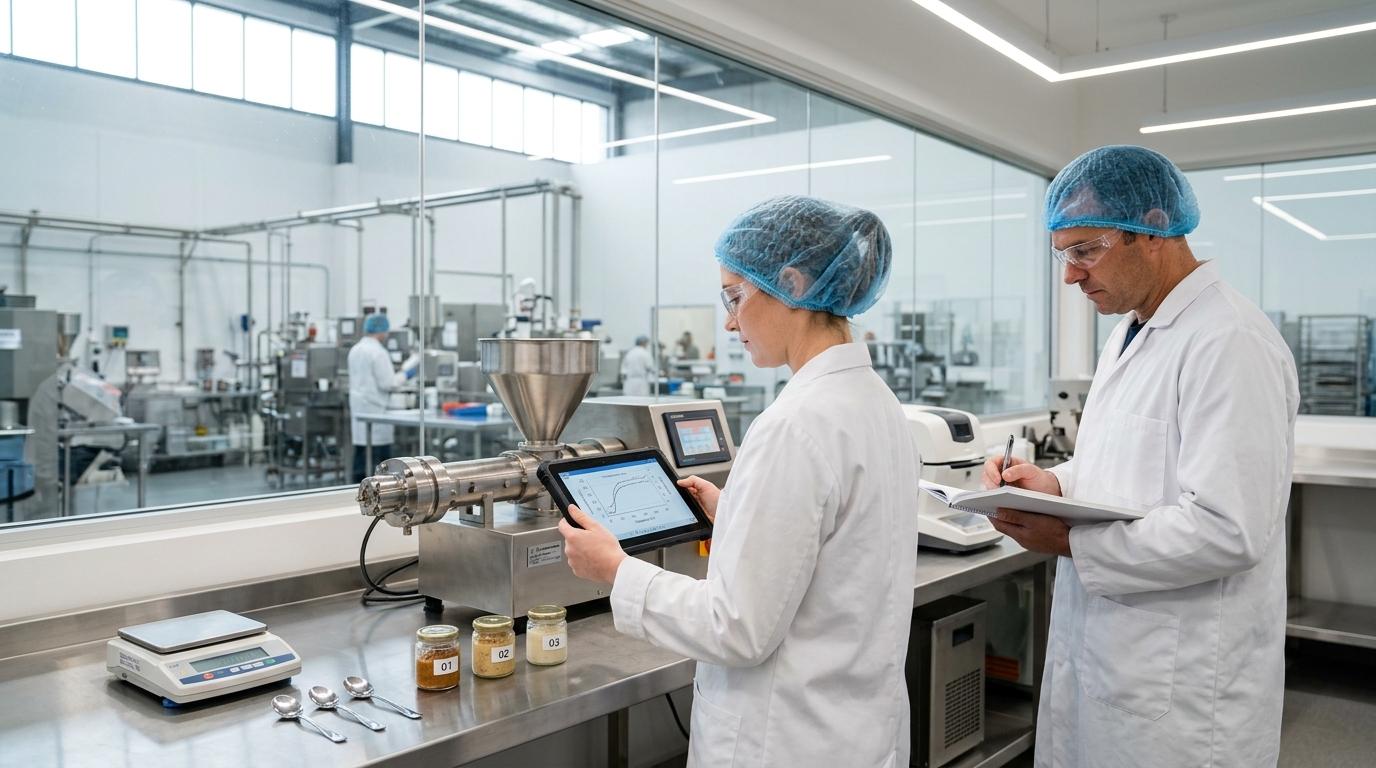
Every week across Australia, mid-tier food and beverage manufacturers run production trials that push the boundaries of food science: replacing synthetic preservatives with natural fermentation hurdles, reformulating high-protein or GLP-1-friendly products without chalky texture, engineering PFAS-free barrier packaging that still survives a 12-month freeze-thaw cycle, or scaling a kitchen emulsion up to a 2,000-litre shear mixer without phase separation.
Yet industry advisers consistently see two opposite mistakes when Australian food processors approach the federal government's Research and Development Tax Incentive (R&DTI):
- Under-claiming: Treating genuine experimental process and shelf-life trials as ordinary "kitchen NPD" and walking past a 43.5% refundable tax offset (worth $87,000 to $185,000+ per year for a typical innovative mid-sized processor).
- Over-claiming without evidence: Bundling routine flavour extensions, packaging artwork updates, or standard commercial production runs into an R&D claim with no contemporaneous hypotheses or batch trial logs—and facing a painful clawback audit from AusIndustry (Department of Industry, Science and Resources) and the Australian Taxation Office (ATO).
This guide explains how the R&D Tax Incentive works for Australian food and beverage manufacturers, the legal line between routine New Product Development (NPD) and eligible Core R&D Activities, how Feedstock Adjustments apply when trial batches are sold, and how to structure your digital recipe and batch records so they pass an AusIndustry review.
How the R&D Tax Incentive Works: The 43.5% Refundable Offset Explained
The R&DTI is jointly administered by AusIndustry (which registers and assesses whether your technical activities meet the statutory definition of R&D under Division 355 of the Income Tax Assessment Act 1997) and the ATO (which verifies and processes your eligible expenditure claim on your company tax return).
The financial benefit depends on your company's aggregated annual turnover:
| Company Aggregated Turnover | Corporate Tax Rate | R&D Tax Offset Structure | Effective Tax Benefit / Cash Value |
|---|---|---|---|
| Under $20 million (Base Rate Entity SME) | 25.0% | 43.5% Refundable Tax Offset (Company tax rate + 18.5% premium) | Net 18.5 cents in the dollar on top of the standard 25% tax deduction—or 43.5 cents per dollar returned as a direct cash refund if the company is in a tax-loss position |
| $20 million or more (Tier 1: R&D Intensity 0% to 2% of total expenses) | 30.0% | 38.5% Non-Refundable Tax Offset (Company tax rate + 8.5% premium) | Net 8.5 cents per dollar permanent tax saving (carried forward if in tax loss) |
| $20 million or more (Tier 2: R&D Intensity > 2% of total expenses) | 30.0% | 46.5% Non-Refundable Tax Offset on expenditure above the 2% threshold (Company tax rate + 16.5% premium) | Net 16.5 cents per dollar permanent tax saving on the incremental tier |
Minimum expenditure threshold: Your company must incur at least $20,000 in eligible notional R&D deductions in an income year (unless expenditure is incurred through a registered Research Service Provider or Cooperative Research Centre).
Why the "Refundable" Offset Is a Game-Changer for Scaling Food Brands
If an Australian food manufacturer with $12 million in annual turnover spends $300,000 on eligible R&D salaries, pilot ingredients, laboratory shelf-life testing and line trials during a financial year:
- If the business is profitable, the $300,000 R&D claim reduces its net company tax bill by $55,500 more than a normal business expense deduction ($130,500 offset vs $75,000 standard 25% deduction).
- If the business is in a tax-loss position (for example, because it invested heavily in new automated lines or export market entry), the ATO pays the full $130,500 (43.5% of $300,000) as a cash refund, injecting non-dilutive working capital straight back into the factory.
The Crucial Distinction: Routine Kitchen NPD vs Eligible Core R&D
Here is the number-one reason food manufacturing claims get challenged during an AusIndustry compliance review: not all New Product Development (NPD) is eligible R&D.
Under section 355-25 of the Income Tax Assessment Act 1997, a Core R&D Activity must be an experimental activity:
- Whose outcome cannot be known or determined in advance on the basis of current knowledge, information or experience (would a competent food scientist or process engineer know whether it works without running the experiment?);
- Which can only be determined by applying a systematic progression of work that is based on principles of established science and proceeds from hypothesis → experiment → observation and evaluation → logical conclusions; and
- Which is conducted for the purpose of generating new knowledge (including new or improved materials, products, devices, processes or services).
Food Manufacturing R&D Eligibility Matrix
| Factory / NPD Activity | Usually INELIGIBLE (Routine Commercial NPD) | Likely ELIGIBLE (Core or Supporting R&D Activity) |
|---|---|---|
| Flavour & Range Extensions | Launching a "Peri-Peri" or "Garlic & Herb" variant of an existing sauce using known ingredient ratios and existing cooking parameters | Developing a novel micro-encapsulated volatile flavour system that survives high-temperature UHT or retort sterilisation (121°C) without thermal degradation |
| Sugar, Sodium & Fat Reformulation | Reducing sugar by 10% and adding a standard commercial stevia blend according to the supplier's technical data sheet | Systematically testing multi-component hydrocolloid, fibre and allulose/polyol matrices to replicate the water activity ($a_w$), Maillard browning and glass-transition structural stability of sucrose in a baked bar |
| Preservative-Free & Clean-Label Shelf Life | Running a standard NATA lab shelf-life test on a finished product to confirm a 14-day use-by date for a supermarket spec | Experimenting with natural organic acid buffers, bacteriocin fermentates and modified atmosphere packaging (MAP) gas ratios to inhibit Listeria and extend chilled shelf life from 14 to 45 days without sensory souring |
| Plant-Based, Hybrid & Upcycled Ingredients | Mixing a commercial pea-protein isolate into a smoothie recipe | Engineering a shear-extrusion or enzymatic cross-linking process to turn upcycled brewer's spent grain or fruit pomace into a shelf-stable functional flour without lipid oxidation |
| Commercial Line Scale-Up Trials | Routine commissioning and operator training on an off-the-shelf packaging machine | Iterative commercial-scale process experiments where non-linear fluid dynamics, heat-transfer rates or shear forces in a 2,000kg industrial vessel cause emulsion breakdown not seen in 5kg lab benches |
| Consumer Tasting & Market Research | Focus groups asking shoppers whether they prefer packaging design A or B, or general hedonic "liking" panels | Quantitative descriptive sensory evaluation and texture-profile analysis (TPA) measuring whether a specific experimental formulation variable met a technical hypothesis |
What Counts as Eligible R&D Expenditure on the Factory Floor?
Once a project has at least one valid Core R&D Activity, you can claim both the direct costs of the Core experiments and the Supporting R&D Activities directly related to them (or undertaken for the dominant purpose of supporting them, where the activity produces goods or is otherwise excluded from being a Core activity):
- R&D Staff Salaries & On-Costs: The proportion of wages, superannuation, payroll tax and workers' compensation for food technologists, R&D chefs, QA microbiologists, process engineers and production operators while actively planning, setting up, running, cleaning down and evaluating R&D trial batches.
- Raw Materials, Ingredients & Packaging Consumed in Trials: The cost of ingredients, packaging film and consumables used in benchtop, pilot and full-scale factory trial runs.
- External Laboratory & Testing Fees: NATA-accredited microbiological challenge tests, water activity ($a_w$) and rheology testing, nutritional analysis, and sensory lab fees tied to evaluating your experimental hypotheses.
- Contractors & Consultants: Australian-based food science consultants, process engineers or university research groups engaged to assist with the experiments.
- Decline in Value (Depreciation) of R&D Plant & Equipment: The proportional depreciation of pilot equipment—or the percentage of time commercial production lines were taken offline specifically to run experimental R&D trials.
- Apportioned Factory Overheads: A reasonable, verifiable allocation of factory utilities (power, gas, water) and facility costs directly attributable to R&D activities.
Watch Out for the "Feedstock Adjustment" When You Sell Trial Batches
In food and beverage manufacturing, full-scale factory line trials often produce hundreds or thousands of saleable units. For example, if you run a 1,500kg experimental dough trial to test whether a new enzyme regime prevents staling on a high-speed commercial oven, and the trial succeeds, you might sell that batch to a customer or discount channel rather than sending 1,500kg of edible food to landfill.
Can you still claim the R&D trial if you sold the resulting product?
Yes—subject to the ATO's Feedstock Adjustment rules:
- You can still claim the full R&D labour, engineering time, laboratory testing and process development costs of the trial.
- However, where your R&D activity produces tangible products that are supplied to someone else (sold) or applied to your own use, the Feedstock Adjustment claws back the R&D tax offset premium on the feedstock input costs (the raw materials, ingredients and energy directly transformed into the sold goods), limited to the lesser of the feedstock input cost or the revenue received.
- If a trial batch fails quality tolerances or is destroyed/consumed during destructive shelf-life and sensory testing, no feedstock adjustment applies—100% of the raw material cost remains eligible for the full 43.5% offset.
That is why your batch management system must record what happened to the output of every R&D trial batch: whether it was destroyed after testing, held in quarantine for shelf-life incubation, or released for commercial sale.
Why AusIndustry & the ATO Audit Food Claims—and How to Be Audit-Ready
In recent years, AusIndustry and the ATO have increased joint compliance reviews on manufacturing and agribusiness R&D claims. The single biggest failure point is retrospective reconstruction: a tax consultant interviews the R&D manager in March, writes up a plausible-sounding technical narrative nine months after the financial year ended, and when AusIndustry asks for the contemporaneous records created during the experiments, the company only has a folder of supplier invoices and generic timesheets.
To survive an AusIndustry or ATO audit, every R&D project needs a contemporaneous audit trail:
| Audit Requirement | What AusIndustry / ATO Reviewers Ask to See | How to Capture It Contemporaneously in Your Factory |
|---|---|---|
| 1. Prior Literature & Knowledge Search | Proof that the answer was not already publicly available in supplier data sheets, textbooks or standard industry practice | Save supplier technical bulletins, initial formulation calculations and notes explaining why standard ratios failed |
| 2. Specific Technical Hypothesis | A testable "If we change X variable [e.g., shear speed / hydrocolloid ratio], then Y measurable outcome [e.g., viscosity / $a_w < 0.91$] will occur because Z scientific mechanism" | Log the specific hypothesis in the R&D project brief before mixing the trial batch |
| 3. Versioned Recipe & Batch Trial Logs | Exact ingredient weights, processing temperatures, mixing speeds, pH, $a_w$ and yield losses for Trial v1, v2, v3, v4 | Use a digital recipe and batch system (Batchbase) that versions every trial iteration and timestamps operator observations |
| 4. Observed Results & Failures | Evidence of failed trials, phase separation, microbial growth or sensory rejection that forced the next iteration | Never delete failed trial batches! Failed experiments are your strongest legal proof that the outcome could not be known in advance |
| 5. Time & Cost Attribution | Contemporaneous timesheets or batch duration logs showing who worked on each trial, plus raw material lot usage | Tag R&D trial batches in your production system so ingredient costs, batch duration and waste/sale disposition are tracked automatically |
Key Deadlines: Don't Miss the 10-Month AusIndustry Window
The R&D Tax Incentive operates on a strict statutory deadline:
- AusIndustry Registration Deadline: You must register your R&D activities via the R&D Tax Incentive Customer Portal within 10 months after the end of your company's income year.
- For companies on a standard Australian financial year (1 July to 30 June), the registration deadline is 30 April of the following year.
- For companies on a calendar year (1 January to 31 December), the deadline is 31 October.
- ATO Tax Return Lodgement: After AusIndustry issues your Registration Number, your accountant includes the R&D Tax Incentive Schedule in your company income tax return.
A Practical 5-Step R&D Tracking Workflow in Your Plant
- Tag R&D Projects at Project Kick-Off: Whenever R&D or operations starts solving a genuine technical problem (shelf-life extension, clean-label reformulation, allergen-free matrix replacement, waste upcycling, or process scale-up), open a dedicated R&D project record and write down the technical uncertainty and hypothesis on Day 1.
- Version Every Trial Recipe Digitally: Instead of overwriting an Excel spreadsheet ten times, save each experimental formulation as a distinct version (
V1.0,V1.1,V1.2) in Batchbase so you can show an auditor the exact progression of variables tested. - Log Trial Batches with Operator Timestamps & QC Measurements: Record actual batch start/finish times, ingredient lot weights, pH, Brix, water activity ($a_w$) and viscosity directly against the trial batch.
- Record Final Batch Disposition (Scrap vs Lab Sample vs Sold): Clearly mark whether each trial batch was destroyed, sent for NATA shelf-life testing, or sold commercially (for accurate Feedstock Adjustment calculation).
- Conduct Quarterly R&D Reviews: Meet with your R&D tax adviser once a quarter rather than once a year so contemporary evidence is collated while trials are fresh.
Frequently Asked Questions
Can we claim the R&D Tax Incentive if our trial failed and we never launched the product? Yes—in fact, a failed or abandoned project often has the clearest evidence of genuine technical uncertainty! Eligibility under the R&D Tax Incentive depends on whether you conducted a systematic experimental process to resolve a technical unknown, not whether the final product succeeded commercially.
Can a contract manufacturer (co-packer) and a brand owner both claim the same R&D trial? No. Under the "for whom" (on own behalf) rules, only the entity that bears the financial risk, controls the conduct of the R&D activities, and effectively owns the resulting technical know-how/IP can claim the expenditure. Your co-manufacturing agreement should clearly specify who owns new process vs formulation IP and who pays for experimental line trials.
Does getting a government grant stop us from claiming the R&D Tax Incentive? If you receive a government grant (such as a Cooperative Research Centres Projects grant or state manufacturing grant) for the same project, a Clawback Adjustment applies to the specific expenditure funded by the grant so you do not double-dip, while your self-funded R&D expenditure above the grant remains eligible.
The Bottom Line
For innovative Australian food and beverage manufacturers, the 43.5% R&D Tax Incentive is one of the most powerful sources of non-dilutive cash flow available—provided you treat R&D documentation with the same discipline as food safety and HACCP. By capturing versioned recipes, hypotheses, trial batch costs and quality measurements in real time inside a connected system like Batchbase, you turn everyday factory innovation into an audit-proof R&D claim.
References
- business.gov.au (AusIndustry / DISR) – Research and Development Tax Incentive Overview & Portal
- Australian Taxation Office (ATO) – Research and Development Tax Incentive Guide & Offset Rates
- ATO – Feedstock Adjustments Under the R&D Tax Incentive
- Department of Industry, Science and Resources – Guide to Interpretation: What Is an Eligible Core and Supporting R&D Activity