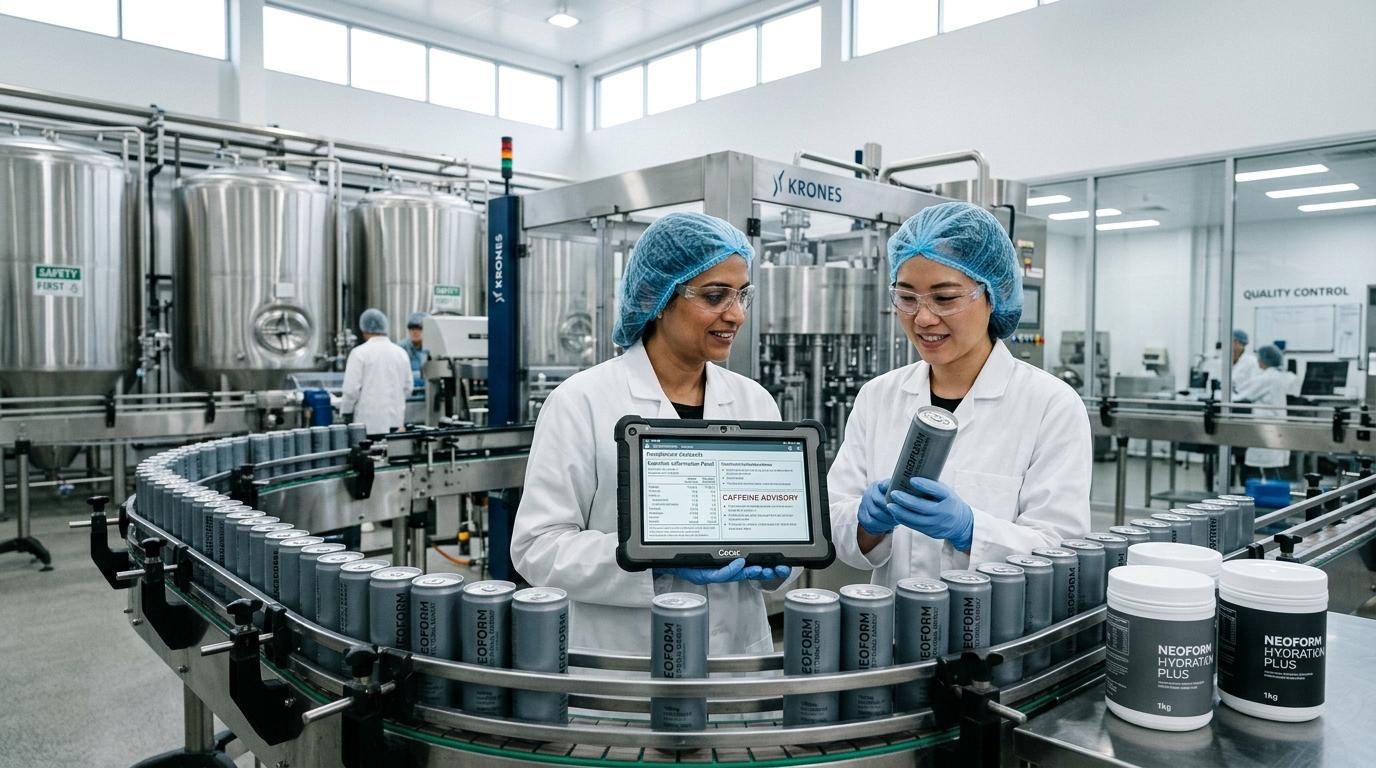
Few categories in Australian food and beverage manufacturing have grown faster over the past three years than functional beverages, energy drinks, nootropics, hydration powders and performance sports foods. Walk into any supermarket, petrol convenience store or gym in 2026 and you will find ready-to-drink (RTD) cans and single-serve sachets promising sharper focus, pre-workout energy, gut health, electrolyte recovery or adaptogenic stress relief.
Yet behind the rapid sales growth, this category sits on the sharpest regulatory fault line in Australian consumer law: the boundary between the FSANZ Australia New Zealand Food Standards Code and the Therapeutic Goods Administration (TGA) under the Therapeutic Goods Act 1989.
With the implementation of FSANZ Proposal P1056 (Caffeine Review)—which overhauled caffeine permissions, banned retail sales of pure/concentrated caffeine foods, and introduced strict 200 mg daily caffeine caps and mandatory advisory warnings under Standard 2.9.4 (Formulated Supplementary Sports Foods)—alongside the TGA's legal reclassification of certain sports supplements as therapeutic medicines, a single formulation or label error can trigger an immediate FSANZ food recall or TGA enforcement fines.
This guide explains the four regulatory buckets for functional beverages and powders in Australia, the exact caffeine limits and warning statements required under Standard 2.6.4 and Standard 2.9.4 after Proposal P1056, how to avoid crossing into TGA therapeutic territory, and how to validate functional formulations before printing a single can or tub.
The Four Regulatory Buckets: What Is Your Product Legally?
In Australia, there is no legal category in the Food Standards Code called a "functional beverage" or a "nootropic drink". Every product you manufacture must fit cleanly into one specific regulatory category—and you cannot mix and match permissions across categories.
| Regulatory Category | Governing Standard / Law | Typical Product Formats | Permitted Caffeine Range & Key Compositional Rules |
|---|---|---|---|
| 1. General Food / Non-Dairy Beverage / Iced Coffee | FSANZ General Food Standards (Standard 1.1.1, 1.3.1, 2.6.2) | RTD iced coffee, cold-brew coffee, matcha/tea drinks, non-caffeinated botanical or electrolyte drinks | Caffeine only allowed where naturally present in tea, coffee, cocoa or guarana ingredients (or restricted flavouring limits in kola drinks); mandatory advisory statements apply under P1056 if caffeine exceeds thresholds |
| 2. Formulated Caffeinated Beverage (FCB / "Energy Drink") | FSANZ Standard 2.6.4 | Carbonated or non-carbonated energy drinks (cans/bottles) | Must contain between 145 mg/L and 320 mg/L of total caffeine (from all sources, including guarana); strict maximum one-day quantity limits on added vitamins, taurine, glucuronolactone and inositol |
| 3. Formulated Supplementary Sports Food (FSSF) | FSANZ Standard 2.9.4 (as amended by Proposal P1056) | Pre-workout powders, RTD sports performance drinks, protein/amino/electrolyte sports supplements | Must be specifically formulated to assist sports people in achieving nutritional or performance goals; under P1056, total caffeine is capped at max 200 mg per one-day quantity (plus concentration caps in powders/liquids) |
| 4. Therapeutic Good (Listed / Registered Medicine) | TGA (Therapeutic Goods Act 1989 & Section 7 Declarations) | Capsules, tablets, pills, OR sports supplements containing higher-risk / WADA-prohibited substances | NOT A FOOD: Must be entered on the Australian Register of Therapeutic Goods (ARTG) with an AUST L or AUST R number and manufactured in a TGA GMP-licensed pharmaceutical facility |
Why Mixing Categories Triggers Immediate Recalls
One of the most common compliance failures among emerging Australian beverage brands is creating a "hybrid" drink that accidentally violates two standards at once:
- Example A (The Under- or Over-Dosed Energy Drink): A manufacturer formulates a 330 mL sparkling botanical drink with 125 mg of added synthetic caffeine (which equals 378 mg/L). Because 378 mg/L exceeds the 320 mg/L legal ceiling for a Formulated Caffeinated Beverage under Standard 2.6.4, it is illegal as an energy drink—and unless it meets every compositional, labelling and daily-dose rule of a Formulated Supplementary Sports Food under Standard 2.9.4, it cannot be sold in Australia.
- Example B (Adding Sports Amino Acids to a Standard Beverage): A brand adds L-citrulline, beta-alanine or high-dose B-vitamins to a fruit-flavoured sparkling water and markets it as a general lifestyle drink without formatting the label as a Formulated Supplementary Sports Food (Standard 2.9.4) or a Formulated Beverage (Standard 2.6.2). Because amino acids and nutritive substances are only permitted in specific scheduled categories at strict maximum claim limits, state food authorities treat the product as containing unpermitted nutritive substances.
What FSANZ Proposal P1056 Changed for Caffeine and Sports Foods
FSANZ initiated Proposal P1056 (Caffeine Review) following tragic fatalities linked to pure caffeine powders and widespread public-health concern over ultra-high-caffeine pre-workout supplements that previously exploited ambiguities in Standard 2.9.4.
Here are the core legal rules food and supplement manufacturers must comply with under the P1056 amendments:
1. Total Ban on Retail Sale of Pure and Highly Concentrated Caffeine
The Code prohibits the retail sale of foods consisting of pure or highly concentrated caffeine—specifically setting strict upper concentration thresholds (5% or more caffeine in solid/semi-solid foods and 1% or more caffeine in liquid foods) for retail sale to consumers.
2. New Caffeine Caps in Formulated Supplementary Sports Foods (Standard 2.9.4)
Previously, some powdered pre-workout supplements sold under Standard 2.9.4 delivered 350 mg to 450 mg+ of caffeine per scoop. Under the updated Code:
- Total caffeine (from all sources combined, including anhydrous caffeine, green tea extract, coffee bean extract, guarana and yerba mate) in a Formulated Supplementary Sports Food must not exceed 200 mg in a one-day quantity based on the label's directions for use.
- Concentration limits also apply (staying well below the prohibited high-concentration retail thresholds, with specific compositional limits for dry powders vs ready-to-drink formats).
3. Mandatory Caffeine Declarations and Advisory Warning Statements
When manufacturing either a Formulated Caffeinated Beverage (Standard 2.6.4) or a caffeinated Formulated Supplementary Sports Food (Standard 2.9.4), your label must carry:
- Quantitative Caffeine Declaration: Exact milligrams of total caffeine per serve and per 100 mL (or 100 g), including caffeine contributed by guarana or botanical extracts.
- Mandatory Advisory Statements: Explicit warnings stating that the food contains caffeine and is not recommended for children, pregnant or lactating women, or individuals sensitive to caffeine, plus a statement specifying the maximum recommended daily consumption (in number of cans, bottles or scoops) so the consumer does not exceed the 200 mg / one-day limit.
- No Mixing with Alcohol Claims: Labelling must not represent that a caffeinated product is to be mixed with alcoholic beverages.
The TGA Sports Supplement Boundary: Why Presentation Form (Powder vs Pill) Matters
In 2020 (with phased enforcement taking full effect by 30 November 2023), the Therapeutic Goods Administration issued the Therapeutic Goods (Declared Goods) Order under Section 7 of the Therapeutic Goods Act 1989.
That legal order permanently redrew the boundary between FSANZ food factories and TGA pharmaceutical plants for any product making performance, sport, exercise, muscle, energy or weight-management claims.
A sports or functional supplement is legally declared to be a Therapeutic Good (Medicine)—and cannot be manufactured or sold as a food under FSANZ—if it makes (or implies) a therapeutic or physical performance claim AND meets either of the following two triggers:
Trigger 1: High-Risk Ingredients
The product contains any substance (above applicable cut-offs) that is:
- Listed in a Schedule to the Australian Poisons Standard (SUSMP);
- Included on the World Anti-Doping Agency (WADA) Prohibited List; or
- Explicitly specified by the TGA (such as certain stimulants or hormone precursors).
Trigger 2: Medicinal Presentation Form (Tablets, Capsules or Pills)
Even if every single ingredient inside the product is a normal, legal food ingredient (such as caffeine, whey protein, electrolytes, creatine or B-vitamins):
- If the product is presented in the form of a tablet, capsule or pill (rather than a beverage, bar, gel or bulk powder to be mixed with water), and is marketed for sports/performance, it is legally a therapeutic medicine and must have an ARTG listing (
AUST L) and be made in a TGA GMP-licensed facility. - Conversely, if it is presented as a traditional food format (powder tub/sachet, RTD beverage can, liquid shot, bar or gel) and contains only food-permitted ingredients within Standard 2.9.4 limits, it remains regulated as a Food under FSANZ.
Botanical Nootropics & Adaptogens: The Novel Food (Standard 1.5.1) Trap
Beyond caffeine and amino acids, many functional beverage briefs ask contract manufacturers to add trending overseas adaptogens, medicinal mushrooms and nootropics—such as Ashwagandha (Withania somnifera), Lion's Mane (Hericium erinaceus), Cordyceps, Rhodiola rosea, L-theanine, 5-HTP or Kava.
Before accepting a co-packing run or ordering raw materials, every Australian formulator must check three separate lists:
- FSANZ Standard 1.4.4 (Prohibited and Restricted Plants and Fungi): Several medicinal herbs and alkaloids that are legal in US dietary supplements or TGA listed medicines are expressly prohibited in general foods in Australia.
- FSANZ Standard 1.5.1 (Novel Foods) & the ACNF Database: Under Australian law, an ingredient or concentrated botanical extract that does not have an established history of human consumption as a food in Australia or New Zealand is a Novel Food and cannot be sold until it undergoes a formal FSANZ pre-market safety assessment. Notably, the Advisory Committee on Novel Foods (ACNF) has issued specific determinations on concentrated mushroom extracts, isolated amino acids (such as pure L-theanine outside permitted sports/special purpose categories) and concentrated botanical extracts.
- FSANZ Standard 1.2.7 (Nutrition, Health and Related Claims): You cannot print claims like "Reduces anxiety", "Treats ADHD/brain fog" or "Lowers cortisol" on a food label. Therapeutic claims (preventing, diagnosing, curing or alleviating a disease, ailment or defect) are strictly prohibited on foods, and general-level health claims must be backed by a pre-approved food-health relationship in Schedule 4 or a formal self-substantiated systematic review dossier notified to FSANZ.
Worked Formulation Audit: Why "Total Caffeine From All Sources" Catches Brands Out
Suppose an Australian beverage start-up develops a 355 mL functional energy drink and asks a contract beverage canner to produce 50,000 cans. The R&D brief lists three ingredients contributing to the "energy blend":
| Ingredient in 355 mL Can | Input Weight per Can | Natural / Added Caffeine Concentration | Actual Caffeine Contributed per Can (mg) | Actual Caffeine per Litre (mg/L) |
|---|---|---|---|---|
| Caffeine Anhydrous (Synthetic) | 95.0 mg | 100% pure caffeine | 95.0 mg | 267.6 mg/L |
| Guarana Seed Extract (Paullinia cupana) | 120.0 mg | Standardised to 22% caffeine | 26.4 mg | 74.4 mg/L |
| Green Tea Extract (Camellia sinensis) | 100.0 mg | Naturally contains 4% caffeine | 4.0 mg | 11.3 mg/L |
| Total Combined Caffeine | — | — | 125.4 mg / can | 353.2 mg/L (NON-COMPLIANT!) |
Look at what happened:
- The brand founder only looked at the 95 mg of Caffeine Anhydrous (which is 267.6 mg/L—well below the 320 mg/L ceiling in Standard 2.6.4).
- However, once the 26.4 mg of caffeine inside the 22% Guarana Extract and the 4.0 mg of caffeine inside the Green Tea Extract are summed, the beverage actually contains 125.4 mg per 355 mL can, or 353.2 mg/L—exceeding the 320 mg/L statutory maximum under Standard 2.6.4 by more than 10%!
- If canned and distributed without catching that sub-ingredient calculation, all 50,000 cans are legally non-compliant and subject to regulatory withdrawal or recall.
How to Prevent Functional Formulation Errors Using Digital Recipe Software
When you manage complex functional beverages or sports powders in Batchbase:
- Sub-Ingredient Active Compound Roll-Up: You enter the exact caffeine percentage on every raw material specification (e.g.,
Caffeine Anhydrous = 100%,Guarana Extract 22% = 22%,Green Tea Extract = 4%,Cocoa Powder = 0.2%). As soon as a formulator adjusts gram weights in a recipe, the software automatically calculates Total Combined Caffeine in mg/serve, mg/100mL and mg/L. - Automated Regulatory Threshold Alerts: If a recipe tagged as a Formulated Caffeinated Beverage (Standard 2.6.4) crosses 320 mg/L (or drops below 145 mg/L), or if a Formulated Supplementary Sports Food (Standard 2.9.4) exceeds 200 mg per daily recommended dose, the system flags the breach before artwork is generated.
- Locked Mandatory Advisory Statements: Based on the product's regulatory standard and caffeine level, the specification automatically attaches the exact prescribed Standard 1.2.3 / 2.6.4 / 2.9.4 warning and advisory statements to the label brief.
Frequently Asked Questions
Can we sell a US-formulated pre-workout or energy drink in Australia using a stick-on Australian NIP label? Only if the underlying liquid or powder formulation itself complies 100% with the Australia New Zealand Food Standards Code. Many US supplements (regulated under DSHEA in the United States) contain >320 mg/L caffeine in RTDs, >200 mg daily caffeine in sports powders, or botanicals/amino acids prohibited in Australian foods. Putting an Australian sticker on an illegal formulation does not make it legal.
Does decaffeinated coffee or cocoa still count toward total caffeine? Where caffeine is required to be declared, the declaration must reflect the true total caffeine present in the finished food from all contributing ingredients, verified by analytical testing where levels sit close to regulatory thresholds.
What is the penalty for selling an unapproved therapeutic good as a food? Under the Therapeutic Goods Act 1989, importing, manufacturing or supplying an unapproved therapeutic good not entered on the ARTG carries severe civil and criminal penalties, alongside mandatory product recalls and TGA infringement notices (which routinely exceed $18,000+ per individual infringement notice issued to companies).
The Bottom Line
Functional beverages and sports foods offer some of the highest margins in Australian food and beverage manufacturing, but the regulatory tolerance for error after FSANZ Proposal P1056 and the TGA Sports Supplement declaration is zero. By classifying every SKU into its exact legal standard on Day 1, rolling up caffeine and nutritive substances across every sub-ingredient automatically, and validating health claims against Standard 1.2.7, you can innovate quickly without risking a regulatory recall.
References
- FSANZ – Proposal P1056: Caffeine Review Final Approval & Amendments
- FSANZ – Standard 2.6.4 Formulated Caffeinated Beverages & Standard 2.9.4 Formulated Supplementary Sports Foods
- Therapeutic Goods Administration (TGA) – Sports Supplements Regulatory Guidance & Section 7 Declaration
- FSANZ – Advisory Committee on Novel Foods (ACNF) Record of Views
- FSANZ – Standard 1.2.7 Nutrition, Health and Related Claims