If your food or beverage manufacturing business turns over less than $100 million a year, it is easy to assume Australia's Modern Slavery Act 2018 (Cth) does not apply to you.
In practice, almost every mid-tier Australian food processor supplying major supermarkets, quick-service restaurant (QSR) chains, airlines, hospitals or foodservice distributors is already squarely inside the compliance net.
Why? Because Coles, Woolworths, ALDI, Metcash, McDonald's, Nestlé, Unilever and major foodservice groups all exceed the statutory reporting threshold—and following the landmark statutory review of the Modern Slavery Act and the appointment of Australia's inaugural Australian Anti-Slavery Commissioner (who commenced in December 2024), those customers are cascading strict, legally binding ethical sourcing requirements directly down to their Tier 1 and Tier 2 food manufacturers.
For a growing Australian food business, that cascade usually arrives in one of two ways: a commercial contract clause requiring active registration and a completed Self-Assessment Questionnaire (SAQ) on SEDEX (Supplier Ethical Data Exchange), or a notification that your factory must pass an independent 2-Pillar or 4-Pillar SMETA (Sedex Members Ethical Trade Audit) to keep its retail listing.
This guide explains how Australia's modern slavery regulatory framework is tightening, which agricultural and imported food ingredients carry the highest risk flags, how SEDEX and SMETA audits work on an Australian factory floor, and a practical playbook to pass ethical sourcing audits without drowning your QA team in duplicate paperwork.
How Australia's Modern Slavery Framework Has Tightened
Under the Modern Slavery Act 2018 (Cth), entities based or operating in Australia with annual consolidated revenue of $100 million or more must submit an annual Modern Slavery Statement to the Online Register for Modern Slavery Statements, detailing the risks of modern slavery in their operations and supply chains and the actions taken to address them.
Following Professor John McMillan's statutory review of the Act (Report of the Statutory Review of the Modern Slavery Act 2018, tabling 30 recommendations) and the Australian Government's reform agenda:
- The Australian Anti-Slavery Commissioner Is Now Active: Established under the Modern Slavery Amendment (Australian Anti-Slavery Commissioner) Act 2024, the Commissioner (Chris Evans, appointed late 2024) leads national engagement on supply-chain due diligence, high-risk sector guidance, and support for business compliance.
- Shift from "Reporting" to Enforceable Due Diligence & Penalties: The government agreed in principle with key review recommendations to introduce civil penalties for failing to submit statements or providing false information, mandate enforceable human rights due diligence duties (rather than mere reporting), and introduce a formal high-risk declaration power for specific regions, industries or commodities. The review also recommended lowering the reporting threshold from $100 million to $50 million.
- Convergence with Global Export Rules: Australian food exporters now navigate overlapping international forced-labour and supply-chain laws, including the US Uyghur Forced Labor Prevention Act (UFLPA), the UK Modern Slavery Act, and the EU Corporate Sustainability Due Diligence Directive (CSDDD).
Why Food and Beverage Manufacturing Is Ranked a High-Risk Sector
Academic benchmarking by university human-rights centres, the Walk Free Foundation's Global Slavery Index, and the Australian Anti-Slavery Commissioner consistently identify food, beverage and agriculture as one of the highest-risk sectors for modern slavery and severe labour exploitation—both globally and domestically.
| Supply Chain Tier | High-Risk Ingredients & Inputs for Australian Food Manufacturers | Primary Modern Slavery & Labour Risk Indicators |
|---|---|---|
| Imported Agricultural Commodities (Tier 2–4) | Cocoa (West Africa), Coffee, Palm Oil (Southeast Asia), Cane Sugar, Cashews & Tree Nuts, Spices & Vanilla, Coconut, Tomato Paste | Forced and child labour on smallholdings, debt bondage, withholding of identity documents, opaque broker aggregation |
| Imported Seafood & Marine Ingredients | Prawns, tuna, surimi, fishmeal and marine collagen from high-risk distant-water or regional processing hubs | Forced labour at sea, transhipment opacity, excessive unpaid overtime in peeling/canning sheds |
| Domestic Horticulture & Primary Processing (Australia) | Fresh fruit, vegetables, herbs, meat processing/abattoirs and poultry | Unlicensed rogue labour-hire contractors, illegal piece-rate underpayments, deceptive recruitment fees, substandard tied accommodation for migrant or seasonal workers |
| Factory On-Site Services & Packaging | Contract night-shift sanitation/cleaning crews, third-party labour-hire packing staff, imported flexible packaging and cartons | Cash-in-hand underpayment below 2026 Modern Award rates, ABN sham contracting, visa working-hour breaches, unsafe night-shift isolation |
Look closely at that fourth row: Factory On-Site Services & Labour Hire.
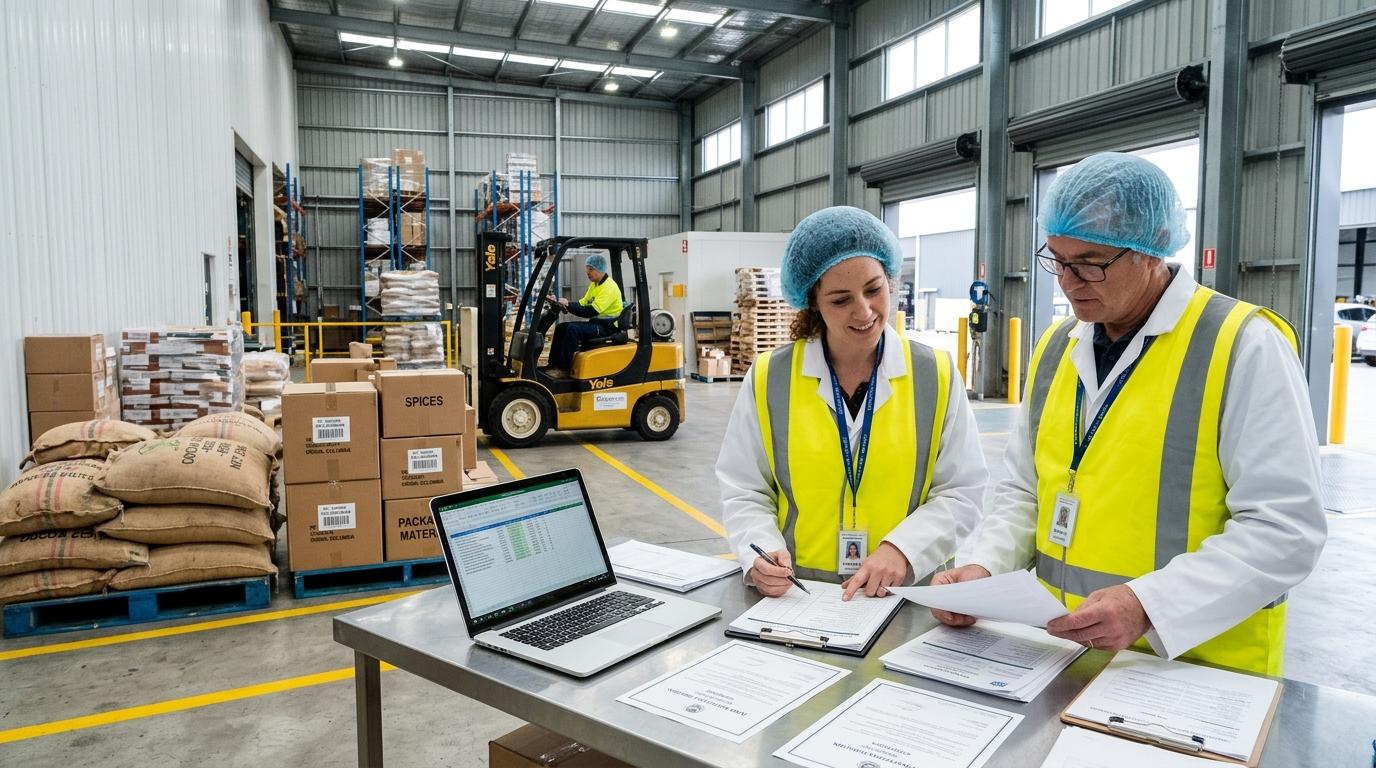
Many Australian food manufacturers assume modern slavery compliance is solely about overseas cocoa or palm oil farms. Yet when a SMETA auditor walks into an Australian food plant, the single most common source of Critical or Major Non-Conformances is right inside the building: third-party labour-hire agencies and contracted night-shift cleaning crews whose workers do not have verified right-to-work checks, compliant payslips, Payday Super contributions, or safe fatigue limits.
Understanding SEDEX and SMETA: What Retailers Actually Require
To avoid sending every food supplier a different 80-page spreadsheet, Coles, Woolworths, ALDI and major global food brands use SEDEX as the standard ethical sourcing data platform for the Australian grocery industry.
How the SEDEX Workflow Operates for an Australian Food Processor
- SEDEX Supplier (B-Member) Registration: Your manufacturing site registers on SEDEX (obtainable as a site "ZC" number) and links your profile to your retail customers (such as Coles or Woolworths) so they have visibility of your site's compliance status.
- The SEDEX Self-Assessment Questionnaire (SAQ): You complete the comprehensive site SAQ covering your workforce demographics (permanent, casual, labour hire, migrant workers), working hours, wage and super compliance, health and safety, environmental permits and raw-material supplier management. Keep the SAQ at 100% completion and refresh it annually.
- Inherent Risk Scoring (Radar): The retailer's ethical sourcing team reviews your SAQ alongside SEDEX's risk tool. Depending on your product category, workforce profile (e.g., use of labour hire or seasonal staff) and turnover volume, the retailer assigns your site a risk tier.
- Independent SMETA Audit (2-Pillar or 4-Pillar): Medium- and high-risk sites—or any private-label co-manufacturer—are required to commission an independent SMETA audit conducted by an APSCA-registered (Association of Professional Social Compliance Auditors) audit firm.
2-Pillar vs 4-Pillar SMETA Audits Explained
| SMETA Audit Scope | Pillars Audited | Typical Duration (Mid-Sized Food Plant, 30–100 Staff) | What the Auditor Inspects on Site |
|---|---|---|---|
| SMETA 2-Pillar (Mandatory Baseline) | Pillar 1: Labour Standards + Pillar 2: Health & Safety (plus Management Systems, Entitlement to Work, Subcontracting & Homeworking) | 1.5 to 2.5 auditor days on site | Payroll records, timesheets, clock-in/out logs, visa/VEVO checks, labour-hire agreements, confidential worker interviews (without managers present), WHS & emergency exits |
| SMETA 4-Pillar (Full ESG Scope) | Pillars 1 & 2 + Pillar 3: Environment (4-Pillar) + Pillar 4: Business Ethics | 2 to 3 auditor days on site | All 2-Pillar items PLUS trade waste permits, energy/water/emissions tracking, waste disposal manifests, anti-bribery policies and whistleblower procedures |
The 7 Most Common Non-Conformances in Australian Food-Plant SMETA Audits
When Australian food manufacturers receive non-conformances (NCs) during a SMETA audit, they rarely involve forced labour in the criminal sense. Instead, they involve verifiable gaps in HR, payroll, WHS and contractor governance:
- Incomplete Oversight of Labour-Hire & Contract Cleaning Agencies: The manufacturer hires casual packers or night sanitation staff through an agency, has never audited the agency's payslips or state labour-hire licence (mandatory in Victoria, Queensland, South Australia and the ACT), and cannot prove those workers are paid correct award penalty rates.
- Excessive Overtime & Missing Rest Breaks Between Shifts: During Christmas or promotional peaks, production or maintenance staff work more than 60 hours in a week or return for a morning shift with less than the mandatory 10-hour (or 12-hour) rest break under the Food, Beverage and Tobacco Manufacturing Award.
- Missing VEVO (Visa Entitlement Verification Online) Records: The employer confirmed that new starters were allowed to work at hiring, but has no systematic reminder to re-verify temporary visa holders whose work rights or hour limits change.
- Blocked Emergency Exits, Missing Evacuation Drills or Expired First-Aid/Fire Checks: Pallets of packaging staged temporarily in front of a warehouse fire exit or night shifts that have never participated in an emergency evacuation drill.
- No Confidential, Multilingual Grievance / Whistleblower Mechanism: The handbook says "speak to your line supervisor", which fails SMETA expectations if the supervisor is the source of the grievance or if workers speak English as a second language.
- Unmapped Tier 1 & Tier 2 Ingredient Origins: The procurement team buys cocoa powder, palm shortening, desiccated coconut or spices from an Australian importer/distributor and lists "Country of Origin: Australia" in their risk register because the invoice came from Melbourne—ignoring where the raw agricultural commodity was actually grown and harvested.
- Overdue Corrective Action Plans (CAPs): Leaving minor non-conformances from last year's audit open on SEDEX past their 30-, 60- or 90-day closure window, which automatically flags your supplier account as non-compliant on retailer dashboards.
A 6-Step Ethical Sourcing & SMETA Readiness Playbook
Step 1: Map Raw Material Country of Origin at the Agricultural Level (Not the Distributor's Postcode)
An invoice from a Sydney ingredient wholesaler does not make Sri Lankan cinnamon, Ivorian cocoa or Malaysian palm oil "low risk". In your central ingredient and supplier specification database, record two separate fields for every raw material:
- Supplier / Broker Location (who you buy from)
- Country of Agricultural / Manufacturing Origin (where the ingredient was grown and processed, matching your Country of Origin Labelling data)
Flag any ingredient originating in a high-risk geography or commodity category (cocoa, coffee, palm oil, seafood, cane sugar, nuts, spices, horticulture) for enhanced supplier due diligence.
Step 2: Require Recognized Third-Party Certifications on High-Risk Commodities
For a mid-sized Australian food manufacturer, you cannot fly an auditor to a West African cocoa farm or a Southeast Asian palm mill. Instead, use internationally recognised certification schemes that major retailers accept as risk-mitigation evidence:
- Palm Oil: RSPO (Roundtable on Sustainable Palm Oil) Segregated (SG) or Mass Balance (MB) certified
- Cocoa & Coffee: Rainforest Alliance or Fairtrade certified, plus EUDR geolocation declarations where exporting
- Seafood: MSC (Marine Stewardship Council) or BAP (Best Aquaculture Practices) with vessel traceability
- Domestic Horticulture: Fair Farms, SEDEX/SMETA, or Freshcare ethical addendums
Attach these certificates directly to the approved raw material specification in Batchbase, with automated expiry reminders so certificates never lapse unnoticed.
Step 3: Audit Every Labour-Hire and Contract Sanitation Provider on Your Site
Before an auditor arrives:
- Verify that every labour-hire agency holds a current State Labour Hire Licence (where applicable in VIC, QLD, SA, ACT).
- Request a quarterly statutory declaration plus redacted sample payslips, time-and-attendance logs and Payday Super remittance confirmations for agency workers placed at your facility.
- Induct agency and night-cleaning workers into your site WHS, psychosocial safety and emergency evacuation procedures on Day 1.
Step 4: Digitise Time-and-Attendance and Overtime Alerts
Ensure your electronic time-clock records exact start, break and finish times for every worker on site. Configure roster alerts when any employee approaches weekly overtime thresholds or minimum inter-shift rest breaks under the relevant Modern Award.
Step 5: Establish an Anonymous Grievance Channel
Set up a simple, confidential whistleblowing and grievance reporting option (such as an anonymous QR-code web form posted in locker rooms and break areas in the main languages spoken on your floor) so workers can raise safety, bullying or pay concerns without fear of retaliation.
Step 6: Pre-Stage Your "SMETA Audit Evidence Pack"
Keep a dedicated digital folder updated quarterly containing:
- Current SEDEX SAQ (100% completed)
- Company Ethical Sourcing / Modern Slavery Policy & Supplier Code of Conduct
- Master Raw Material & Packaging Risk Register showing agricultural country of origin and certification status
- Labour-hire licences, service agreements and sample agency wage audits
- Past 12 months of fire drill logs (covering all shifts, including night shift), WHS committee minutes and hazard registers
Frequently Asked Questions
Our revenue is under $100 million. Do we have to submit a formal statement to the Modern Slavery Register? Entities under $100 million are not legally required to submit an annual statutory statement to the federal register (unless they opt in voluntarily or until the proposed $50 million threshold is legislated). However, if you supply major supermarkets, QSRs or large food manufacturers that do report under the Act, you are contractually required to comply with their ethical sourcing standards (such as SEDEX SAQs, SMETA audits and supplier questionnaires).
How long is a SMETA audit valid for Australian supermarkets? Audit frequency depends on your site's risk rating and the number/severity of non-conformances found. Typically, a clean audit with all minor NCs closed on time is valid for 1 to 3 years depending on the retailer's risk matrix, whereas sites with Major or Critical NCs require a follow-up verification audit within 30 to 90 days.
Can we share one SMETA audit across Coles, Woolworths and other customers? Yes—that is one of the biggest advantages of the SEDEX platform. Because SMETA is a standardised methodology, you upload the audit report and close your Corrective Action Plans once on SEDEX, and grant visibility to multiple retail and foodservice customers simultaneously.
The Bottom Line
Ethical sourcing and modern slavery compliance have moved from a corporate CSR statement to a frontline commercial requirement for Australian food manufacturers. By tracking the true agricultural origin of every ingredient in your specification system, holding recognized commodity certifications against high-risk inputs, and tightening governance over on-site labour hire and shift rosters, you can pass SMETA audits smoothly—and build a supply chain that stands up to retailer, regulator and consumer scrutiny.
References
- Australian Government – Online Register for Modern Slavery Statements
- Australian Anti-Slavery Commissioner – Official Guidance & Priorities
- Attorney-General's Department – Report of the Statutory Review of the Modern Slavery Act 2018 (McMillan Review)
- SEDEX – SMETA Audit Methodology & Supplier Ethical Data Exchange
- Fair Work Ombudsman – Contracting, Labour Hire and Supply Chain Compliance