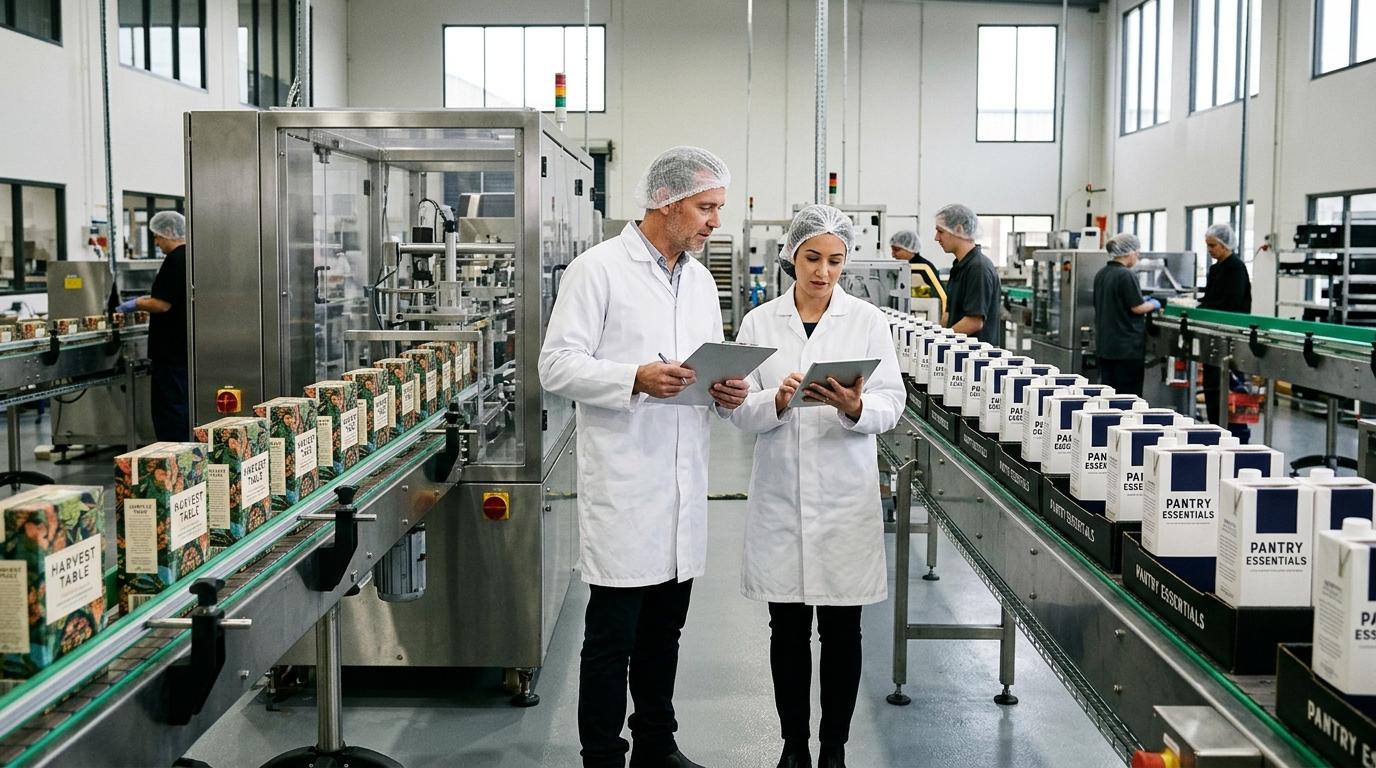
Walk down almost any aisle in an Australian supermarket in 2026 and the shelf architecture tells a clear story. Where three or four mid-tier national brands once sat between the category leader and a plain budget "home brand", shoppers now see a sophisticated, multi-tiered wall of supermarket private label and exclusive brands.
Across the Australian fast-moving consumer goods (FMCG) sector, private-label products now account for roughly 35% to 36% of total grocery sales value. At ALDI Australia (which holds around 9% to 10% of the national grocery market), exclusive brands represent 75% to 80%+ of the range. Inside Woolworths (~38% market share) and Coles (~29% market share), own-brand growth has consistently outpaced branded grocery growth as cost-of-living pressures pushed households to trade down—and stay down after discovering that tiered private-label lines (Coles Finest, Woolworths Gold, Macro, Coles Simply) match national-brand quality.
For mid-sized Australian food and beverage manufacturers, this structural shift creates one of the most consequential strategic questions in the industry: Should you bid to co-manufacture private-label products for major supermarkets, or stay strictly focused on your own brands?
Get the decision right, and a private-label contract can absorb hundreds of thousands of dollars in fixed factory overhead, fund automation upgrades, and stabilise year-round shift utilisation. Get the costing or contract terms wrong, and you can lock your best production lines into razor-thin margins while training a direct competitor to your flagship brand.
This guide examines the economics of private-label co-manufacturing in Australia, the protections available under the ACCC Supermarkets Inquiry and the Mandatory Food and Grocery Code of Conduct, a worked factory P&L comparison, and the rules every manufacturer should enforce before signing a private-label tender.
Why Private Label Has Evolved Far Beyond "Budget White Label"
A decade ago, private label in Australia was largely confined to commodity staples: fresh milk, white bread, canned tomatoes, sugar and basic flour. Today, Australian supermarkets operate a three-tier private-label architecture across almost every chilled, frozen and ambient category:
| Private Label Tier | Supermarket Examples | Target Shopper & Positioning | Typical Co-Manufacturer Profile |
|---|---|---|---|
| 1. Value / Entry Tier | Coles Simply, Woolworths Essentials | Price-first shoppers comparing unit price per 100g/100mL directly against ALDI | High-speed, highly automated volume plants with minimal changeover downtime |
| 2. Core / Mainstream Equivalents | Coles Brand, Woolworths Own Brand, ALDI Exclusive Brands, "Phantom" exclusive brands | Everyday family staples benchmarked directly against the #1 or #2 national brand in blind sensory tests | Mid-to-large Australian processors (e.g., dairy, bakery, snacks, sauces, ready meals, canned goods) |
| 3. Premium & Specialty Tiers | Coles Finest, Woolworths Gold, Macro Wholefoods Market | Foodies and health-conscious shoppers seeking restaurant-style, organic, free-from or provenance-led products at 15–25% below boutique brands | Mid-tier specialty and artisan-scale manufacturers with flexible batch capability and strong QA certification |
It is that third row—Premium and Specialty Private Label—where mid-tier Australian food manufacturers are seeing the sharpest increase in tender invitations. Supermarkets do not own artisanal bakeries, sous-vide kitchens, specialty sauce kettles or gluten-free snack lines. They rely on a distributed network of Australian co-manufacturers to develop and pack those ranges.
The Strategic Dilemma: Branded vs Private-Label Economics
On paper, a branded product looks far more attractive than a private-label contract because its gross margin percentage is higher. In practice, factory profitability depends on contribution dollars per machine hour and fixed overhead absorption—and the two models carry completely different cost structures below the gross margin line.
| Commercial Dimension | Manufacturing Your Own Brand | Co-Manufacturing Supermarket Private Label |
|---|---|---|
| Target Gross Margin (%) | Typically 35% – 50%+ (before trade spend) | Typically 12% – 22% (net of trade spend) |
| Promotional Trade Spend & Rebates | Heavy (15% – 25%+ of gross sales spent on half-price promos, catalogue fees, Gondola ends) | Zero or minimal — the retailer funds and manages retail promotions |
| Sales, Marketing & Account Management | High (field sales reps, brand marketing, digital ads, slotting/ranging focus) | Very low (B2B technical and commercial contract management) |
| Demand Predictability & Run Lengths | Volatile (promo spikes followed by post-promo troughs) | High volume, longer committed production runs, fewer SKU changeovers |
| Recipe Costing Transparency | Closed-book wholesale list price (subject to cost-justification reviews) | Open-book costing — retailer demands full visibility of raw materials, packaging, labour, yield loss and factory margin |
| Contract & Delisting Risk | Can be delisted at range review if scan velocity lags private label | Fixed-term tender (typically 1–3 years); risk of losing 100% of volume at retender if underbid by 2 cents/unit |
Worked Factory P&L: How a 70/30 Branded + Private-Label Mix Lifts Net Profit
To see why many successful Australian food processors run a hybrid model (protecting a core branded portfolio while allocating spare shift capacity to private label), consider a mid-sized sauce and condiment manufacturer.
The factory has a single day-shift capacity of 3 million units per year and incurs $900,000 per year in fixed facility overheads (rent, depreciation, QA team, base engineering, insurance). Currently, its own brand sells 1.8 million units per year (60% capacity utilisation).
A major retailer invites the manufacturer to tender for 900,000 units per year of a Premium Tier private-label simmer sauce using the same kettle and hot-fill glass jar line.
| Financial Metric | Scenario A: Branded Only (60% Plant Utilisation) | Scenario B: Hybrid 1.8M Branded + 900K Private Label (90% Plant Utilisation) | Impact of Adding Private Label Contract |
|---|---|---|---|
| Annual Volume (Units) | 1,800,000 | 2,700,000 (1.8M Brand + 0.9M PL) | +900,000 units (+50% volume) |
| Net Wholesale Revenue (after trade spend) | $4,500,000 ($2.50/unit net) | $6,300,000 ($4.5M Brand + $1.8M PL @ $2.00/unit) | +$1,800,000 revenue |
| Direct Ingredients & Packaging | -$2,160,000 ($1.20/unit) | -$3,375,000 ($1.20 Brand / $1.35 PL) | Volume purchasing saves 2% across all glass jars |
| Direct Batch Labour & Variable Energy | -$540,000 ($0.30/unit) | -$765,000 ($0.30 Brand / $0.25 PL longer runs) | Lower changeover downtime per unit on PL runs |
| Total Gross Contribution | $1,800,000 (40.0%) | $2,160,000 (34.3% blended) | +$360,000 gross contribution |
| Fixed Factory Overheads | -$900,000 ($0.50/unit absorbed) | -$940,000 ($0.348/unit absorbed) | Fixed overhead per unit drops by 30% |
| Brand Sales & Marketing Overheads | -$540,000 | -$540,000 (no marketing required for PL) | $0 incremental marketing cost |
| Net Operating Profit (EBIT) | $360,000 (8.0% EBIT margin) | $680,000 (10.8% EBIT margin) | +$320,000 net profit (+89% profit lift) |
Notice what happened in Scenario B:
- Even though the private-label contract earned a modest 20% gross margin ($0.40 contribution per $2.00 unit) compared with the brand's 40% gross margin, adding 900,000 units of predictable volume absorbed fixed factory overhead, unlocked a 2% volume discount on glass jars across the entire plant, and nearly doubled annual net profit from $360,000 to $680,000.
The Five Traps That Turn Private-Label Contracts Unprofitable
If private-label co-manufacturing can boost factory utilization so effectively, why do some Australian processors get burned by it? Almost every unprofitable private-label contract traces back to one of five operational mistakes:
1. Bidding on "Guessed" Open-Book Costings
Supermarket private-label tenders require open-book cost breakdowns: exact gram weights of every ingredient, yield and cook-out loss percentages, packaging component costs, direct labour minutes per batch, line run-rates (units per minute), changeover times and overhead recovery. If you underestimate your cook-out moisture loss by 3% or bid using theoretical line speeds rather than actual 2026 fully loaded award labour rates, that 3% error comes straight out of your 15% net margin—and because the costing is open-book, you cannot easily hide or recover it later.
2. Giving Away Your Proprietary Brand IP ("Clone Risk")
If you manufacture a category-leading branded product with a distinctive texture, flavour profile or functional claim, never hand that exact formulation over as a private-label tender at a 25% lower retail price point. Leading hybrid manufacturers enforce a strict Formulation Firewall:
- The private-label product is developed to meet the retailer's sensory brief using a distinct recipe, inclusion ratio and spice/flavour profile from your signature branded SKU.
- Under the Mandatory Food and Grocery Code of Conduct (strengthened following the 2024–2025 review with civil penalties up to $10 million or 10% of turnover), supermarkets are subject to specific obligations regarding confidential supplier information, intellectual property and range reviews when developing private-label products. Keep written records separating your proprietary brand R&D from retailer-briefed private-label development.
3. Ignoring Raw Material & Packaging Indexation Clauses
Signing a fixed-price 24-month private-label supply agreement without a raw-material rise-and-fall mechanism is fatal when cocoa, coffee, dairy, oil or gas prices spike. Ensure supply agreements include documented cost-review triggers linked to verifiable commodity indices, currency bands and packaging price movements.
4. Accepting Unfunded Packaging Write-Offs at Delisting or Artwork Changes
Supermarkets update private-label artwork frequently—for mandatory Health Star Ratings, ARL recycling logos, or seasonal refreshes. To achieve economical unit prices from film and carton converters, you often have to buy 3 to 6 months of packaging stock at a time. Your contract must state clearly who pays for obsolete pre-printed packaging if the retailer changes the artwork or discontinues the SKU.
5. Letting Private-Label Complexity Crowd Out Your Peak Branded Production
If a private-label contract requires small batch runs, frequent allergen washdowns, and peak production in October–December right when your own high-margin Christmas branded lines need the line, the opportunity cost destroys the profit. Negotiate Minimum Order Quantities (MOQs), minimum run lengths, and agreed stock-build schedules.
What Retailers Demand Before Awarding a Private-Label Tender
Before Coles, Woolworths, ALDI or a major QSR chain will award a private-label contract, your facility must pass both a commercial review and a rigorous technical audit:
- GFSI & Retailer Food Safety Certification: Active certification to SQF, BRCGS or FSSC 22000, plus the retailer's own technical addendum (such as Woolworths Quality Assurance (WQA) or Coles Supplier Requirements (CSR)).
- Portal & Spec Readiness: Ability to build and maintain complete, accurate technical specifications in retailer portals (Coles Fusion, Woolworths Partner Hub, Hamilton Grant, and GS1 Australia NPC).
- 2-Hour Digital Traceability & Recall Readiness: Proven ability to trace every ingredient lot, packaging roll and CCP check within 2 hours during an unannounced audit.
- Ethical Sourcing & Sustainability Compliance: Valid SEDEX registration and SMETA ethical audit, APCO packaging data, and increasingly Scope 1, 2 and 3 emissions data.
A Decision Matrix: Should Your Plant Bid on Private Label?
| Factory Situation | Recommendation | Primary Focus |
|---|---|---|
| Plant running at 50%–70% single-shift capacity; high fixed overhead per unit | Strong Candidate to Bid | Target 1–2 high-volume SKUs that run on your existing underutilised equipment with minimal capex |
| Plant running at 90%+ capacity on profitable branded SKUs | Pass (or Only Bid if Expanding Shifts) | Adding private label without adding a second shift will cannibalise high-margin branded capacity |
| Costings still managed in disconnected spreadsheets with estimated yields | Fix Costing First Before Bidding | Open-book tenders punish inaccurate yield and labour data; digitise batch costing before quoting |
| Category where your brand is a undifferentiated #3 or #4 player losing shelf space | Proactive Hybrid Strategy | Differentiate your #1 hero brand SKU while bidding to supply the retailer's Premium Tier private label |
Frequently Asked Questions
Does the Mandatory Food and Grocery Code of Conduct protect private-label suppliers? Yes. The Food and Grocery Code of Conduct (made mandatory with substantial civil penalties under the Competition and Consumer Act) applies to grocery supply agreements with signatory/designated supermarkets, including provisions covering written supply agreements, confidential information, intellectual property, price increase notification processes and good-faith dealing.
What is a "phantom brand" in Australian supermarkets? A phantom brand (or exclusive proprietary brand) is a trademarked brand name owned entirely by the supermarket that does not carry the "Coles" or "Woolworths" name on the front of the pack. Supermarkets use exclusive brands across wine, snacks, dairy, pantry and pet food to compete with national brands at mid-to-premium price points.
How do I protect my margin during an open-book private-label cost review? By grounding every line of your open-book costing in verifiable, batch-level production data: actual historical yield loss percentages, metered energy per batch, real changeover and CIP washdown times, and fully loaded 2026 award labour rates. Retail buyers respect documented factory data far more than rounded estimates.
The Bottom Line
Private label is no longer a side story in Australian grocery—at roughly 36% of category value, it is a permanent pillar of the market. For Australian food manufacturers with spare line capacity and disciplined digital costing, co-manufacturing premium and mainstream private-label ranges can transform factory overhead recovery while funding the innovation that keeps your own brands strong.
References
- ACCC – Supermarkets Inquiry 2024–25 Final Report & Findings
- Australian Treasury / ACCC – Food and Grocery Code of Conduct
- Woolworths Group – Partner Hub & Woolworths Quality Assurance (WQA) Standards
- Coles Group – Supplier Portal & Coles Supplier Requirements
- ALDI Australia – Australian Supplier & Manufacturing Partnerships